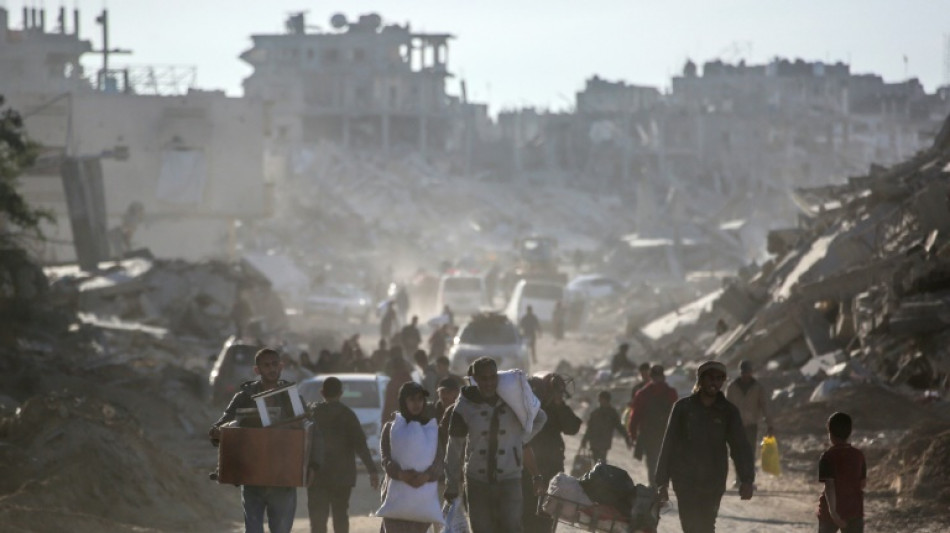
Israel army chief resigns over October 7 'failure' / Photo: © AFP

 In Ghana, larger-than-life coffins tell the stories of the dead

 Menoncello, Reece headline Top 14 new-season signings

 Families descend on Nepal in search of missing tourists

 Far-right AfD eyes huge win in east German state vote

 Brazil-Japan to play World Cup rematch at Singapore tournament

 Defence chiefs back boosting US military presence in Australia

 Nepal seeks climate justice after Himalayan disaster

 Stocks rise, yields ease as oil slips on Trump hint at short bombing campaign

 Brussels Diamond League finals Day 1 - five events to watch

 Thailand's 'Jurassic Park' shines light on dinosaur evolution
 'Role model' Stokes set to open for Adelaide Strikers

 Palau urges 'unified' Pacific response to China missile test

 Grinding away: in remote Appalachia, old mills fuel US clean food dreams

 Sabalenka races into US Open third round

 Chinese lucky loser stuns Jodar at US Open

 US Open under the influence: content creators spark debate

 NBA hammers Clippers over Leonard salary cap violations

 NBA strips five first-round draft picks from Clippers for Leonard salary cap violations
 Kane brace helps Bayern win German Cup opener

 Migrant plight, local anger divide Ceuta one month after influx

 Outrage as Maltese tycoon acquitted of reporter's murder

 Rare train of Pacific cyclones fueled by historic El Nino
 Macron, King Charles hail UK-France ties after viewing Bayeux Tapestry

 Fury hits out at 'coward' Joshua as 'Battle of Britain' talks go on

 Maltese tycoon acquitted of masterminding reporter's murder

The head of Israel's military resigned on Tuesday, taking responsibility for its "failure" to stop Hamas's October 7 attack, days after a fragile truce took effect following 15 months of war in the Gaza Strip.
In his resignation letter, released by the army, Lieutenant General Herzi Halevi said he was stepping down "due to my acknowledgement of responsibility for the (military's) failure on October 7", but added that he was leaving at a time of "significant successes".
He acknowledged, however, that the goals of the Gaza war "have not all been achieved", adding the army would "continue to fight to further dismantle Hamas", bring back the hostages and enable Israelis displaced by militant attacks to return home.
Shortly after his announcement, Major General Yaron Finkelman also resigned. Finkelman headed Israel's southern military command, which is responsible for Gaza.
Hamas's attack, the deadliest in Israeli history, resulted in the deaths of 1,210 people, mostly civilians, according to an AFP tally of official Israeli figures.
It sparked a war that has levelled much of Gaza and, according to the health ministry in the Hamas-run territory, killed 46,913, a majority of them civilians, figures the United Nations has said are reliable.
The attack, which also saw 251 people taken hostage, traumatised Israelis and created an unprecedented crisis for the country's top leadership.
Ninety-one hostages remain in captivity, 34 of whom the military says are dead.
Prime Minister Benjamin Netanyahu had vowed early in the war to crush Hamas and to bring home all the hostages.
Israeli opposition leader Yair Lapid on Tuesday called on Netanyahu to follow Halevi's example.
Saying he saluted the military chief for stepping down, Lapid added: "Now, it is time for them to take responsibility and resign -– the prime minister and his entire catastrophic government."
- 'Maintain this calm' -
After months of fruitless negotiations, mediators Qatar and the United States announced a ceasefire that took effect Sunday, on the eve of Donald Trump's inauguration as US president.
Trump, who claimed credit for the agreement, said he doubted the deal would hold as he took office for a historic second term.
"That's not our war; it's their war. But I'm not confident," he said.
However, Qatari Prime Minister Sheikh Mohammed bin Abdulrahman bin Jassim Al-Thani told the World Economic Forum on Tuesday that if Israel and Hamas acted "in good faith, this will last and hopefully... will lead to a permanent ceasefire".
Since the truce took effect, desperately needed humanitarian aid has begun to flow into Gaza, and Palestinians displaced by the war have headed back to their homes in devastated areas of the territory, hopeful the agreement would last.
Displaced Gazan Ghadeer Abdul Rabbo, 30, told AFP she hoped that "with or without Trump", the ceasefire would hold and world governments would help "maintain this calm, because we are afraid".
The truce has so far seen Israel and Hamas conduct one exchange of hostages for prisoners.
Hamas official Taher al-Nunu told AFP that another four Israeli women hostages would be freed on Saturday in exchange for a second group of Palestinian prisoners.
- 'We will rebuild' -
If all goes to plan, a total of 33 hostages will be returned from Gaza in exchange for around 1,900 Palestinians during the 42-day first phase of the truce.
Over those six weeks, the parties are meant to negotiate a permanent ceasefire.
In the final phase, militants would return the bodies of dead hostages, while the reconstruction of Gaza would get under way.
The first day of the truce saw three Israeli hostages, all women, reunited with their families after more than 15 months in captivity.
Hours later, 90 Palestinian prisoners were released from an Israeli jail.
The war has devastated much of the Gaza Strip and displaced the vast majority of its population of 2.4 million.
More than 900 trucks carrying humanitarian aid entered Gaza on Monday, the United Nations said.
The day the deal came into force, 630 trucks entered Gaza.
In Rafah, in southern Gaza, Ismail Madi said that "we have endured immense hardships, but we will stay here. We will rebuild this place."
- West Bank violence -
While there was quiet in Gaza, violence flared in the occupied West Bank, with the Israeli military launching a deadly operation in the area of Jenin, a bastion of Palestinian militancy.
In a statement, Netanyahu said the raid aimed to "eradicate terrorism" in Jenin and was part of a broader strategy to counter Iran "wherever it sends its arms -- in Gaza, Lebanon, Syria, Yemen," and the West Bank.
The Israeli government has accused Iran, which backs militant groups across the Middle East including Hamas in Gaza, of attempting to send weapons and money to militants in the West Bank.
The Palestinian health ministry, based in Ramallah, said the operation had killed eight people.
burs-ser/smw
C.Kreuzer--VB