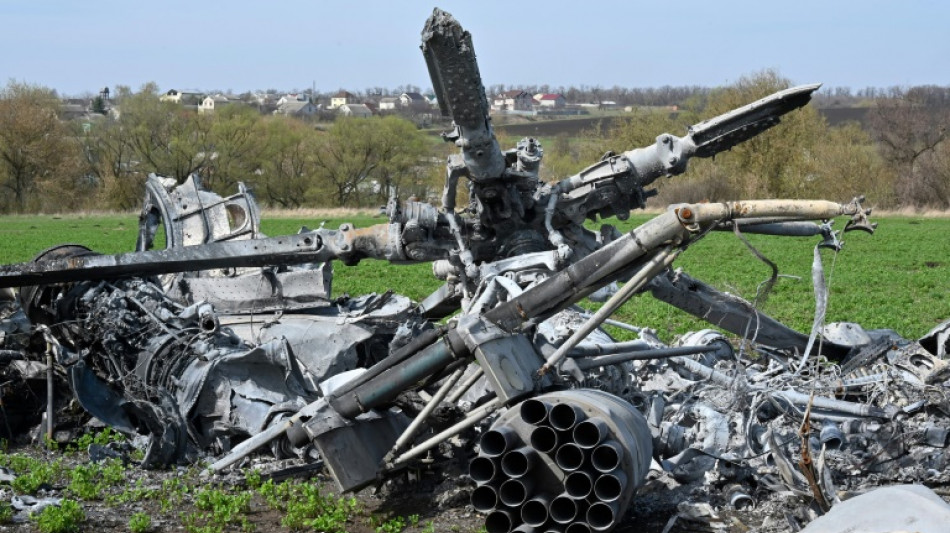
Is Ukraine the attack helicopter's grave? / Photo: © AFP

 Major quake rocks Colombia and neighbors, 18 confirmed dead
 Brazil aircraft maker Embraer raises outlook after record revenue
 Drought forces water restrictions across nearly 70 percent of France

 Europe wary as gas stocks languish at lows while winter looms

 OFunded Enters the Prop Trading Market With Broker-Backed Infrastructure From OFinancial Markets

 Stocks mostly flat with focus on US inflation
 UK radio broke rules in announcing king's death: watchdog

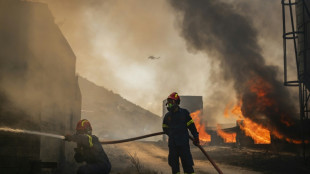 Europe braces for another summer heatwave
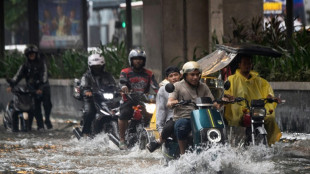
 Tentoglou keep bid for fourth Euro title on course, Nowicki misses out

 MEXC Sponsors Yohani's Colombo Concert, Bridging Sri Lankan Culture and Global Digital Finance

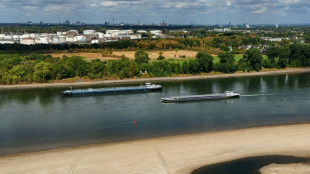 Parts of Germany's Rhine could become unnavigable, group warns
 Base Markets Appoints Nazim Moussaoui as Head of Premium Clients and Partnerships

 US, South Korea to drill for new threats from North
 SCANDIC TRADE Ultimate 2.6 är färdigutvecklat – SNC SCANDIC ECO-Systemet är nu komplett

 SCANDIC TRADE Ultimate 2.6 je hotový – systém SNC SCANDIC ECO je kompletní

 SCANDIC TRADE Ultimate 2.6が完成――SNC SCANDIC ECOシステムが完成しました

 Record July heat in regions home to 900 mn people: AFP analysis

 SCANDIC TRADE Ultimate 2.6이 완성되었습니다 – SNC SCANDIC ECO-시스템이 완성되었습니다

 SCANDIC TRADE Ultimate 2.6 завершена — экосистема SNC SCANDIC стала полноценной

 SCANDIC TRADE Ultimate 2.6 is now complete – the SNC SCANDIC ECO-System is now fully operational
 Chinese AI drives price competition among US labs
 Indian students step up exam protests in Jharkhand
 Stopped broadcast, layoffs: Hungary media eyes post-Orban renewal

 Typhoon Dolphin weakens but disrupts travel in east China

 Pakistan brickmakers scorched by sun above and fire below
Is the war in Ukraine sounding the death knell for attack helicopters? The large number destroyed has sparked a debate among experts over whether the aircraft are under-performing or being used poorly by Russian forces.
Saturated with anti-aircraft defences, both long-range systems and short-range missiles that can be carried and launched by a soldier (Manpads), the skies above Ukraine are deadly for helicopters.
The numerous videos on social media of Russian helicopter gunships being shot down are very public evidence of the extent of the losses.
Russia has lost at least 42 helicopters since its February 24 invasion and Ukraine seven, according to specialist blog Oryx, which has recorded material losses from photographs and videos taken from the battlefields.
Attack helicopters were designed to aid troops and tanks on the battlefield.
They are armoured themselves and heavily armed, but as the conflict shows, they too are extremely vulnerable.
Experts are divided as to why.
"Since those early days of the war, the air defences of both sides have had a clear deterrent effect on helicopter operations," according to Sash Tusa, an aerospace and defence analyst at Britain-based Agency Partners.
"These unpleasant reminders of the realities of high-intensity warfare against near-peer adversaries are in turn undermining the case for further investment in and maintenance of Western air assault capabilities, whether fixed- or rotary-wing," he wrote in the specialist magazine Aviation Week.
In other words, the future of the helicopter as an assault craft is in question, according to Tusa.
- 'Russian fiasco' -
Other experts point to Russian mistakes, such as the helicopter assault on the Gostomel airport near Kyiv at the opening of the invasion, which Ukrainian forces repelled.
Joseph Henrotin, a researcher at the Paris-based Institute of Comparative Strategy, called the operation a "Russian fiasco" that had nothing to do with the capabilities of the helicopters, but with how they were used.
"The Russians did a poor job," he said. "Before an airborne operation, you have to ensure the skies have been cleared and anti-aircraft defences wiped out."
One of the major surprises of the war is that Russia did not gain air superiority at the start of the conflict by suppressing Ukraine's anti-aircraft defences, a mission normally carried out by fixed-wing aircraft and missiles rather than helicopters.
Michael O'Hanlon, an expert at the Brookings Institution think tank in Washington, agreed the problem is not with the helicopters but how the Russians are using them.
"They aren't outdated, but assaulting a predictable location when an enemy is on alert won't generally work," he told AFP.
Yet the conflict in Ukraine is very much like the war envisaged by Soviet and NATO experts during the Cold War, when the current generation of attack helicopters were developed.
That includes the Russian Mi-24 and Mi-28, earlier versions of the Ka-52, and the US Apache and Franco-German Tiger.
"They were conceived in an epoch where they might have been engaged above Germany or Poland, with a very high density of fire and threats for helicopters," said Henrotin.
- 'Bloody reminder' -
Patrick Brethous, a former general who headed up the helicopter detachment of the French special forces, said that before predicting the end of attack helicopters one had to look at how the Russians and Ukrainians were using them.
"We've seen many Russian helicopters flying by day, 300 feet from the ground, being shot" down, said Brethous, who now works as a military adviser to Airbus Helicopters.
"It's an employment of the helicopter which is very dangerous," he noted, saying they are better used for night operations and should be flown closer to the ground to avoid enemy missiles.
Henrotin also believes that the conflict "is a fairly bloody reminder for the Russians of the fundamentals: a helicopter should not be used alone" but in conjunction with other types of military forces.
Military experts call that a combined arms approach, where aircraft, armoured vehicles, artillery and infantry work together, providing complementary effects to overcome an enemy and protect one another.
Tusa believes helicopters' future as an assault weapon is being thrown further into doubt as many of their missions can now be carried out by much cheaper drones.
But Henrotin said that although drones can complete some of their missions, such as reconnaissance, they are complementary and cannot do everything as they lack an attack helicopter's firepower.
For example, a Turkish Bayraktar drone used by Ukrainian forces can carry four missiles, whereas the Russian Ka-52 helicopter, with its 12 missiles and rocket capacity, remains "the gunboat of the sky".
B.Shevchenko--BTB