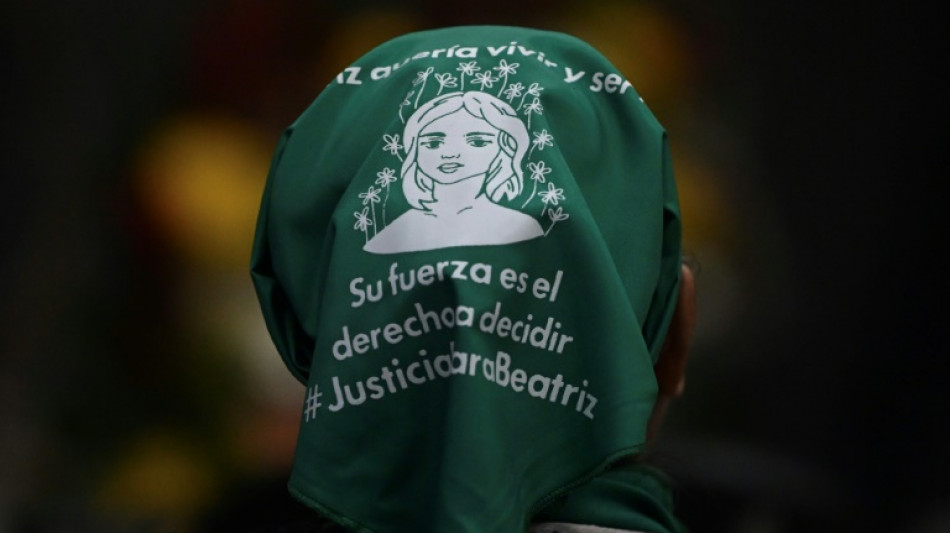
Court rules against El Salvador in controversial abortion case / Photo: © AFP/File

 Alcaraz falls to Shelton in epic latest-ever US Open finish

 South Korea video game tycoon to pay record $1.5 bn in divorce
 'Long live Chairman Mao': Supporters pay respects to founder of Communist China

 Sweden immigration restrictions spark healthcare concerns
 EU to help cities tighten screws on Airbnb, holiday rentals

 'Our year': Kane and Bayern primed for Champions League tilt

 Australian World Cup star Volpato fined over positive cocaine test
 Sabalenka edges Noskova to keep US Open treble bid alive

 Pegula outlasts Navarro to set US Open semi with Sabalenka

 From trenches to catwalk: Ukraine's amputee soldiers hit the runway

 UK airports face more disruption after air traffic control glitch

 ECB meets, weighing a tricky balance between savers and spenders
 Pakistan police counter drone attacks with Ukraine-style nets

 Russia torments Kyiv with new 'horror' jet drones

 Iran attacks US base in Jordan as Hormuz impasse deepens

 New Apple CEO to face first test with foldable iPhone launch

 Sabalenka edges Noskova, keeps US Open treble bid alive

 Real Madrid win Champions League opener as Haaland stars for Man City

 Gambian leader vows power boost after violent blackout protests

 Newcastle battle past Millwall to reach League Cup fourth round
 Mourinho's Real Madrid make winning start against Inter Milan

 Villa take 'big step forward' with win over Brugge

 Yaya Toure hails 'new era' for African coaches ahead of Champions League bow

 Lawes and Marchant told to prove themselves in quest for England recalls

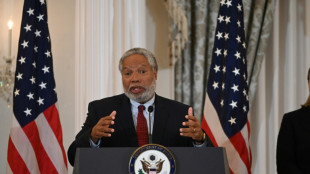 Smithsonian secretary to retire as Trump exerts control over institution
The Inter-American Court of Human Rights on Friday ruled against El Salvador for barring a woman from getting an abortion, despite her life being at risk and her fetus being unviable.
It ordered the Salvadoran government to pay compensation, establish guidelines for medical and judicial personnel, and take legal and other steps to guarantee "legal certainty in regard to similar cases."
The case goes back to 2013 when the woman -- identified publicly as "Beatriz" -- was unable to obtain an abortion because El Salvador bans them in all cases, even when a woman's life is in danger or when pregnancy results from rape.
The Costa Rica-based court found El Salvador responsible for "obstetric violence and violation of the right to health" in Beatriz's case.
It said the Salvadoran government failed "to comply with its duty of due diligence in guaranteeing the rights of access to effective judicial remedies, personal integrity, health, and privacy of a woman who went through a pregnancy with multiple risks."
Organizations in Costa Rica advocating for women's health hailed the ruling.
"Justice has triumphed. We are happy. Today... is a day that has gone down in history for reproductive justice for women," Angelica Rivas, a lawyer for a group called the Colectiva Feminista, told AFP.
- High-risk pregnancy -
Beatriz, who was 22 at the time of the pregnancy, suffered from lupus, lupus-related kidney disease and rheumatoid arthritis.
She already had a young child from a pregnancy two years previously, during which she had severe preeclampsia, a type of high blood pressure.
Taken together, doctors determined her pregnancy was high-risk, and could kill her -- and ultrasounds found the fetus was anencephalic, meaning part of its brain and skull were missing, making it no longer viable.
But while terminating the pregnancy was considered, "no decision was made since... there were no protocols for the care of cases such as Beatriz's," the court said.
It noted that El Salvador had admitted there was "a situation of confusion" and that better protocols could have been established for such an unusual set of circumstances.
After Salvadoran authorities heard a contradictory expert opinion that Beatriz's life was not at risk, the fetus was carried to term and a cesarean section was performed at birth.
The baby died five hours after delivery.
Beatriz survived the birth. But she died in October 2017 after contracting pneumonia while getting treatment for injuries from a traffic accident.
The court said there was no proof of a causal link between the risky pregnancy and her death.
The court also said it was not trying to arbitrate the different medical opinions, nor trying to establish what the best course of treatment would have been for Beatriz.
But it stressed that Beatriz's underlying medical condition meant the Salvadoran state had "a special duty of protection" to provide her with "diligent and timely medical care."
But "the lack of legal certainty regarding the approach to Beatriz's case led to the bureaucratization and judicialization of the required medical care, which generated multiple consequences."
El Salvador has banned abortion since 1998, with anybody breaking that law facing a potential prison sentence of up to eight years.
More commonly, though, Salvadoran courts apply charges of aggravated homicide in such cases, which carry heavier penalties of up to 50 years behind bars.
L.Wyss--VB