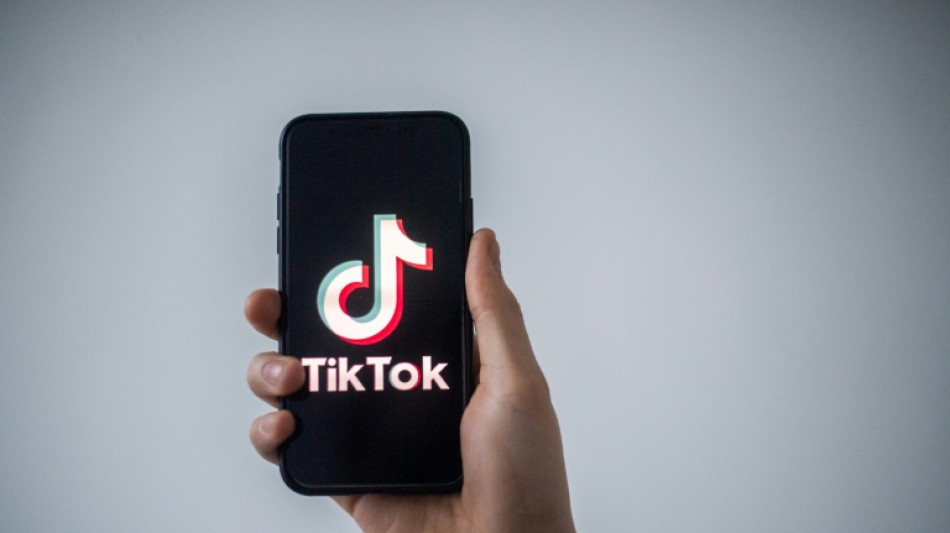
One billion users, but controversies mount up for TikTok / Photo: © AFP/File

 England edge ahead in third Test after latest Pakistan collapse
 'Alarm bells ringing': US summer heat shatters record

 IAEA board refers Iran to UN Security Council
 Rubio pushes extraditions, anti-drug fight in Ecuador

 Amboss and Aureo Connect the Lightning Network to Mexico's Banking System

 Brent oil passes $100 on Mideast flare-up, stoking inflation fears

 Israeli settlement winemaker defiant after UK-led trade sanctions

 Josh Kerr: I pick my races and never get 'greedy'

 Carrick confident Man Utd can go far in 'magical' Champions League

 France far right expels policeman member over racist remarks

 Pakistan collapse to 133 all out against England in 3rd Test

 Heat forces French champagne makers to stiffen their drink

 Iran war drives oil prices to $100 per barrel as Tehran strikes ships

 Pakistan collapse to 100-7 against England in 3rd Test

 Workers, migrants focus of documentaries by Oscar winners at Venice

 Nepal seeks survivors two weeks after deadly floods

 Bangladesh measles crisis kills more than 1,000 children
 Pakistan collapse to 26-4 against England in 3rd Test

 EU helps cities tighten screws on Airbnb, holiday rentals
 Courtois to put Belgium career on hold
 RavenDB Launches Quill to Bring Production AI Agents to Enterprise SQL Systems, No Migration Required

 Affleck family affair at Venice for Casey's latest film 'Company'
 Yemen rebels report fresh Saudi strikes as conflict deepens

 'They're playing with our lives': AI researcher quits Anthropic

 Series finale of 'Babylon Berlin' offers dark mirror for today's Germany
TikTok's breakneck rise from niche video-sharing app to global social media behemoth has drawn intense scrutiny, particularly over its links to China.
The platform faces accusations of espionage in the United States, while the European Union has launched an investigation into claims it was used to sway Romania's presidential election in favour of a far right candidate.
So is TikTok a spying tool for Beijing, a fun app, or both?
- Romania influence campaign -
The EU is probing whether far-right presidential candidate Calin Georgescu's surprise victory in the first round of Romania's presidential election was aided by Russian meddling and "preferential treatment" by TikTok.
It is the third investigation the commission has launched against TikTok, which risks fines of up to six percent of its global turnover.
The platform said it had taken "robust actions" to tackle election-related misinformation. Russia has denied interfering in the vote.
- Under pressure -
The United States in April passed a law obliging TikTok's Chinese owner ByteDance to sell off the platform by January 19 on the grounds it allowed China to access data on US users.
If not, the platform would be banned in the United States -- denying TikTok its claimed 170 million users in the countries.
TikTok admitted ByteDance employees in China had accessed Americans' data but it has denied giving data to the Chinese authorities.
To protect data, the US government, the European Commission and Britain's government had already banned TikTok from their employees' work devices in 2023.
- Teenage ban in Australia -
But bans have not halted TikTok's growth.
With more than one billion active users worldwide, the platform is a phenomenon for young people attracted by its never-ending scroll of ultra-brief videos.
Nearly a third of TikTok users are between 10 and 19 years old, according to the Wallaroo agency.
But that success has brought accusations that the platform encourages the spread of misinformation and illegal, violent, or pornographic content, particularly among young people.
TikTok was among the many platforms targeted by a landmark law passed in Australia in November banning under-16s from accessing social media.
Social media firms that fail to comply with the law face fines of up to Aus$50 million (US$32.5 million) for "systemic breaches".
TikTok said it was "disappointed" by the Australian legislation, claiming it could push young people to the "darker corners of the internet".
- Opaque algorithm -
Its editing features and powerful algorithm have kept it ahead of the game, attracting an army of creators and influencers as well as creating many of its own.
But the algorithm is opaque and often accused of leading users into digital content silos.
TikTok and ByteDance employees also manually increase the number of views on certain content, according to a report in Forbes.
TikTok has said manual promotion only affects a tiny fraction of recommended videos.
In August, the company, under pressure from EU regulators, was forced to ditch a feature in its TikTok Lite spinoff in France and Spain rewarding users for the time spent in front of their screens.
In that rewards programme, users aged 18 and over could earn points to exchange for goods like vouchers or gift cards by liking and watching videos.
It was accused by the EU of potentially having "very addictive consequences".
- Disinformation -
The app is regularly accused of putting users in danger with the spread of hazardous "challenge" videos.
Several children have reportedly died while trying to replicate the so-called blackout challenge, which involves users holding their breath until they pass out.
And around one-fifth of videos on topical issues such as the Russian invasion of Ukraine were found to be fake or misleading in a study by misinformation group NewsGuard.
AFP, along with more than a dozen fact-checking organisations, is paid by TikTok in several countries in Asia and Oceania, Europe, the Middle East and Spanish-speaking Latin America to verify for internal moderation videos that potentially contain false information. The videos are removed by TikTok if the information is shown to be false by AFP teams.
J.Sauter--VB