War monitor says Israel conducted 300 strikes on Syria since Assad's fall / Photo: © AFP

 'Bragging rights' up for grabs at game-changing Ultimate Championship, says Coe

 ECB hikes borrowing costs to combat Mideast energy shock

 England turn screw in 3rd Test against Pakistan

 France will not support Infantino in FIFA election: federation chief

 In their words: Israeli forces describe AI-backed Gaza killing in new film

 Yemen's Houthis seize key city on Red Sea: military source

 Oil prices extend gains as markets await ECB rate outlook
 Wars pose a test as India hosts BRICS summit with China, Russia, Iran leaders

 Messi to buy second Spanish lower league club

 Pochettino calls for Chelsea to lose 2016-17 Premier League title

 North Korea leader's daughter believed to have younger sibling: Seoul
 Wars pose a test as India hosts BRICS summit with Russia, Iran leaders

 Alessio Vinassa Unveils an Emerging Technology Investment Approach Shaped by Financial Challenges
 Stocks drop as oil spike fans inflation and interest rate fears
 Portugal harvests grapes at night to beat the heat
 Philippine ferry fire kills 5, dozens missing

 Oil prices flare as Iran tightens grip on Hormuz

 Japan gymnasts under injury cloud for home Asian Games

 India trailblazer won't 'let go' of chance for Asian weightlifting glory

 Zverev cruises past van de Zandschulp into US Open semis

 Myanmar tin mega-mine restarts operations: think tank
 Online and undercover: saving trafficked wildlife in Thailand

 Antonelli faces new challenge after stirring triumph in Monza

 Korda leads US bid to win first away Solheim Cup since 2015
 Eurozone rate-setters to hike borrowing costs as energy prices jump

A war monitor said on Tuesday that Israel had conducted 300 strikes on Syria since the fall of president Bashar al-Assad, adding that the raids had "destroyed the most important military sites" in the country.
Assad fled Syria as an Islamist-led rebel alliance swept into the capital Damascus, bringing to an end on Sunday to five decades of brutal rule by his clan.
Abu Mohammed al-Jolani, the Islamist leader who headed the offensive that forced Assad out, has begun talks on a transfer of power and vowed to pursue former senior government officials responsible for torture and war crimes.
His group, Hayat Tahrir al-Sham, is rooted in Syria's branch of Al-Qaeda and is proscribed by many Western governments as a terrorist organisation, though it has sought to moderate its rhetoric.
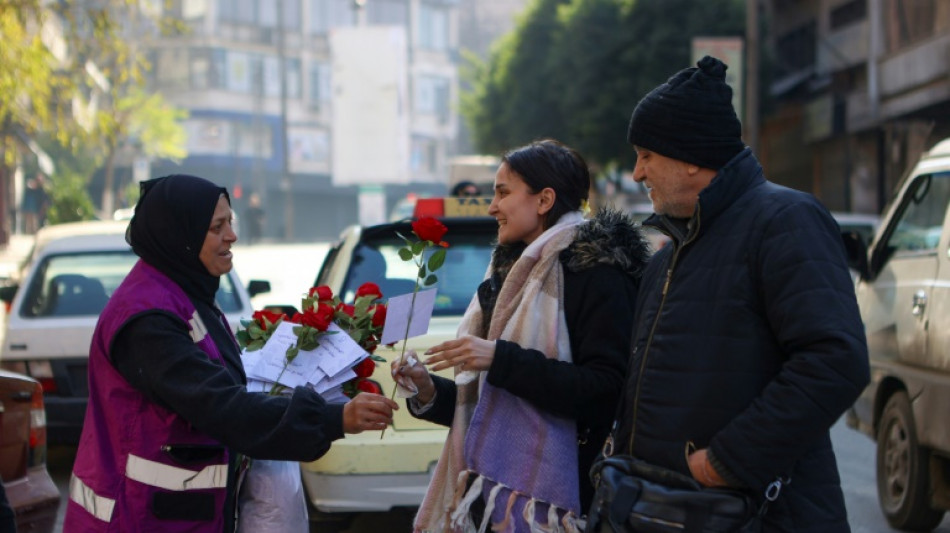
The fall of Assad, whose clan had zero tolerance for dissent and who maintained a complex web of prisons and detention centres to keep Syrians from straying from the Baath party line, sparked celebrations around the country and in the diaspora all over the world.
Syria's civil war killed 500,000 people and forced half the country to flee their homes, millions of them finding refuge abroad.
The country now faces profound uncertainty after the collapse of a government that had run every aspect of daily life in the image of Assad and his father, from whom the ousted president inherited power.
Israel has conducted hundreds of strikes on Syria since the civil war began in 2011 following Assad's crackdown on a democracy movement.
Since his ouster, the Syrian Observatory for Human Rights said it had recorded more than 300 Israeli strikes.
AFP journalists in the capital Damascus heard loud explosions on Tuesday, but could not independently verify the source or scope of the attacks.
- 'Most important military sites' -
On Monday, Israel said it had struck "remaining chemical weapons or long-range missiles and rockets in order that they will not fall in the hands of extremists".
The Observatory, which relies on a network of sources around Syria, said Israeli strikes had "destroyed the most important military sites in Syria".
The group said the strikes targeted weapons depots, boats from the Assad government's navy, and a research centre that Western countries suspected of having links to chemical weapons production.
Near the port city of Latakia, Israel targeted an air defence facility and damaged Syrian naval ships as well as military warehouses.
In and around the capital Damascus, strikes targeted military installations, research centres and the electronic warfare administration.
With Syria in flux and in the absence of a government authority just two days after Assad's escape, AFP journalists in Damascus were unable to obtain comment from the Syrian side on the Israeli strikes.
Israel, which borders Syria, also sent troops into a buffer zone east of the Israeli-annexed Golan Heights after Assad's fall, in what Foreign Minister Gideon Saar described as a "limited and temporary step" for "security reasons".
Israeli Prime Minister Benjamin Netanyahu said Monday that the Golan Heights, occupied by Israel for almost 60 years, would perpetually remain part of Israel.
Israel backer the United States said the incursion must be "temporary", after the United Nations said Israel was violating a 1974 deal.
"Israel has said that these actions are temporary to defend its borders. These are not permanent actions, and so ultimately, what we want to see is lasting stability between Israel and Syria, and that means we support all sides upholding the 1974 disengagement agreement," US State Department spokesman Matthew Miller told reporters.
Lebanon's Hezbollah, which had helped prop up Assad, condemned the strikes late Monday and lambasted Israel for "occupying more land in the Golan Heights".
Hezbollah backer and Israel's arch-foe Iran also condemned the Israeli military's incursion into the buffer zone, calling it a "violation" of law.
After Assad for years deployed all the means at his government's disposal to put down the revolt, including air strikes and even chemical attacks on rebel bastions, it was ultimately a lightning offensive launched on November 27 that took him down.
The rebels started their renewed campaign in northern Syria on the very same day a ceasefire took effect in the Israel-Hezbollah war, which killed thousands in Lebanon.
The war saw Israel inflict staggering losses on Hezbollah, which had for years fought in support of Assad's government in Syria, long a conduit of weapons for the militant group from Iran.
- 'Transfer of power' -
Islamist leader Jolani, who now uses his real name Ahmed al-Sharaa, said on Tuesday: "We will not hesitate to hold accountable the criminals, murderers, security and army officers involved in torturing the Syrian people."
"We will offer rewards to anyone who provides information about senior army and security officers involved in war crimes," he said, adding the incoming authorities would seek the return of officials who have fled abroad.
The ouster of Assad has sparked a frantic search by families of the tens of thousands of people held in the country's network of jails and detention centres.
As they advanced towards Damascus, the rebels released thousands of detainees, but many thousands more remain missing.
A large crowd gathered Monday outside a jail synonymous with the worst atrocities of Assad's rule to search for relatives, many of whom had spent years in the Saydnaya facility outside Damascus, AFP correspondents said.
"I ran like crazy" to get to the prison, said Aida Taha, 65, searching for her brother who was arrested in 2012.
Fadwa Mahmoud, whose husband and son are missing, posted calls for help on social media.
"Where are you, Maher and Abdel Aziz? It's time for me to hear your news. Oh God, please come back," wrote Mahmoud, herself a former detainee.
Crowds of freed prisoners wandered the streets of Damascus, distinguishable by the marks of their ordeal: maimed by torture, weakened by illness and emaciated by hunger.
The United Nations said that whoever ends up in power in Syria must hold the Assad regime to account.
But how the ousted leader might face justice remains unclear, especially after the Kremlin refused on Monday to confirm reports by Russian news agencies that he had fled to Moscow.
Russia played an instrumental role in keeping Assad in power, directly intervening in the war starting in 2015 and providing air cover to the army during the rebellion.
R.Flueckiger--VB