South Korea's Yoon calls on North to trade nukes for aid / Photo: © AFP

 Dakar Rally moved to Portugal and Morocco following Houthi attacks in Gulf

 German economy logs 0.2% growth, faster than expected

 Crypto platform Binance confirms 'complex' $6.3 bn hack

 Spanish inflation stays at three-year high before election
 Drugs giant AstraZeneca reveals higher profits, savings plan
 French economy 'headed for a wall' as GDP shrinks

 South Korea to prosecute students cheating with smart glasses
 Surging costs of living top US voter concerns

 Basic services, fading loyalties loom over South Africa's vote

 Shock, vindication, regret: Scientists react to AI roiling life's work
 Crypto platform Binance confirms $6.3 bn hack
 Boozer shines as Grizzlies top Blazers in battle of NBA unbeatens

 Jorge Martin confirmed to race at Malaysian MotoGP

 Bayern and Kane host Dortmund after week of 'extremes'

 Packers beat Panthers 27-19 as Watson returns from hospital

 Affordable supermarket fashion offers designer-inspired autumn alternatives

 Judge throws out Australian mushroom killer's appeal, imposes harsher sentence
 Pelicans down Kings for first win of NBA season

 Tech firms take fresh hit as earnings misses fan AI fears

 Worcestershire leaders back renewed two-unitary council reorganisation

 India's animal megacentre vows reset after criticism

 Dodging fuel price hikes, Damascus drivers turn to electric cars

 Alvechurch manager praises resilience but seeks improvement after Anstey draw
 Crypto platform Binance confirms major hack, more than $2.5bn frozen
 Sports chiefs face losing battle to keep sport separate from politics
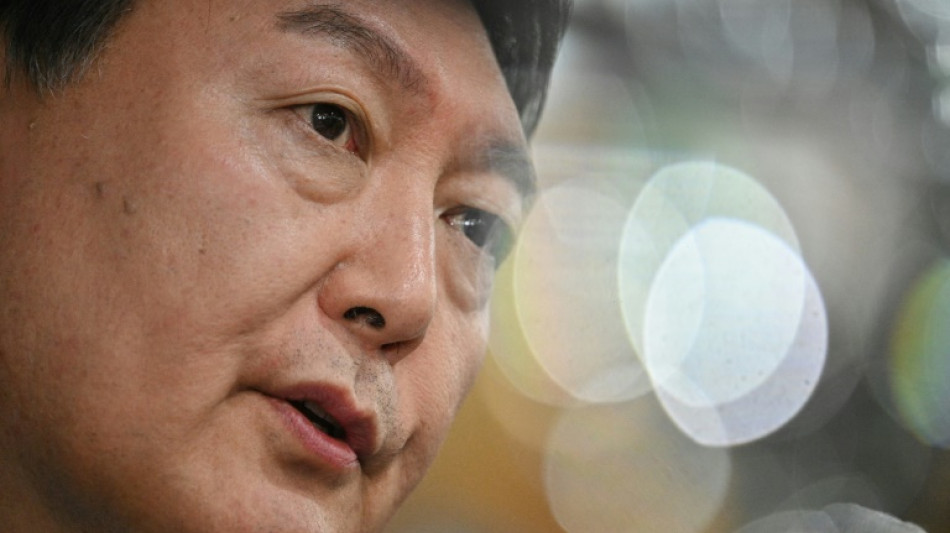
South Korea's President Yoon Suk-yeol called on the North to give up its nuclear weapons in exchange for massive economic aid at his swearing-in Tuesday, describing Pyongyang's missiles as a threat to regional and global security.
Yoon, 61, who started work in an underground bunker with a security briefing on North Korea, took office at a time of high tensions on the peninsula, with Pyongyang conducting a record 15 weapons tests since January, including two launches last week.
The former prosecutor, who won a close election by a razor-thin margin in March, said in his inaugural speech that he would consider sending transformative levels of economic aid to the North -- but only if Pyongyang first gives up its nuclear weapons.
"If North Korea genuinely embarks on a process to complete denuclearisation, we are prepared to work with the international community to present an audacious plan that will vastly strengthen North Korea's economy and improve the quality of life for its people," he said.
Yoon's predecessor Moon Jae-in pursued a policy of engagement with Pyongyang, brokering summits between Kim and then-US president Donald Trump. But talks collapsed in 2019 and diplomacy has stalled since.
"While North Korea's nuclear weapon programs are a threat not only to our security and that of Northeast Asia, the door to dialogue will remain open so that we can peacefully resolve this threat," Yoon added.
But the offer of "audacious" aid is a dud, analysts say: North Korea, which invests a vast chunk of its GDP into its UN-sanctioned weapons programs, has long made it clear it will not trade nukes for aid.
"Since 2009, North Korea has stated it will not give up its nukes for economic incentives," Park Won-gon, a professor at Ewha University told AFP.
"Yoon's comment will only trigger Pyongyang, who will see it as an attack," Park added.
Kim does not want massive economic growth because achieving this would require opening up North Korea's information ecosystem, said Chad O'Carroll of Seoul-based specialist site NK News.
"Ideological pollution would rapidly steep in, a key risk for Pyongyang's ruler... Yoon's denuclearisation plans won't go anywhere... because the 'carrot' is actually poisonous," he wrote on Twitter.
- Unpopular move -
During his inauguration speech, Yoon said that South Korea was facing "multiple crises," citing the pandemic, global supply chain issues and economic woes, and new armed conflicts and wars.
"Such complex, multi-faceted crises are casting a long and dark shadow over us," he said, adding that he was confident the country would emerge from its current difficulties.
"Koreans never succumbed; we became stronger and wiser," he said.
But Yoon is not likely to have an easy ride, taking office with some of the lowest approval ratings of any democratically elected South Korean president.
His approval hovers at around 41 percent, according to a recent Gallup poll, with outgoing President Moon, in contrast, at 44 percent.
The biggest reason for Yoon's unpopularity, the survey found, was his decision to move the presidential office from the decades-old Blue House to the former defence ministry in downtown Seoul.
The hasty, expensive move soured public sentiment, with critics claiming it was unnecessary and put the country's security at risk during a time of heightened tensions with the North.
Yoon said the Blue House, located at a site used by the Japanese colonial administration from 1910 to 1945, was a "symbol of imperial power", claiming the relocation would ensure a more democratic presidency.
The Blue House grounds will be opened to the public as a park, and during the inauguration ceremony, footage of people walking up to the once-fortified compound was broadcast live.
The formal inauguration ceremony was staged outside Seoul's National Assembly, featuring marching army bands, soldiers in ceremonial dress, and a 21-gun salute.
Around 40,000 people attended the massive inauguration ceremony, which local reports said was the country's most expensive such event by far, at 3.3 billion won ($2.6 million).
US President Joe Biden -- who is set to visit Seoul later this month -- sent a high-profile delegation, headed by Douglas Emhoff, husband of US Vice President Kamala Harris.
Japan and China also sent high-level representatives, with Yoon saying he wants to mend sometimes fractious relations with regional powers.
E.Schubert--BTB