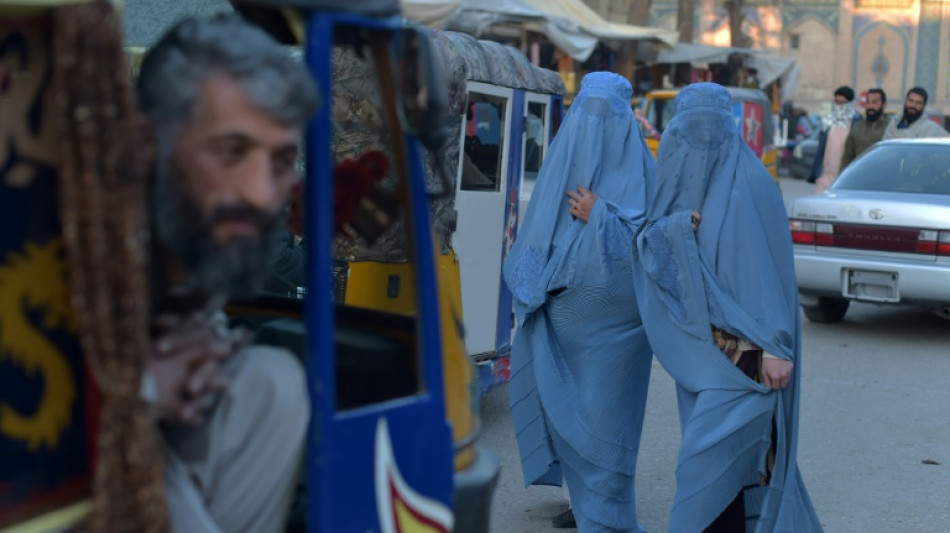
Taliban order Afghan women to cover faces in public / Photo: © AFP/File

 French economy 'headed for a wall' as GDP shrinks

 South Korea to prosecute students cheating with smart glasses
 Surging costs of living top US voter concerns

 Basic services, fading loyalties loom over South Africa's vote

 Shock, vindication, regret: Scientists react to AI roiling life's work

 Crypto platform Binance confirms $6.3 bn hack
 Boozer shines as Grizzlies top Blazers in battle of NBA unbeatens
 Jorge Martin confirmed to race at Malaysian MotoGP

 Bayern and Kane host Dortmund after week of 'extremes'

 Packers beat Panthers 27-19 as Watson returns from hospital

 Affordable supermarket fashion offers designer-inspired autumn alternatives

 Judge throws out Australian mushroom killer's appeal, imposes harsher sentence
 Pelicans down Kings for first win of NBA season

 Tech firms take fresh hit as earnings misses fan AI fears

 Worcestershire leaders back renewed two-unitary council reorganisation
 India's animal megacentre vows reset after criticism
 Dodging fuel price hikes, Damascus drivers turn to electric cars
 Alvechurch manager praises resilience but seeks improvement after Anstey draw

 Crypto platform Binance confirms major hack, more than $2.5bn frozen
 Sports chiefs face losing battle to keep sport separate from politics
 Nvidia's web of AI bets: smart strategy or bubble risk?
 Carrick fights for Man Utd job, Arsenal face Liverpool test

 Apple TV crime drama Nocturne brings a Scandinavian thriller to Pennsylvania

 Charity crowdfunds millions to buy historic English estate

 'Diabolical' Halloween festivities banned in Honduran towns

The Taliban on Saturday imposed some of the harshest restrictions on Afghanistan's women since seizing power, ordering them to cover fully -- including their faces -- in public, ideally with the traditional burqa.
The decree from Taliban leader Hibatullah Akhundzada also said that if women had no important work outside then it was "better they stay at home", and outlined punishments for their male guardians if they did not comply with the new dress code.
It was the latest in a slew of Taliban restrictions on women, including banning them from any government jobs, secondary education and travelling alone outside their cities, and prompted widespread international condemnation.
"So much pain & grief for women of my country, my heart is exploding. So much hatred & anger against Taliban, enemies of women, enforcers of gender apartheid, enemies of Afghanistan & humanity. The world is a bystander to our pain, to an apartheid, to complete tyranny," tweeted Shaharzad Akbar, the former chairperson of Afghanistan's Human Rights Commission.
"Those women who are not too old or young must cover their face, except the eyes, as per sharia directives, in order to avoid provocation when meeting men who are not mahram (adult close male relatives)," said the decree approved by Akhundzada and released by Taliban authorities at a ceremony in Kabul.
It said the best way for a woman to cover her face and body was to wear the chadari, a traditional, blue, all-covering Afghan burqa that includes a screen over the face.
"They should wear a chadari as it is traditional and respectful," it said.
The Ministry for Promotion of Virtue and Prevention of Vice, which released the new order, announced a slew of punishments if the dress code is not followed.
It said a woman's father or male guardian would be summoned and could even be imprisoned if the offence was committed repeatedly.
Women working in government institutions who did not follow the order "should be fired", the ministry added.
Government employees whose wives and daughters do not comply will also be suspended from their jobs, the decree said.
- 'Regressive' -
The militants took back control of the country in August last year, promising a softer rule than their previous stint in power between 1996 and 2001, which was marked by human rights abuses.
The international community has long tied the resumption of aid to Afghanistan's economy, shattered by more than four decades of fighting, and the recognition of the Taliban government to the Islamists' ability to keep their promises.
But the new controls on women have realised the worst fears of human rights activists and sparked a flurry of condemnation abroad.
"We are extremely concerned that the rights and progress Afghan women and girls have achieved and enjoyed over the last 20 years are being eroded," a US State Department spokesman told AFP.
The official added: "We and many of our partners in the international community remain deeply troubled by recent steps the Taliban have taken directed at women and girls, including restrictions on education and travel."
The United Nations mission in Afghanistan similarly condemned the Taliban's move, saying it might "further strain engagement with the international community."
"If they want international acceptance, they must live up to their obligations and commitments, particularly on the rights of women and girls," the British Foreign Office said in a statement.
"Such steps will only intensify opposition to them," said Imtiaz Gul, head of the Islamabad-based Centre for Research and Security Studies.
During their first regime, the Taliban made the burqa compulsory for women.
Since their return to power, the much-feared vice ministry has issued several "guidelines" on dress but Saturday's edict is one of the harshest restrictions on women.
"Islam never recommended chadari," said a women's rights activist who asked not to be named.
"I believe the Taliban are becoming regressive instead of being progressive. They are going back to the way they were in their previous regime."
Another women's rights activist, Muska Dastageer, said Taliban rule had triggered "too much rage and disbelief".
"We are a broken nation forced to endure assaults we cannot fathom. As a people we are being crushed," she said on Twitter.
The hardline Islamists triggered international outrage in March when they ordered secondary schools for girls to shut, just hours after they reopened for the first time since their seizure of power.
Officials have never justified the ban, apart from saying girls' education must be according to "Islamic principles".
That ban was also issued by Akhundzada, according to several Taliban officials.
Women have also been ordered to visit parks in the capital on separate days from men.
Some Afghan women initially pushed back strongly against the restrictions, holding small demonstrations -- but the Taliban cracked down on these unsanctioned rallies and rounded up several of the ringleaders, holding them incommunicado while denying they had been detained.
In the 20 years between the Taliban's two stints in power, girls were allowed to go to school and women were able to seek employment in all sectors, though the country remained socially conservative.
Many women already wear the burqa in rural areas.
L.Janezki--BTB