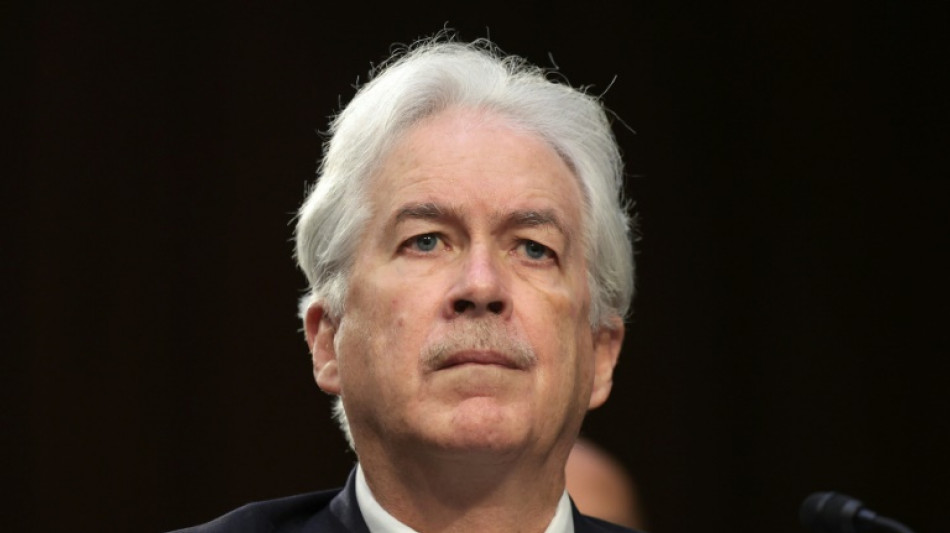
Putin 'doesn't believe he can afford to lose' in Ukraine: CIA chief / Photo: © GETTY IMAGES NORTH AMERICA/AFP

 French economy 'headed for a wall' as GDP shrinks

 South Korea to prosecute students cheating with smart glasses
 Surging costs of living top US voter concerns

 Basic services, fading loyalties loom over South Africa's vote

 Shock, vindication, regret: Scientists react to AI roiling life's work
 Crypto platform Binance confirms $6.3 bn hack
 Boozer shines as Grizzlies top Blazers in battle of NBA unbeatens
 Jorge Martin confirmed to race at Malaysian MotoGP
 Bayern and Kane host Dortmund after week of 'extremes'

 Packers beat Panthers 27-19 as Watson returns from hospital

 Affordable supermarket fashion offers designer-inspired autumn alternatives

 Judge throws out Australian mushroom killer's appeal, imposes harsher sentence
 Pelicans down Kings for first win of NBA season
 Tech firms take fresh hit as earnings misses fan AI fears

 Worcestershire leaders back renewed two-unitary council reorganisation

 India's animal megacentre vows reset after criticism

 Dodging fuel price hikes, Damascus drivers turn to electric cars

 Alvechurch manager praises resilience but seeks improvement after Anstey draw
 Crypto platform Binance confirms major hack, more than $2.5bn frozen

 Sports chiefs face losing battle to keep sport separate from politics
 Nvidia's web of AI bets: smart strategy or bubble risk?
 Carrick fights for Man Utd job, Arsenal face Liverpool test

 Apple TV crime drama Nocturne brings a Scandinavian thriller to Pennsylvania

 Charity crowdfunds millions to buy historic English estate

 'Diabolical' Halloween festivities banned in Honduran towns

Russian President Vladimir Putin believes that he cannot afford to lose in Ukraine and is "doubling down" on the war, but shows no signs of planning to use tactical nuclear weapons, CIA director Bill Burns said Saturday.
Despite the failure of Russian forces to capture Kyiv and their struggle to advance along the war's main frontlines in the southeastern Donbas region, the Russian leader has not changed his view that his troops can defeat Ukraine's, Burns said.
Putin's belief in the Russian military's ability to wear down Ukrainian resistance probably has not been shaken despite key battlefield defeats, the US spy chief told a Financial Times conference.
"I think he's in a frame of mind in which he doesn't believe he can afford to lose," Burns said.
He said Putin has been "stewing" for years over Ukraine -- once part of the Soviet Union -- in a "very combustible combination of grievance and ambition and insecurity."
Putin has not been deterred by the resistance in the war "because he staked so much on the choices that he made to launch this invasion," Burns said.
"I think he's convinced right now that doubling down still will enable him to make progress," Burns said.
- Tactical nuclear weapons -
Burns, a former US ambassador to Russia who has spent much time studying the Russian leader, said his and other Western intelligence agencies see no sign that Moscow is prepared to deploy tactical nuclear weapons in order to gain a victory in Ukraine or to target Kyiv's supporters.
Russia placed its nuclear forces on high alert shortly after launching the invasion on February 24.
Since then Putin has made thinly veiled threats hinting at willingness to deploy Russia's tactical nuclear weapons if the West directly intervenes in the Ukraine conflict.
"We don't see, as an intelligence community, practical evidence at this point of Russian planning for the deployment or even potential use of tactical nuclear weapons," Burns said.
"Given the kind of saber-rattling that ... we've heard from the Russian leadership, we can't take lightly those possibilities," he said.
"So we stay very sharply focused as an intelligence service ... on those possibilities at a moment when the stakes are very high for Russia," he said.
Burns did not offer any assessment of the current battlefield situation or predict how the war would end.
- China 'unsettled' -
But he said that China, which Washington now sees as its primary adversary, is studying closely the lessons of the war and what they mean for Beijing's desire to take control of Taiwan.
Burns said he does not believe that Chinese President Xi Jinping has altered his goal of eventually uniting Taiwan with China, by force if necessary.
But he said he thinks Beijing has been "surprised" by the poor performance of Russian military forces as well as the tough resistance coming from the entire Ukrainian society, as well as the strong defense support the West has provided Kyiv.
Russia's experience in Ukraine is probably affecting Beijing's calculation "about how and when" they try to gain control of Taiwan, which China views as a renegade province.
"I think they've been struck by the way in which particularly the transatlantic alliance has come together to impose economic costs on Russia as a result of that aggression," he continued.
Beijing has been "unsettled by the fact that what Putin has done is to drive Europeans and Americans closer together," Burns said.
"What conclusions get drawn from all that remains a question mark," he said.
"I think the Chinese leadership is looking very carefully at all this, at the costs and consequences of any effort to use force to gain control over Taiwan."
Y.Bouchard--BTB