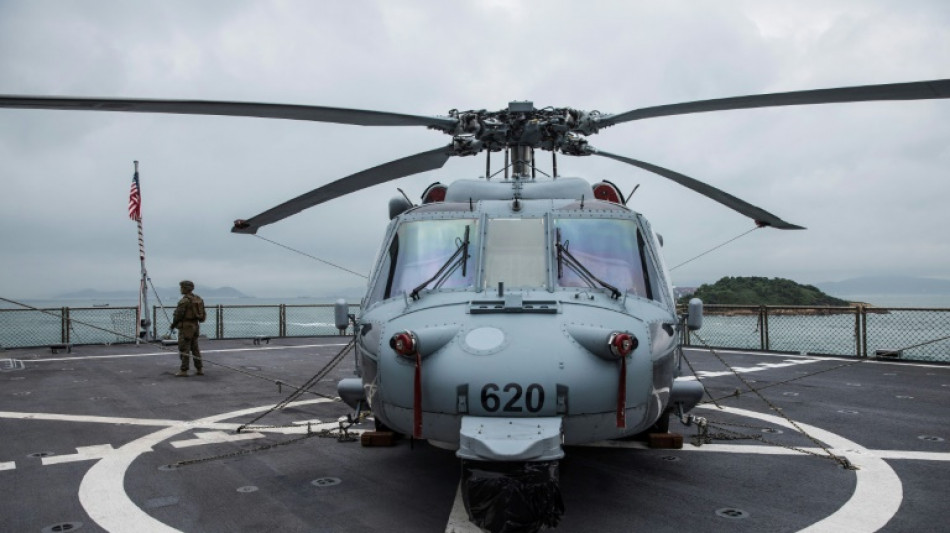
Taiwan scraps deal to buy US anti-submarine helicopters / Photo: © AFP

 Malawi's fuel shortages, record prices deepen economic crisis
 Rubio hosts G20 ministers as Iran, Ukraine wars divide members
 From minerals to AI, EU and Canada to forge new alliance

 Fire pollution killed 3,560 people in Indonesia in September: report
 Ian Wright and Jamie Carragher split on Liverpool-Arsenal prediction

 The Duskbloods delayed as Nintendo Switch 2 release moves to 2027

 Russia turns to NATO countries for prosthetics amid war-related shortages

 Researchers on island encounter giant spider legs emerging from a burrow

 Britain's King Charles lands in ex-colony Guyana

 Arsenal assess Bukayo Saka fitness concerns before Liverpool meeting
 £10,000 garden project transforms a UK home into a miniature Greece

 Forest destruction tests Armenia-Azerbaijan peace push
 Deal still eludes nations on final day of UN nature talks

 Teen rallies take to the streets across Italy

 Netanyahu bloc finishes ahead in Israel vote, but well short of majority
 Rural US hospitals, collateral victims of Trump politics
 How Trump could interfere in US midterm elections
 As Republicans downplay abortion for midterms, four US states to vote

 No. 4 Indiana looks to revive offense against improving Minnesota

 Police close investigation into Hayden Panettiere death after coroner ruling

 Australian mushroom killer loses appeal, has sentence extended

 Lethbridge students learn how city transit and transportation systems work

 India highlights defence ties with Japan and Australia at Cebu meetings

 Horoscope for October 30, 2026: communication and patience shape the day

 Amazon cloud business accelerates but shares drop on profit miss

Taiwan has opted out of purchasing anti-submarine helicopters from the United States because they are too expensive, its defence minister said Thursday.
The island was planning to buy up to 12 Seahawk choppers but the deal has been scrapped as Taipei prioritises lower cost, more mobile weaponry to counter any threat from China.
Local media reported earlier this year that the sale could fall through after Washington concluded the helicopters were not the best bet for Taiwan's "asymmetric warfare" needs.
Taiwan has shifted to a "porcupine" strategy that seeks to equip the island to repel an attack from a far larger Chinese military.
On Thursday defence minister Chiu Kuo-cheng confirmed the chopper deal was dead.
"We feel the price is too high and it's above what we can afford," he told lawmakers.
Taiwan's 23 million people live under the constant threat of invasion from China, which views the democratic island as its territory.
Russia's invasion of Ukraine has heightened fears that Beijing might one day follow through on threats to annex its smaller neighbour.
Taiwan's defence ministry earlier this week revealed that key deliveries of other weapons from the United States had hit roadblocks.
The Russia-Ukraine war has led to a shortage of Stinger anti-aircraft missiles, while production line issues were delaying a delivery of M109A6 Paladin self-propelled howitzers.
Chiu indicated Taiwan is now looking for suitable replacements.
"We have other alternatives and we definitely will have responsive measures. We will not throw our hands up because (these weapons) are not available. The military will do our job of preparing for combat," Chiu told lawmakers.
Stingers are highly portable shoulder-launched missiles that have been invaluable to Ukrainian forces fighting off Russian air power.
M109A6 Paladins are massive artillery guns on a tank chassis that can be easily moved, making them harder to spot and take out.
Western countries have been sending Ukraine thousands of the surface-to-air missiles and shoulder-mounted launchers, which are effective against helicopters and low-flying planes. Washington has promised 1,400.
Raytheon Technologies, which makes Stingers, said last month it would not be able to accelerate production of the missiles before 2023 due to a lack of parts.
The United States agreed to sell Taiwan 250 Stinger missiles as part of a 2019 deal worth more than $2.2 billion that sparked a protest by China.
Washington has remained a key ally and leading arms supplier to Taipei despite switching diplomatic ties to Beijing in 1979.
R.Adler--BTB