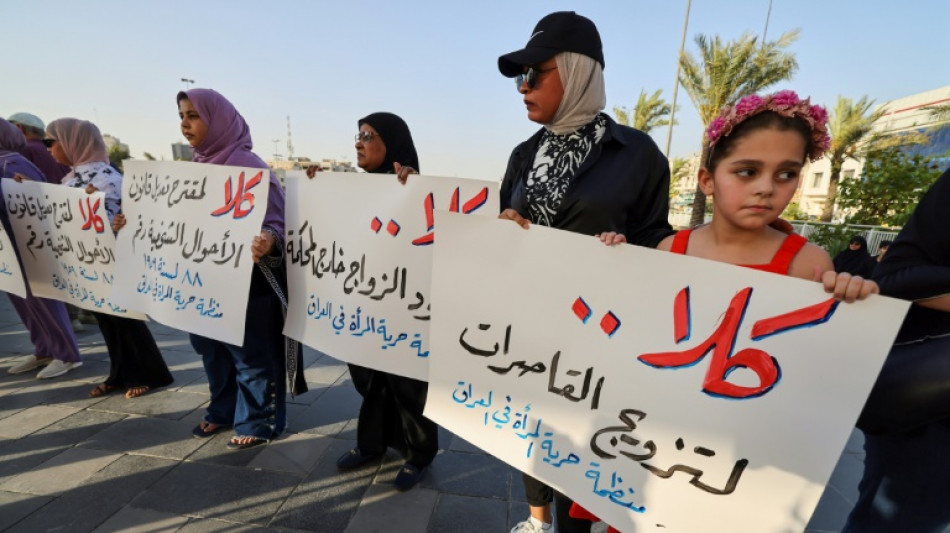
Fears for women's rights as Iraqi bill resurfaces / Photo: © AFP/File

 Ahead of Paris mass, pope urges life together in 'dignity and peace'

 Austria 'ghetto' language classes leave children to repeat school

 S.African women runners arm themselves after string of killings

 'I felt embarrassed': Japan eSports whizz-kid, 11, wins Games gold

 Indonesia fires threatens critically-endangered orangutan: IUCN

 Bangkok declares flood disaster across city

 'World records not enough': North Korea weightlifters target Olympic gold rush

 Iran proposes Hormuz plan, Trump reportedly refuses

 El Nino rewrites the menu in the world's top restaurants

 Pope to hold giant mass on Champs-Elysees

 TikTok to pay Alabama $100 mn under pre-trial settlement

 Internationals take 7-3 Presidents Cup lead after foursomes sweep

 Brazil team returns to Colombian site of doomed jet crash

 Mbappe injured as Zidane wins on France debut, Italy lose on Mancini return

 Senegal draw in Vieira debut, Nigeria survive scare as Cape Verde crash

 U2 performs surprise 50th anniversary gigs in Dublin

 Pope calls worshippers 'saints of France' after AI warning

 US court sides with Pentagon in Anthropic AI ban

 Wall Street stocks rise, greeting optimism over possible US-Iran deal

 NFL players chief raises concerns over pitch for Maracana game

 Daytime Russian attacks kill seven in Kyiv

 Spotting AI writing: how reliable are the detectors?

 French youth await pope after AI 'paradise of machines' warning

 Man City found guilty of Premier League charges, set to appeal: reports

 Embolo follows Xhaka out of Swiss squad over fake Covid documents

Rights advocates are alarmed by a bill introduced to Iraq's parliament that, they fear, would roll back women's rights and increase underage marriage in the deeply patriarchal society.
The bill would allow citizens to choose either religious authorities or the civil judiciary to decide on family affairs. Critics fear this will lead to a slashing of rights in matters of inheritance, divorce and child custody.
In particular, they are worried it would effectively scrap the minimum age for Muslim girls to marry, which is set in the 1959 Personal Status Law at 18 -- charges lawmakers supporting the changes have denied.
According to the United Nations children's agency, UNICEF, 28 percent of girls in Iraq are already married before the age of 18.
"Passing this law would show a country moving backwards, not forwards," Human Rights Watch (HRW) researcher Sarah Sanbar said.
Amal Kabashi, from the Iraq Women's Network advocacy group, said the amendment "provides huge leeway for male dominance over family issues" in an already conservative society.
Activists have demonstrated against the proposed changes and were planning to protest again later Thursday in Baghdad.
The 1959 legislation passed shortly after the fall of the Iraqi monarchy and transferred the right to decide on family affairs from religious authorities to the state and its judiciary.
This looks set to be weakened under the amendment, backed by conservative Shiite Muslim deputies, that would allow the enforcement of religious rules, particularly Shiite and Sunni Muslim.
There is no mention of other religions or sects which belong to Iraq's diverse population.
In late July, parliament withdrew the proposed changes when many lawmakers objected to them. They resurfaced in an August 4 session after receiving the support of powerful Shiite blocs which dominate the chamber.
- 'Option to shop' -
It is still unclear if this bid to change the law will succeed where several earlier attempts have failed.
"We have fought them before and we will continue to do so," Kabashi said.
Amnesty International's Iraq researcher Razaw Salihy said the proposed changes should be "stopped in their tracks".
"No matter how it is dressed up, in passing these amendments, Iraq would be closing a ring of fire around women and children," she said.
According to the proposed changes, "Muslims of age" who want to marry must choose whether the 1959 Personal Status Law or Sharia Islamic rules apply to them on family matters.
They also allow already-married couples to convert from the civil law to religious regulations.
Constitutional expert Zaid al-Ali said the 1959 law "borrowed the most progressive rules of each different sect, causing a huge source of irritation for Islamic authorities".
Several attempts to abrogate the law and revert to traditional Islamic rules have been made since the 2003 US-led invasion that toppled dictator Saddam Hussein.
This time, lawmakers are maintaining the 1959 law by giving people a chance to choose it over religious authorities.
"They are giving men the option to shop in their own favour," Ali said. The bill would hand them "more power over women and more opportunities to maintain wealth, control over children, and so on."
By giving people a choice, "I think basically they're trying to increase the chances of the law being adopted," Ali said.
- 'Malicious agenda' -
The new bill gives Shiite and Sunni institutions six months to present to parliament for approval a set of rules based on each sect.
By giving power over marriage to religious authorities, the amendment would "undermine the principle of equality under Iraqi law," Sanbar of HRW said.
It also "could legalise the marriage of girls as young as nine years old, stealing the futures and well-being of countless girls."
"Girls belong on the playground and in school, not in a wedding dress," she said.
HRW warned earlier this year that religious leaders in Iraq conduct thousands of unregistered marriages each year, including child marriages, in violation of the current law.
Many argue that historically Islam has allowed the marriage of pubescent girls from the age of nine, as the Prophet Mohammed is said to have married one of his wives Aisha at that age.
But rights group say child marriages violate human rights, deprive girls of education and employment, and exposes them to violence.
Lawmaker Raed al-Maliki, who brought the amendment forward and earlier this year successfully backed an anti-LGBTQ bill in parliament, denied that the new revisions allow the marriage of minors.
"Objections to the law come from a malicious agenda that seeks to deny a significant portion of the Iraqi population" the right to have "their personal status determined by their beliefs," he said in a television interview.
But Amnesty's Salihy said that enshrining religious freedom in law with "vague and undefined language" could "strip women and girls of rights and safety."
P.Vogel--VB