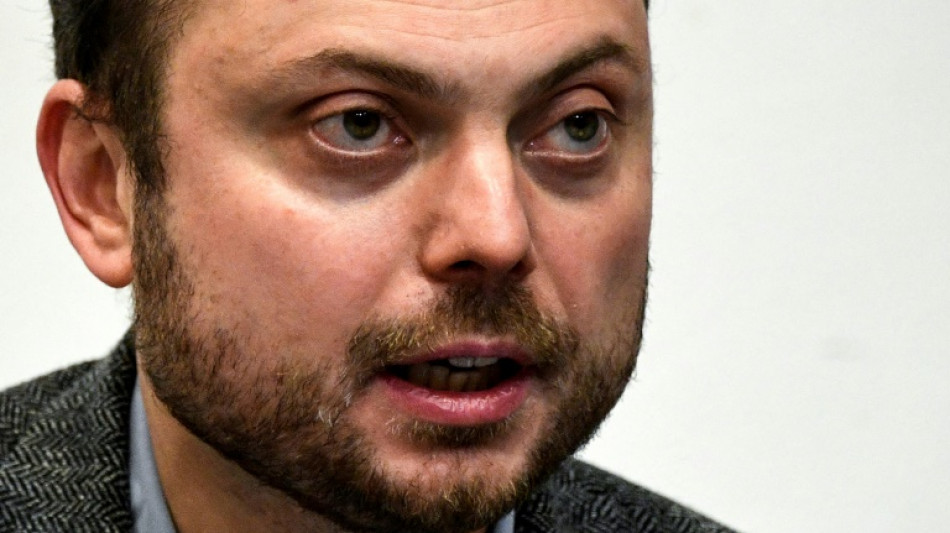
Poisoned and jailed: Kremlin critic Kara-Murza / Photo: © AFP/File

 Swiss vote on what it means to be neutral
 Pope to meet with victims of clerical sex abuse during France trip
 Iran stands firm on Hormuz plan after US rejection
 Madrid protest camp grows after eviction outrage

 Italy winemakers hail bumper harvest but cut output

 Kyiv shoppers feel the pinch from Russian strikes
 Japanese anime actor fights TikTok over AI voice cloning
 Curtain falls on the romance of India's single-screen cinemas
 Smells like teen spirit as US thrash Peru 4-1
 Cavy chaos: Hundreds attend New Zealand's biggest guinea pig show
 Venezuela releases more political prisoners after opposition talks

 England's best 'for a long time' despite Spain defeat, says Kane
 Powerful storm pummels northeast US with rain, high winds
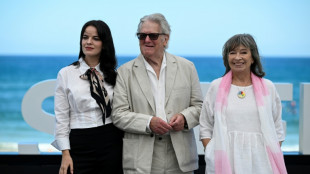 Filmmaker Mike Leigh wins top prize at Spain festival with 'last film'
 Spain beat England in Nations League to extend unbeaten run
 Ireland squad vote to play Israel tie despite Gaza unease
 Gutsy Vollering wins cycling road race world title
 Vollering wins cycling road race world title
 Man City's meteoric rise clouded by dark shadow
 Mbappe out for two weeks or more with knee injury say Real
 Lyon collapse away to Stade and suffer first Top 14 loss
 Russia accuses Europe of seeking to thwart Ukraine talks

 Man City chairman defiant over reported Premier League charges
 Germany ready to 'walk through fire' for Klopp, says Tah
 At least 16 killed in Russian and Ukrainian strikes
Kremlin critic Vladimir Kara-Murza, who was released from a 25-year prison sentence on Thursday in a prisoner swap, has spent years warning the world of the dangers of a revanchist President Vladimir Putin.
The 42-year-old journalist and opposition activist, a dual British-Russian national, was arrested soon after Moscow launched its February 2022 invasion.
Convicted in April 2023 of treason and spreading "false information" about Russia's military, he was sentenced to one of the longest prison terms ever handed down to a Putin critic.
The judgement was condemned internationally as politically motivated and repressive.
Kara-Murza was sent last September to a penal colony in the Siberian city of Omsk, some 2,200 kilometres (1,400 miles) east of Moscow.
In July, he was moved to a prison hospital, his wife Evgenia Kara-Murza said, with lawyers denied access for several days.
The dissident suffers from a nerve disease after falling severely ill in 2015 and 2017 in what he claims were poisonings orchestrated by the Kremlin and executed by security services.
His treatment behind bars sparked international concern, particularly after the death of opposition leader Alexei Navalny in an Arctic prison colony in February.
"What is happening to Vladimir Kara-Murza is very frightening," Svetlana Gannushkina, a prominent Russian rights activist, told AFP last month.
"There is no doubt that he is a political prisoner, convicted for his statements," she said.
- 'The price of war' -
Kara-Murza was arrested in April 2022 after a speech in the United States where he accused Russia of "war crimes" against Ukraine.
Russia made criticism of its Ukraine campaign a crime punishable by lengthy prison sentences shortly after it despatched troops.
For years Kara-Murza had campaigned against Putin, warning Russians and Western officials about the dangers of the Kremlin leader's increasing authoritarianism at home and imperial ambitions abroad.
"Today this is obvious to everyone, but at a terrible price -- the price of war," he said at his trial.
Even before being jailed, the dissident had suffered heavily for his activism.
In 2015 he was hospitalised in Russia with acute kidney failure. Blood tests found high levels of heavy metals, but Russia refused to open a criminal probe.
In an interview with AFP, Kara-Murza recalled: "I suddenly felt that I was unable to breathe anymore."
In 2017 he was again hospitalised with organ failure and fell into a coma.
An investigation led by Bellingcat journalists in 2021 suggested Russian security agents were involved in both instances.
Russia has always denied poisoning high-profile regime opponents.
Kara-Murza's lawyers and family say he developed polyneuropathy, a nerve condition, as a result of the attacks.
His wife has repeatedly warned that his health was deteriorating in jail.
- 'Don't give up' -
Yet the risk of death did not deter Kara-Murza.
"The biggest gift that those of us who oppose Vladimir Putin could give to the Kremlin would be to give up and run away," he told AFP just before Russia invaded Ukraine.
When he learned of Navalny's death in prison, Kara-Murza again refused to stay silent.
"Alexei said: don't give up. It's impossible to give up," Kara-Murza said in communications from jail.
Kara-Murza's family has a storied tradition of opposition.
His father, also Vladimir Kara-Murza, was an outspoken critic of Soviet authorities, and came from a line of Latvian anti-Kremlin activists killed by secret police.
In the post-Soviet era, his father, then a TV presenter, introduced his son to liberal politicians.
Kara-Murza moved to the UK as a teenager with his mother, acquired British citizen and studied history at Cambridge.
-'Sudden and unexpected change' -
In 2003 he stood unsuccessfully for election in Russia.
He worked as a journalist for a variety of news outlets, including the BBC, mining his knowledge of history to understand current events.
"If there's one thing modern Russian history teaches us is that major political change in our country comes suddenly and unexpectedly," he told AFP.
He served as deputy chairman of a liberal party led by former prime minister Mikhail Kasyanov and worked for former tycoon Mikhail Khodorkovsky's anti-Kremlin Open Russia foundation.
As Putin mounted an increasingly aggressive crackdown on his opponents through the 2010s, Kara-Murza campaigned in the US and Europe for individual sanctions against Russian officials.
From behind bars, he continued to write and campaign, winning a Pulitzer Prize for Washington Post dispatches.
Even during his trial, Kara-Murza voiced confidence that Putin's reign would end and Russia would be free.
"The day will come when the darkness over our country will dissipate, when those who kindled and unleashed this war -- rather than those who tried to stop it -- will be recognised as criminals," he said to the court.
L.Meier--VB