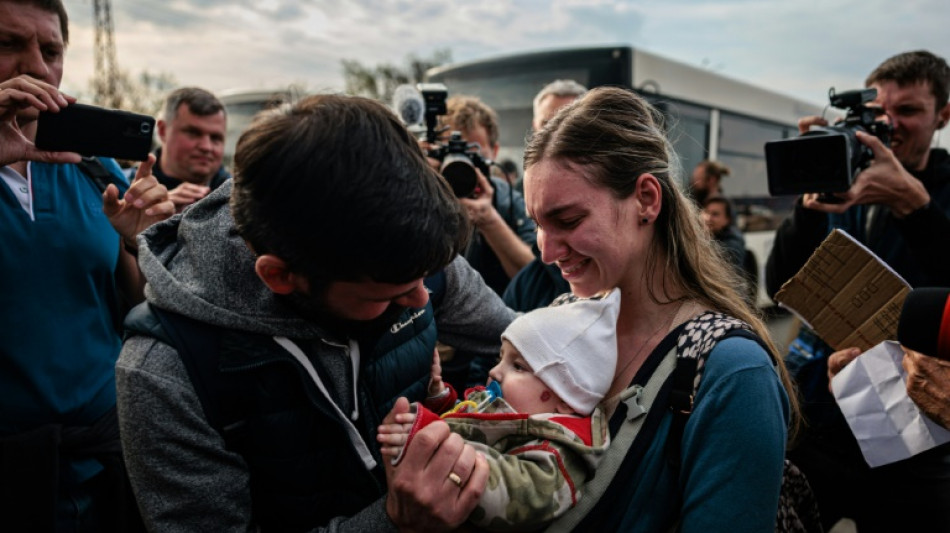
Tears and relief, as Azovstal evacuees reach safety / Photo: © AFP

 Malawi's fuel shortages, record prices deepen economic crisis

 Rubio hosts G20 ministers as Iran, Ukraine wars divide members

 From minerals to AI, EU and Canada to forge new alliance

 Fire pollution killed 3,560 people in Indonesia in September: report
 Ian Wright and Jamie Carragher split on Liverpool-Arsenal prediction

 The Duskbloods delayed as Nintendo Switch 2 release moves to 2027

 Russia turns to NATO countries for prosthetics amid war-related shortages

 Researchers on island encounter giant spider legs emerging from a burrow

 Britain's King Charles lands in ex-colony Guyana

 Arsenal assess Bukayo Saka fitness concerns before Liverpool meeting
 £10,000 garden project transforms a UK home into a miniature Greece

 Forest destruction tests Armenia-Azerbaijan peace push

 Deal still eludes nations on final day of UN nature talks
 Teen rallies take to the streets across Italy
 Netanyahu bloc finishes ahead in Israel vote, but well short of majority

 Rural US hospitals, collateral victims of Trump politics

 How Trump could interfere in US midterm elections
 As Republicans downplay abortion for midterms, four US states to vote

 No. 4 Indiana looks to revive offense against improving Minnesota
 Police close investigation into Hayden Panettiere death after coroner ruling
 Australian mushroom killer loses appeal, has sentence extended

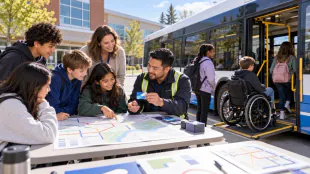 Lethbridge students learn how city transit and transportation systems work
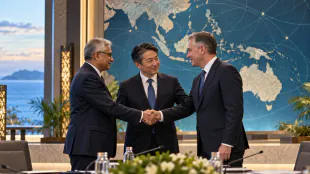 India highlights defence ties with Japan and Australia at Cebu meetings

 Horoscope for October 30, 2026: communication and patience shape the day

 Amazon cloud business accelerates but shares drop on profit miss
Their bunker couldn't withstand a direct hit from ferocious Russian bombardment, food was running out and finding water could get them killed -- yet that ordeal finally ended Tuesday for Azovstal evacuees in the banal safety of a shopping centre car park.
They had survived in tunnels below the steel works in the devastated city of Mariupol among holdout Ukrainian troops, having to pick bomb-shattered glass from their food and hope someone would finally get them out of there.
It was aboard a caravan of white city buses that they made it to the Ukrainian-held city of Zaporizhzhia, where they were met at a makeshift reception centre by crying loved ones and dozens of journalists.
"Under permanent fire, sleeping on improvised mats, being pounded by the blast waves, running with your son and being knocked to the ground by an explosion -- everything was horrible," evacuee Anna Zaitseva told reporters.
She carried her six-month-old baby in her arms and cried when expressing her gratitude to everyone from the troops who found formula for her child to the urgent international rescue effort that got them to safety.
"Thank you," she said before being escorted to a private area inside the shopping centre.
A group of some 100 civilians who become trapped in their refuges beneath the steel works were granted passage in an agreement worked out with the invading Russian forces, and which took days to carry out as the world watched.
The fate of civilians, but also the Ukraine troops still there, turned into an international issue and has been the subject of repeated negotiations.
Yet Ukrainian officials noted that some civilians had been left behind during the operation, prompting fresh concerns for their fate after Kyiv announced that Russian forces had launched an offensive with tanks and armoured vehicles at the giant site.
Stretching over 11 square kilometres (4.2 square miles), the Azovstal complex is a sprawling warren of rail lines, warehouses, coal furnaces, factories, chimneys and tunnels seen as ideal for guerrilla warfare.
- 'Left behind' -
The terror of her refuge at the steel works was fresh for Elyna Tsybulchenko, 54, who used to work at the site doing quality control before the war trapped her there.
"They bombed like every second... everything was shaking. Dogs barked and children screamed," she said. "But the hardest moment was when we were told our bunker would not survive a direct hit."
"We understood that it would just be a mass grave and no one could save us under fire," she added. "It would be impossible to save us."
She sought shelter there after shelling destroyed her home and water was running short in the city, yet even getting water inside the plant carried immense risks.
"To find water we had move between buildings. The men did that for us, including my dad," said Zaitseva, the young mother. "He was wounded but thank god it wasn't fatal."
She said Ukrainian troops located formula for her infant son, and when that ran out, they came up with semolina that she cooked over candles.
"Raising a child is a difficult thing," she added, noting about 70 people were sheltering in the same place as her. "It's even harder in a bunker with no light."
Mariupol is among the most battered cities in Ukraine, and the Azovstal site was the place that Kyiv's troops have managed to hold out against Russian forces.
The risk to civilians has been repeatedly decried, with accusations that Moscow has done little to protect the city's people from its explosive strikes.
"We personally tried to evacuate three times. One time everyone went out and shooting started. The truce was broken," Zaitseva said.
"And, of course, after that, we were very wary. We thought we had been left behind. But in the end, that turned out not to be true."
K.Brown--BTB