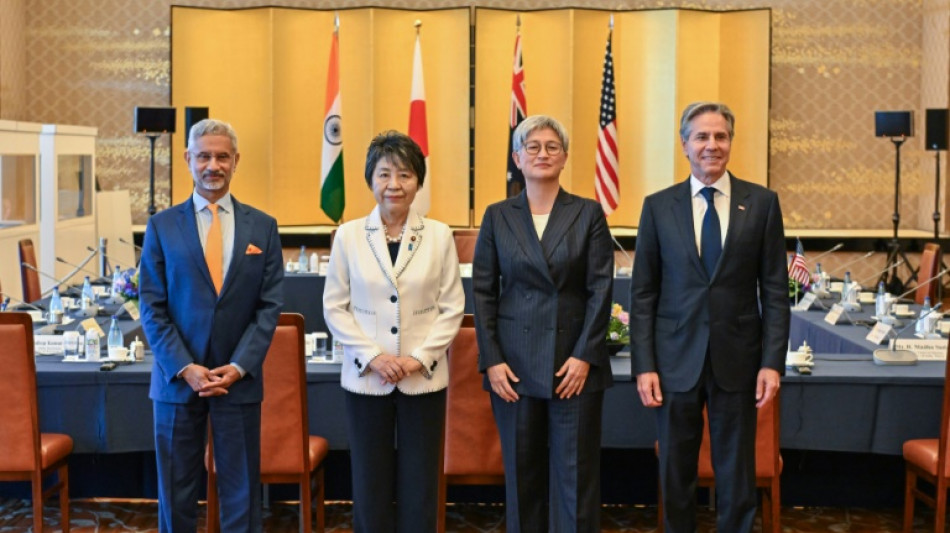
Quad 'seriously concerned' about situation in South China Sea / Photo: © AFP

 AVEVA and PETROJET Sign MoU for Digital Twin Projects in Egypt
 Daily Horoscope November 20, 2026: Astrological Predictions for All Signs

 Desire Under the Elms review - a horror show that bruises more than it moves

 Saudi PIF Retains Top Sovereign Wealth Fund Brand Title for Third Year

 Phoenix Weekend Guide: Sangria Socials, Pie Markets, and New Brunch Spots

 Trent Perry’s Late Heroics Lift No. 7 UCLA Past Cal State Fullerton

 2027 Hyundai Elantra Review: Brutalist Design and Expanded Dimensions
The foreign ministers of the United States, Japan, Australia and India on Monday expressed "serious concern" over the situation in the South China Sea in a veiled rebuke to Beijing.
US Secretary of State Antony Blinken and his counterparts in the so-called Quad grouping issued a joint statement calling for a "free and open" Pacific after talks in Tokyo.
The statement did not name China directly but referenced a series of recent confrontations between Chinese and Philippine vessels in the disputed South China Sea.
"We are seriously concerned about the situation in the East and South China Seas and reiterate our strong opposition to any unilateral actions that seek to change the status quo by force or coercion," the communique said.
"We continue to express our serious concern about the militarization of disputed features, and coercive and intimidating maneuvers in the South China Sea," it added.
The group also condemned North Korea's "destabilizing" missile launches.
Blinken is on a tour of Asia-Pacific countries aimed at reinforcing regional cooperation in the face of Beijing's growing assertiveness and its deepening ties with Russia.
The Quad talks in Tokyo, the first since September, included Japanese Foreign Minister Yoko Kamikawa, India's S. Jaishankar and Australia's top diplomat Penny Wong.
Their statement was noticeably more muted than a communique issued after talks on Sunday between Blinken, US Defense Secretary Lloyd Austin and their Japanese counterparts.
Without India and Australia present, the two countries issued scathing verbal attacks that, unlike the Quad statement, named and criticised not only China but also Russia.
Washington and Tokyo said China's "foreign policy seeks to reshape the international order for its own benefit at the expense of others".
It also condemned Russia's "growing and provocative strategic military cooperation" with China, as well as Moscow's procurement of ballistic missiles and other materiel from North Korea "for use against Ukraine".
Criticism of Moscow by the Quad is awkward for India, which relies heavily on Russian arms supplies and whose Prime Minister Narendra Modi met Vladimir Putin this month.
- Maritime clashes -
The Philippines -- Blinken and Austin's next stop -- is locked in a longstanding territorial row with Beijing over parts of the South China Sea.
Violent clashes in the area have sparked concern that Manila's ally Washington could be drawn into a conflict as Beijing steps up efforts to push its claims to almost the entire waterway, through which trillions of dollars' worth of trade passes annually.
"We are charting a course for a more secure and open Indo-Pacific and Indian Ocean region by bolstering maritime security and domain awareness," Blinken told reporters after the talks on Monday.
Kamikawa said the Quad was determined to "cooperate for the coexistence and co-prosperity of the international community".
Bec Strating, professor of international relations at La Trobe University, warned ahead of the talks that the Quad's varied agendas meant their message did not always ring clear.
On one hand, the idea that the four countries are willing to work together on defence and foreign policy issues presents them "as a 'partner-of-choice' in the region, compared with China", she told AFP.
But "global issues such as the war in Ukraine have demonstrated that the Quad countries are not necessarily as 'like-minded' as the rhetoric suggests", Strating said.
W.Huber--VB