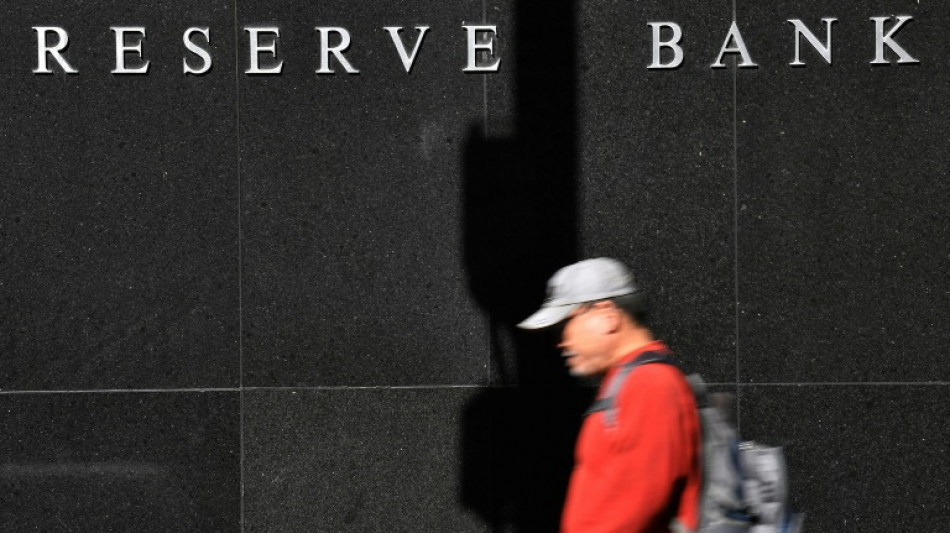
Australia hikes interest rates for first time since 2010 / Photo: © AFP/File

 Malawi's fuel shortages, record prices deepen economic crisis

 Rubio hosts G20 ministers as Iran, Ukraine wars divide members
 From minerals to AI, EU and Canada to forge new alliance

 Fire pollution killed 3,560 people in Indonesia in September: report

 Ian Wright and Jamie Carragher split on Liverpool-Arsenal prediction

 The Duskbloods delayed as Nintendo Switch 2 release moves to 2027

 Russia turns to NATO countries for prosthetics amid war-related shortages

 Researchers on island encounter giant spider legs emerging from a burrow

 Britain's King Charles lands in ex-colony Guyana

 Arsenal assess Bukayo Saka fitness concerns before Liverpool meeting
 £10,000 garden project transforms a UK home into a miniature Greece

 Forest destruction tests Armenia-Azerbaijan peace push

 Deal still eludes nations on final day of UN nature talks

 Teen rallies take to the streets across Italy

 Netanyahu bloc finishes ahead in Israel vote, but well short of majority
 Rural US hospitals, collateral victims of Trump politics
 How Trump could interfere in US midterm elections

 As Republicans downplay abortion for midterms, four US states to vote

 No. 4 Indiana looks to revive offense against improving Minnesota

 Police close investigation into Hayden Panettiere death after coroner ruling
 Australian mushroom killer loses appeal, has sentence extended

 Lethbridge students learn how city transit and transportation systems work
 India highlights defence ties with Japan and Australia at Cebu meetings

 Horoscope for October 30, 2026: communication and patience shape the day
 Amazon cloud business accelerates but shares drop on profit miss

Australia's central bank raised interest rates for the first time in more than a decade on Tuesday, a pre-election hike designed to curb soaring consumer prices.
The Reserve Bank of Australia raised the main lending rate by 25 basis points to 0.35 percent, the first increase since November 2010.
Ending record-low rates, the bank cited inflation levels that had "picked up more quickly, and to a higher level, than was expected".
The move thrusts the bank to the centre of a fierce political debate about the health of Australia's economy just weeks before the May 21 elections.
The opposition Labor party has seized on the prospect of a rate rise as evidence of a weakening economy and the conservative government's economic maladministration.
Prime Minister Scott Morrison, who is trailing in the polls, has insisted inflation is a result of worldwide trends, including the war in Ukraine.
The annual inflation rate is currently at 5.1 percent.
Like consumers around the world, Australians have been hit by soaring prices for food and fuels.
But house prices have been rising for years even as wages have stagnated. Sydney and Melbourne are among the world's most expensive cities in the world to live.
The rate rise is expected to be the first of several, which could have serious implications for Australia's once-perennially growing economy.
Higher interest rates will spell higher borrowing costs for millions of already heavily indebted Australians, in a country where real estate market speculation at times appears to be a national pastime.
Interest rates of two percent would cost the average homeowner about US$362 a month, according to financial services website RateCity.com.au.
"That's going to be a lot for many borrowers to swallow, particularly anyone already struggling to make the monthly budget add up," said RateCity's Sally Tindall.
Australia's vast resource wealth has for decades provided insulation from global financial headwinds and underpinned high standards of living.
The country is among the world's largest producers and exporters of iron ore, gas and coal.
But there are growing concerns that the "lucky country's" run of good fortune may be coming to an end.
In early 2020 the economy fell into recession for the first time in almost three decades, largely because of devastating bushfires and the start of the Covid-19 pandemic.
Climate-fuelled floods, bushfires and droughts are proving increasingly costly.
This year's east coast floods cost an estimated Aus$3.35 billion (US$2.4 billion) in insured losses, making it the costliest flood in Australia's history, according to the Insurance Council of Australia.
E.Schubert--BTB