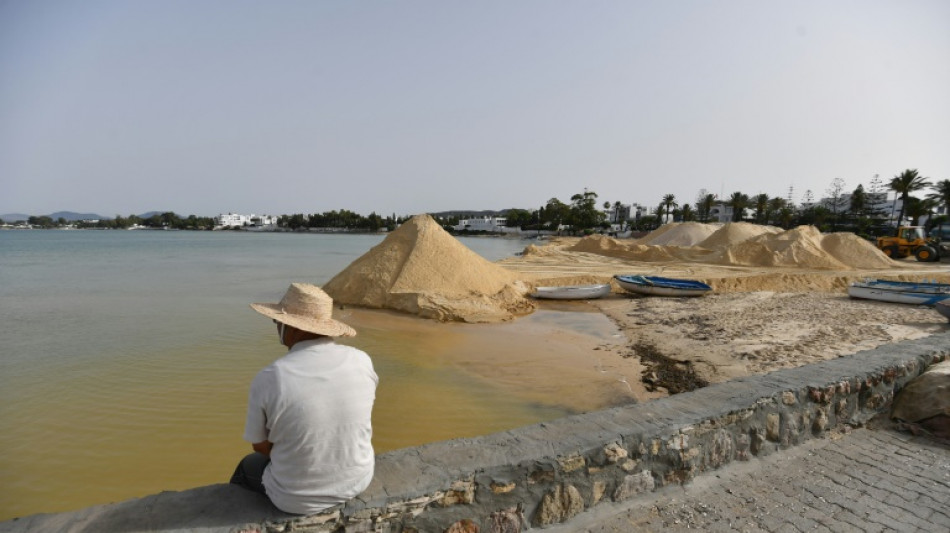
Tunisia's sandy beaches eaten away by coastal erosion / Photo: © AFP

 NFL Giants obtain QB McCarthy from Vikings

 Deal for evicted Spanish pensioner as PM seeks new housing law

 Clippers apologize, warn fans of 'challenges' after Leonard scandal

 Turkish comedian convicted for Erdogan 'insult' freed pending appeal

 Trump announces 'biggest' US steel plant in battleground Iowa

 Olise wonder strike gives Zidane's France win in Belgium

 US stocks fall, bond yields rise as Middle East war drags on

 Trump denies offering to sell arms to China's Xi

 Wemby ready for NBA Spurs to move rivals in climb to top

 Ukraine to postpone some spending amid delays in aid: PM

 Tuchel says Czech Republic game 'not yet a must-win'

 MaXhosa puts South Africa on the Paris fashion map

 Rose, Scott among 2027 World Golf Hall of Fame finalists

 Brunson says NBA champion Knicks can't get satisfaction

 France puts out largest wildfire since 1949

 Real Madrid's Perez summoned over Barcelona referee payments comments

 Oil takes off again, Wall Street dips after Trump rejects Iran truce offer

 AlgoQuant Asset Management Selects Liquid Mercury to Enhance Digital Asset Trading Infrastructure

 UK to reopen refugee resettlement scheme to push 'safe' migration

 Pope urges Europe to help combat 'lies and deceit' in world affairs

 Iranian lawyer Nasrin Sotoudeh wins Council of Europe's rights prize

 French far-right's Bardella denies alleged 2013 antisemitic comments

 Oil up, Wall Street dips after Trump rejects Iran truce offer

 Gakpo withdraws from Netherlands squad

 SpaceX puts Starship megarocket in orbit for first time
In Tunisia's seaside town of Hammamet, bulldozers diligently shovel sand from a nearby desert onto a popular beach in an attempt to stop it from disappearing due to erosion.
"This beach is the postcard image of Hammamet," said environmentalist Chiheb Ben Fredj peering nostalgically at the town's iconic Yasmine beach.
"It has been seared in our minds since our childhood," he added, as labourers worked to restore the central Tunisian waterfront to its former sandy glory.
Like many other coastal areas in North Africa, severe erosion has led to many of Hammamet's sandy beaches vanishing in recent years, taking a toll on the holiday hotspot about 65 kilometres (40 miles) east of the capital Tunis.
Coastlines across the world are in a constant natural flux, with the seas claiming and depositing sediment.
But human activity, including coastal property development and offshore sand mining, significantly accelerates beach erosion.
Among other impacts, construction and coastal defences in one area can stop sediment from travelling along a coastline, leaving existing beaches deprived of new material.
Studies have also shown the impacts of climate change, including rising temperatures and sea levels, exacerbate the phenomenon.
- Tourism draw -
In the Mediterranean, where the British National Oceanography Centre says sea levels have risen at a higher rate over the past 20 years than the entirety of the 20th century, shorelines are changing rapidly.
The sea is also warming 20 percent faster than the rest of the world, according to the United Nations.
Tunisia's coastline has been a major asset for the Mediterranean country with a struggling economy, as it aims to host some 10 million tourists this year.
Tourism accounts for up to 14 percent of the country's GDP, providing tens of thousands of jobs in a country where unemployment tops 16 percent and 40 percent among young people.
Tunisia has already lost more than 90 kilometres of beaches to erosion, according to official figures from last year.
Of the country's 570 kilometres of sandy beaches suitable for swimming, 190 kilometres are at imminent risk of disappearing, according to Tunisian reports.
A majority of the beaches most affected by erosion are located near cities.
Tunisia's environmental groups, as well as the government's Coastal Protection and Development Agency (APAL), blame the rapid erosion mostly on human activity and construction on the coast, which they say is further aggravated by climate change.
"Construction projects have not been designed to respect coastal dynamics," an APAL official told AFP.
- 'Not sustainable' -
To save the Hammamet beach, one of Tunisia's worst-affected according to the World Bank, authorities last month began trucking in around 750 lorry loads filled with sand from the inland desert province of Kairouan, about 110 kilometres away.
APAL, which operates under the environment ministry, was in a race against time to refill the beach before the peak of tourist season.
But while the rebuilding of beaches, known as beach nourishment, may be a quick fix, "it's not a sustainable solution", said Ben Fredj.
"This sand may not last long," added the secretary general of the Environmental Education Association.
"It can be swallowed in a few days in the event of a storm", he said, as was the case in the summer of 2023.
The process can also prove expensive.
Coastal authorities estimated the cost of restoring sand to three beaches in Hammamet, Monastir and Sfax at 3.9 million Tunisian dinars ($1.25 million).
But for locals, restoring their priceless seafront is worth the money.
The Yasmine beach "is a showcase for Hammamet," said Narjess Bouasker, who runs the town's Menara hotel and leads the regional hotel federation.
"We must take back our beach that the sea has swallowed," she said, calling for a balance between safeguarding the landscape, cherished by locals and foreign visitors alike, and fighting coastal erosion.
"For us, the priority is not to touch the beauty of the city," she said.
Bouasker said she has seen increasing awareness among authorities, but refilling beaches with sand is still a gamble.
"We don't know how the sea will react", she added.
G.Haefliger--VB