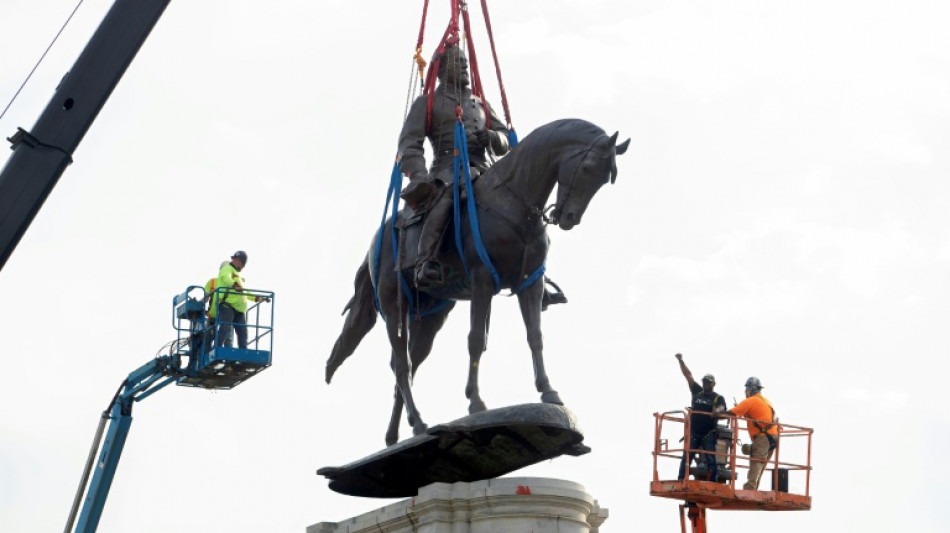
In US, death threats for those removing Confederate statues / Photo: © AFP

 Trump's secret plane swap triggers questions and confusion

 California calls Paramount's threat to leave state 'blackmail'

 PSG 'want to win everything', says Luis Enrique

 Barred from elections, Russia's anti-war party vows to fight on

 Jaissle states Newcastle ambition but urges patience

 NBA star Cooper Flagg trading card a slam dunk for lucky buyer

 ForumPay Expands Payment Infrastructure with New Card and Bank Transfer Acceptance Solution
 Oil prices higher, stocks flat ahead of inflation report
 Orban-critic ex-judge becomes Hungary president after predecessor ouster
 US rights groups sue Trump over ICC sanctions

 Sphere 3D Corp. (Nasdaq: ANY) Attracts 6.5% Stake from Turnaround Bitcoin-Mining Investor

 Oil prices lower, stocks higher as Hormuz doubts drag on
 Colombia scrambles to find survivors as quake kills 181

 Colombia scrambles to find survivors as quake kills 169

 MEXC Report: 74.2% of Traditional Finance Users Have Shifted Their Trading Activity to Crypto Exchanges

 MEXC Lists DAPPOS (DOS) With $60,000 Worth of DOS and 10,000 USDT in Airdrop+ Rewards

 Jellyfish force shutdown of three reactors at French nuclear plant

 Hodgkinson, Werro sail through Euro 800m qualifying

 Somali referee denied World Cup 'proud' to oversee UEFA Super Cup

 French newspapers target Google over AI summaries

 Ebola death toll in DR Congo outbreak rises to more than 2,000

 PrimeXBT Launches MT5 Cent Account for Beginners and Risk-Conscious Traders

 British sprinter Hunt chasing three more golds after winning 100m
 Ethiopia's Tigray rebel authorities condemn army drone strikes

 Too hot to live? French buyers rethink housing choices after heatwaves

Since his contracting company began removing Confederate statues from Richmond, Virginia -- controversial symbols of the South's slave-holding past -- Devon Henry has got himself a gun that never leaves his side.
"Based on all the comments and the vitriol that folks spew over these two years, I just refuse to let my guard down," the African-American business owner told AFP.
"On one of the removals, we were driving down the road with the Confederate statue on the trailer and someone tried to run us off the road," said Henry, who is 45.
Death threats, racist insults and intimidation have rained down on him since July 1, 2020, when the contractor and his team unbolted their first statue, a monument to General Thomas "Stonewall" Jackson.
Jackson was a leading figure of the pro-slavery Confederate forces during the Civil War of 1861-1865.
On that day in 2020 in Richmond, the former capital of the Confederacy, Henry wore a bulletproof vest and felt himself oscillating between pride and anxiety.
"You're trying to figure out how to take this thing down and you're also looking over your back and making sure that no one's trying to come and bring harm to you and your crew," he said.
When the 17-foot tall (five-meter) statue was finally dislodged from its pedestal in the pouring rain, "to see thousands of people still around laughing, smiling and in some cases crying, you feel like you did something pretty special."
"To me, the removal was akin to the falling of the Berlin Wall," said Richmond Mayor Levar Stoney.
- Hate and bigotry -
The African-American mayor, a Democrat, used his emergency powers in the summer of 2020 to push for the dismantling of the controversial sculptures at a time when the country was undergoing an unprecedented outcry against racism following the death of George Floyd, a Black man asphyxiated by a white police officer in Minneapolis, Minnesota.
"Those monuments represented division, hate, bigotry," he said. "They were erected to intimidate and to put Black people who lived in Richmond in their place."
"This is not the Richmond of 2022," the mayor said.
The erasure of Confederate symbols has, however, proven a rocky road for Stoney.
Before Henry agreed to take on the risky job, several other businesses refused to do so. Some were simply opposed to the removal of the monuments, others feared for their safety, and still others even said they feared family members might drop them from their wills if they took on the work.
Henry himself hesitated to say yes, fearful for his family's safety after several violent events in recent years. In January 2016, a contractor hired to remove four Confederate statues in New Orleans pulled out of the project after his car was set afire.
"It was really difficult to find others who were interested in taking the work" after that attack, said Flozell Daniels Jr., president of the Foundation for Louisiana, which worked with New Orleans officials to remove the statues.
"Contractors were being told that if it was found out that they were working with the city on this, they would not get other contracts in the region. It's an important financial threat," he said.
The monuments were ultimately removed in the spring of 2017, under police protection and at night, by masked workers equipped with bulletproof vests and wearing no visible logos that might have identified them, said Daniels, whose association also received death threats.
A few months later, in August 2017 in Charlottesville, Virginia, hundreds of ultra-right protesters marched against the removal of a statue of Confederate general Robert E. Lee. At the end of the rally, a neo-Nazi sympathizer drove his car into a crowd of anti-racist activists, killing 32-year-old Heather Heyer.
- Living out a prophecy -
Four years later, Devon Henry proudly removed that same statue, along with three others, in Charlottesville.
His company has removed a total of 23 Confederate monuments in the southeastern US, including 15 in Richmond, and is set to dismantle several others in different cities. Hundreds remain across the American South.
Despite the repercussions for Henry's business, his life and his family, he says he has never regretted his choice.
"It goes back to 1890, when a Black man said that it was Black people that put up the monuments, and when it would be time to come down, it would be a Black man who does that.
"So being able to live out that prophecy is pretty rewarding," Henry said, referring to the words of civil rights activist John Mitchell Jr., a Richmond native who was born a slave.
C.Meier--BTB