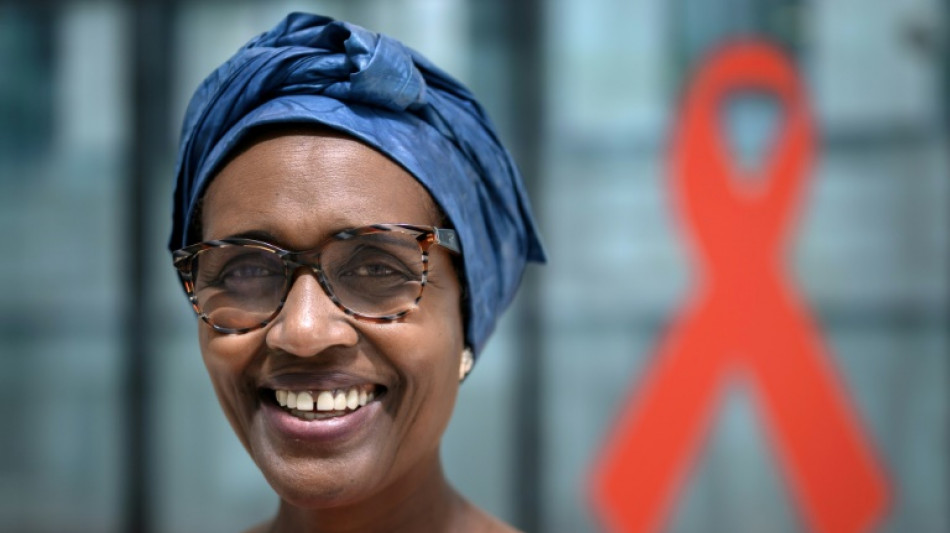
UN urges Gilead to 'make history' with game-changing HIV drug / Photo: © AFP

 AI bosses head to White House as safety pressure builds

 Batista sacked as Costa Rica coach after six months

 Flooding, power cuts and evacuations as Hurricane Polo slams Mexico

 Dodgers eye three-peat, Red Sox face Yankees as MLB playoffs begin

 Certification of Boeing 737 MAX delayed by software bug

 Celine Dion wows Paris Fashion Week with surprise gig

 AMD buys firm founded by AI 'godmother' Fei-Fei Li

 Italy rebound in Turkey as France win late in Belgium

 Pope says concerns about AI 'should be taken seriously'

 Hurricanes to hoist title banner as NHL season begins

 Justice Alito steps aside from major US climate case

 Willis happy with England exile after retains Top 14 player award

 Spain housing protests keep heat on government as PM seeks new law

 Wissa spoils Zimbabwe homecoming as DR Congo win AFCON qualifier

 UK police release on bail five men held over airbase incident

 Ex-All Black Plummer 'sure' New Zealand will find Super Rugby solution

 Shein sees 1% revenue growth in first half of 2026

 Netherlands regrets Israel retaliation in settlements row

 Moscow seizes Russian assets of German food retailer Metro

 Bulgarian spirits inflamed by new rakia rules

 Documentary turns camera on architect Peter Zumthor

 UK police say releasing on bail five men held over airbase incident

 Trump admin finalizes reversal of US fuel economy standards

 US says no China arms sale plans after envoy cites Trump offer

 Dozens kidnapped in two weekend attacks in northern Nigeria

Gilead could bring the AIDS pandemic towards an end if the US pharmaceutical giant opens up access to its game-changing new HIV drug, the head of UNAIDS told AFP.
Winnie Byanyima urged Gilead to "make history" by allowing generic manufacturing of Lenacapavir, a twice-yearly injectable antiretroviral medication used to treat HIV patients.
She urged Gilead to open up Lenacapavir to the UN-backed Medicines Patent Pool international organisation, whereby cheaper generic versions could be sold under licence in low- and middle-income nations.
Whatever the financial rewards of creating Lenacapavir, the renown of being the company that conquered the AIDS pandemic would be greater, Byanyima said.
"Gilead has an opportunity to take us closer to ending AIDS as a public health threat," Byanyima told AFP in an interview at UNAIDS' headquarters in Geneva.
"Gilead has an opportunity to save the world. To save the world, literally," from the pandemic.
"They can be the company that wins a Nobel Prize, for example. Reward doesn't come just through money. There is also recognition... imagine how great it would be."
- In a different league -
While around 10 million people with HIV still need to be reached with antiretroviral therapy, around 30 million are on such treatment.
Byanyima, the executive director of the Joint United Nations Programme on HIV and AIDS, said this was only possible thanks to innovations from pharmaceutical companies like Gilead.
But Lenacapavir is "so highly effective, it's in a different category of preventive medicines", she said.
Byanyima said the drug would help the hardest to reach.
"Those people hiding from the law -- gay men, trans women -- who could come out just twice a year to get their injection and be safe", she said, not to mention young women in Africa, fearing stigma and domestic violence.
Lenacapavir was approved for use for HIV patients in the United States and the European Union in 2022. It is available from around $40,000 a year in the US.
It is also being tested for potential pre-exposure prophylaxis (PrEP) use, to prevent people without HIV from getting the virus -- with very promising interim results.
Byanyima insisted that through tiered pricing -- for example someone in Nepal paying a fraction of the price of someone in Britain -- Gilead could still turn a profit on Lenacapavir.
"We could come close to ending this disease," she insisted.
Gilead has previously said it is in talks with governments and organisations "as we work to reach our access goals".
- 2030 target -
Broadly speaking, HIV innovations were producing better products for prevention and treatment with greater efficacy and fewer side effects, Byanyima said.
However, "a vaccine is very, very difficult to make. Same as a cure.
"But we have everything in between now for people to live long, healthy lives."
Some 1.3 million people were newly infected with HIV last year.
UNAIDS maintains it is possible to end HIV as a public health threat by 2030 -- but only if leaders make the right decisions on funding, resourcing and rights.
"We do see countries making progress towards that, which also proves that it is possible," said Byanyima.
She said that since 2010, some countries in sub-Saharan Africa had reduced new infections by more than half, and deaths by up to 60 percent.
However, "we also have regions such as Eastern Europe, Central Asia and Latin America where we see new infections moving in the wrong direction and rising," with stigma pushing people away from services.
- 'Fulfil the promise' -
Byanyima also warned of a "well-coordinated, well-resourced pushback" against LGBTQ rights, reproductive rights and gender equality.
She cited the harsher Anti-Homosexuality Act imposed in her native Uganda, moves to decriminalise female genital mutilation in The Gambia and the US Supreme Court stripping constitutional protections for abortion.
The 25th International AIDS Conference takes place in Munich from Monday to Friday, bringing together governments, civil society, academia, scientists and people living with HIV to share knowledge.
Byanyima said she wanted to see a boost in the political will to conquer the AIDS pandemic.
"Fulfil the promise that this disease will end. No-one should suffer, living with HIV," she said.
"We have all the possibilities for people to live healthy lives. And we should do it."
B.Wyler--VB