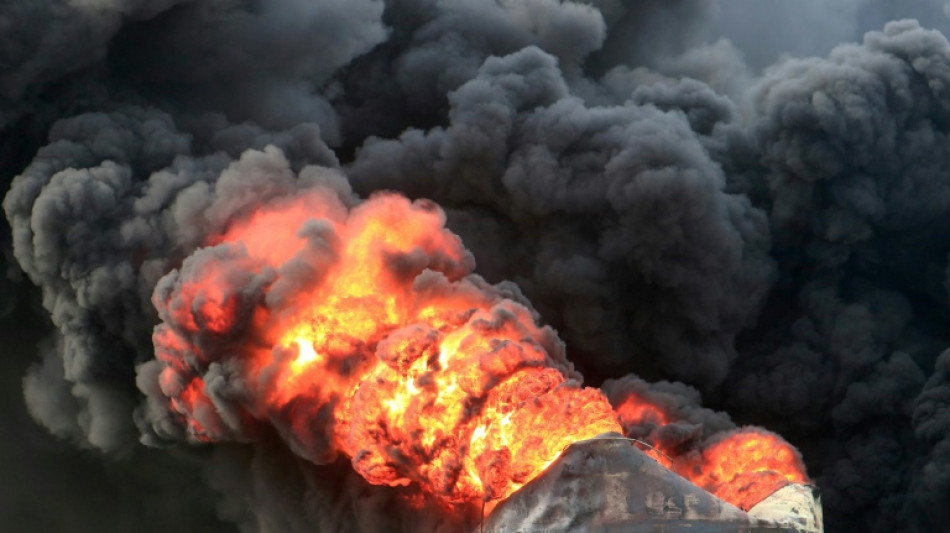
Yemen's Huthis vow major retaliation for Israeli port strike / Photo: © AFP

 ALIX LASERS shareholders remove Michael Sobitsch as managing director in view of the circumstances

 Progressive Vision Wins Irish Healthcare Awards 2026 Innovation Prize for Office-Based Cataract Surgery

 Eight-Year-Old Georgia Wins Penrith Valley Public Speaking Competition

 Steven Berkoff on Memory and His New Autobiography 'Shouting At Night'

 Jimmy Carr Confirms 25-Year Estrangement From Father Amid Podcast Reflections

 Arizona Superintendent Tom Horne to Leave Office, Plans Law Practice and Charter School

Yemen's Huthi rebels on Sunday promised a "huge" retaliation against Israel for a deadly strike on the port of Hodeida, as regional fallout widens from months of war in Gaza.
The Israeli strike, the first claimed by Israel in Yemen, set oil tanks ablaze at the vital port and came a day after the first fatal attack by the Huthis in Israel.
On Sunday, Israel said it intercepted a missile fired from Yemen and struck targets in southern Lebanon. Residents of southern Gaza reported combat in the Rafah area.
The fighting across the region came ahead of Prime Minister Benjamin Netanyahu's trip this week to Washington, which has been trying to secure a ceasefire in the more than nine-month war between Israel and Palestinian militants Hamas in Gaza.
On Sunday, Netanyahu's office said he was sending a negotiating team -- it was unclear where -- for new talks on a deal under which hostages held by Hamas would be freed.
But Saudi Arabia's foreign ministry warned Israel's attack on Hodeida "aggravates the current tension in the region and halts the ongoing efforts to end the war in Gaza".
Dozens have been killed since Saturday across Gaza, the civil defence agency in the Hamas-run territory said, including in strikes on homes in the central Nuseirat and Bureij areas and near southern Khan Yunis.
Residents said a major operation was underway in a district west of Rafah, where they reported heavy artillery and clashes.
On Sunday, Abdul Malik al-Huthi, chief of the Iran-backed group, said the Hodeida strikes would lead to "further escalation and more attacks targeting Israel". He said the deadly Huthi drone attack on Tel Aviv had opened "a new phase" in operations.
Huthi military spokesperson Yahya Saree said the rebels' "response to the Israeli aggression against our country is inevitably coming and will be huge".
Israeli Defence Minister Yoav Gallant said the fire left raging by the strikes on rebel-held Hodeida port "is seen across the Middle East and the significance is clear".
Gallant warned of further operations if the Huthis "dare to attack us" after the rebel strike hit Tel Aviv, at least 1,800 kilometres (1,119 miles) from Yemen.
It appeared to be the first to pierce Israel's intricate air defences but an analyst said Huthi drones do not pose a "strategic threat" to Israel.
- Fuel storage tanks -
In Hodeida, six people were killed and 83 wounded, health officials said in a statement carried by Huthi media.
AFPTV images showed heavy flames and black smoke spiralling into the sky from burning oil tanks. Debris covered the dock where equipment was damaged.
Hodeida port is a vital entry point for fuel imports and international aid for rebel-held areas of Yemen, a country where the United Nations says more than half the population needs humanitarian assistance.
Analysts say the strike on Hodeida will likely only embolden the Huthis. They have already withstood since January repeated United States and British strikes aimed at deterring recurrent Huthi attacks on shipping.
The rebels also endured thousands of air raids during nearly a decade of war against forces backing Yemen's internationally-recognised government.
On Sunday, the Israeli military said it had intercepted a missile fired from Yemen towards the Red Sea resort town of Eilat. The rebel spokesman said ballistic missiles were fired towards the port.
In Lebanon, Iran-backed and Hamas-allied Hezbollah said it fired Katyusha rockets and drones at northern Israel after Israeli strikes hit a weapons depot and wounded six civilians.
Hezbollah, which reported three more of its fighters killed, said Israel's strikes on its Yemeni allies marked "a new, dangerous phase".
- Netanyahu to Washington -
The Gaza war was triggered by Hamas's October 7 attack on southern Israel which resulted in the deaths of 1,195 people, mostly civilians, according to an AFP tally based on Israeli figures.
The militants also seized 251 hostages, 116 of whom are still in Gaza, including 42 the Israeli military says are dead.
Vowing to destroy Hamas, Israel has killed at least 38,983 people, also mostly civilians, according to data from the Gaza health ministry.
The war has left most of Gaza's population displaced, much of the housing and other infrastructure destroyed, and essential goods in short supply as the UN says diseases are spreading.
Israel has started vaccinating its troops in Gaza against polio and supplying vaccines for the Palestinian population after health agencies said the virus was found there, the military said.
The war has brought Israelis to the streets, sometimes in their tens of thousands, demanding a deal to free remaining hostages.
On Sunday they protested at Ben Gurion International Airport near Tel Aviv ahead of Netanyahu's meetings in the United States where he will be under pressure to reach a ceasefire with Hamas.
H.Weber--VB

