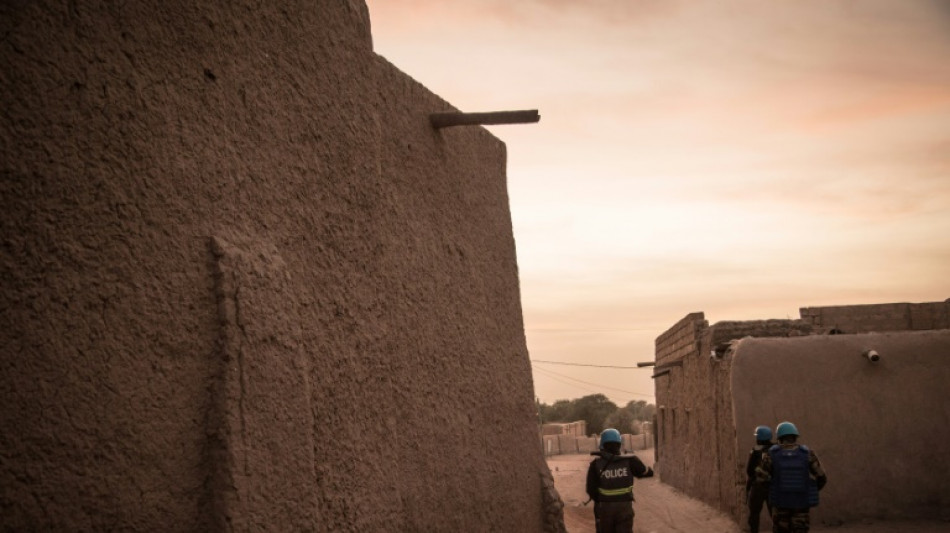
UN chief urges swift return to civilian rule in Burkina Faso, Guinea, Mali / Photo: © AFP

 Malawi's fuel shortages, record prices deepen economic crisis

 Rubio hosts G20 ministers as Iran, Ukraine wars divide members

 From minerals to AI, EU and Canada to forge new alliance

 Fire pollution killed 3,560 people in Indonesia in September: report

 Ian Wright and Jamie Carragher split on Liverpool-Arsenal prediction

 The Duskbloods delayed as Nintendo Switch 2 release moves to 2027
 Russia turns to NATO countries for prosthetics amid war-related shortages

 Researchers on island encounter giant spider legs emerging from a burrow

 Britain's King Charles lands in ex-colony Guyana

 Arsenal assess Bukayo Saka fitness concerns before Liverpool meeting

 £10,000 garden project transforms a UK home into a miniature Greece

 Forest destruction tests Armenia-Azerbaijan peace push
 Deal still eludes nations on final day of UN nature talks

 Teen rallies take to the streets across Italy

 Netanyahu bloc finishes ahead in Israel vote, but well short of majority

 Rural US hospitals, collateral victims of Trump politics
 How Trump could interfere in US midterm elections
 As Republicans downplay abortion for midterms, four US states to vote
 No. 4 Indiana looks to revive offense against improving Minnesota

 Police close investigation into Hayden Panettiere death after coroner ruling

 Australian mushroom killer loses appeal, has sentence extended

 Lethbridge students learn how city transit and transportation systems work

 India highlights defence ties with Japan and Australia at Cebu meetings

 Horoscope for October 30, 2026: communication and patience shape the day

 Amazon cloud business accelerates but shares drop on profit miss

UN chief Antonio Guterres called Sunday for the military juntas in Burkina Faso, Guinea and Mali to hand power back to civilians as soon as possible and reminded the world to deliver on "climate emergency" promises.
Speaking after meeting Senegalese President Macky Sall in Dakar, he said they had agreed on the need to keep talking to the de facto authorities in all three countries so as to get a swift return to "constitutional order".
All three countries, struggling with a jihadist insurgency in the Sahel region, have recently experienced military coups: Mali in August 2020 and May 2021; Guinea in September 2021; and Burkina Faso in January 2022.
Sall is the current chair of the West African bloc ECOWAS, which has suspended all three countries from its membership.
ECOWAS imposed heavy sanctions against Mali in January after the regime there rejected a rapid return to civilian rule.
It has threatened similar sanctions against Guinea and Burkina Faso if they fail to enable a swift transition to civilian rule within a "reasonable" timeframe.
But the military regimes in both countries rejected the timetable set out by ECOWAS.
Last Monday, Ouagadougou said they had no plans to shorten the three-year transition period they had already announced.
And on Saturday evening, Guinea's junta leader Colonel Mamady Doumbouya said he had opted for a 39-month transition period to civilian rule.
The decision was roundly condemned Sunday by opposition leaders in Guinea, including both the party of the ousted president Alpha Conde and opposition groups that had opposed him.
The regime in Mali is also continuing to defy ECOWAS pressure.
On April 21 it announced the launch of a two-year transition "process" before elections are held.
ECOWAS had called for elections within 16 months at the most.
- Triple crisis -
Turning to the issue of global warming, Guterres said "the climate emergency... increases the security risk".
African countries, he said, were "often the first victims" of global warming for which they are "not responsible".
Developed countries had pledged to help the countries of the south to finance their "transition towards renewable energies and green jobs", he noted.
"It's time to take action. It's time to keep the promise of 100 billion dollars a year made in Paris," he said, referring to national pledges under the 2015 Paris Agreement aimed at capping global warming below two degrees Celsius.
In Dakar, Guterres visited the site of the future headquarters of the UN's regional operations as well as a manufacturing unit soon to produce Covid-19 vaccines and also experimental anti-malaria and tuberculosis vaccines.
Guterres also addressed the consequences of the war in Ukraine on Africa, where he said the conflict "aggravates a triple crisis: food, energy and financial".
To enable the countries of the continent to cope, Guterres urged once again international financial institutions to put in place "urgently... debt relief measures... so that governments can avoid default and invest in social safety nets and sustainable development for their people".
I.Meyer--BTB