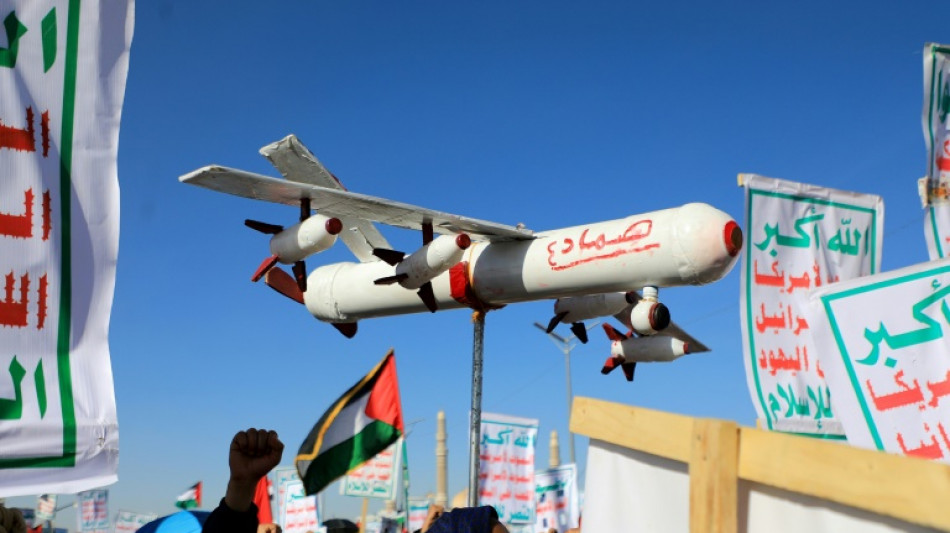
Drone warfare: what threat do Yemen's Huthis pose to Israel? / Photo: © AFP

 French teens clash with police as school blockades intensify

 FIFA accuses UEFA of 'misinformation campaign' in bid for World Cup papers

 Myanmar airstrike toll hits 50 as families gather dead

 STARTRADER Raises Lloyd's of London Client Fund Insurance to USD 30 Million in Aggregate

 North Korean DMZ landmine blasts 'violation of armistice': Seoul

 Sabalenka 'fresh' for first tournament since losing No.1 spot

 Myanmar airstrike death toll rises to 50: aid workers
 North Korean DMZ landmine blast 'violation of armistice'

 South Korea volleyball team latest to be bussed to wrong Games venue

 Malaysia starts sending Myanmar migrants home

 8.3 mn refugees at risk due to 'severe' funding cuts: UN

 Stocks drop and oil rises as Hormuz hopes fade

 OpenAI cancels release of newest model due to safety concerns

 AI bosses head to White House as safety pressure builds

 Batista sacked as Costa Rica coach after six months

 Flooding, power cuts and evacuations as Hurricane Polo slams Mexico

 NFL Giants obtain QB McCarthy from Vikings

 Deal for evicted Spanish pensioner as PM seeks new housing law

 Clippers apologize, warn fans of 'challenges' after Leonard scandal

 Turkish comedian convicted for Erdogan 'insult' freed pending appeal

 Trump announces 'biggest' US steel plant in battleground Iowa

 Olise wonder strike gives Zidane's France win in Belgium

 US stocks fall, bond yields rise as Middle East war drags on

 Trump denies offering to sell arms to China's Xi

 Wemby ready for NBA Spurs to move rivals in climb to top

Yemen's Huthi rebels, who claimed a deadly strike far from their borders inside Israel early Friday, have built up a significant drone arsenal.
Since the Israel-Hamas war broke out in Gaza on October 7, the Iran-backed Huthis have carried out dozens of drone and missile attacks against shipping in the Red Sea and the Gulf of Aden, in what they say is an act of solidarity with the Palestinians.
After repeatedly threatening to expand their operations, the rebels claimed a drone attack Friday on Tel Aviv that, according to Israeli authorities, left one person dead.
It marked a "new phase" in their operations against Israel, said the Huthis who have been steadily developing their drone capabilities since 2014 when they seized the Yemeni capital Sanaa.
Here is background on their technology:
- Made in Yemen? -
Saudi Arabia and the United States have repeatedly accused Iran of supplying the Huthis with drones, missiles and other weapons, a charge Tehran denies.
The Huthis say they manufacture their drones domestically, although analysts say they contain smuggled Iranian components.
"The Huthis don't build their own drones and they don't build their own missiles. None of them are homemade," said Andreas Krieg, a military analyst and senior lecturer in security studies at King's College London,
"They're all assembled in Yemen but are entirely based on Iranian infrastructure, Iranian blueprints and Iranian technology," he told AFP.
The Huthi arsenal includes the Iranian Shahed-136 drones that Russia is using in its war on Ukraine, Fabian Hinz of the International Institute for Strategic Studies, has told AFP. They have a range of about 2,000 kilometres (1,240 miles), he said.
Another combat drone model, the Samad-3, has been used by the rebels in attacks on the United Arab Emirates and Saudi Arabia.
The Huthis' drones use GPS guidance and "fly autonomously along pre-programmed waypoints" towards their targets, experts from the Center for Strategic and International Studies wrote in a 2020 report.
Since January, US military forces have shot down scores of drones in Huthi-held parts of Yemen and over surrounding waters as part of a campaign to deter the rebels from conducting ship attacks and to protect maritime traffic, according to United States Central Command.
- New drone? -
On Friday, the rebels said a new drone dubbed 'Yafa' was fired at Tel Aviv, which is at least 1,800 kilometres away from Yemen, making the attack their deepest yet.
Huthi military spokesperson Yahya Saree said the drone could bypass air defence systems and radar detection.
An Israeli military official who spoke on condition of anonymity said a "very big" drone had been detected but the alarm was not immediately raised because of "human error".
Hinz, who analysed drone debris footage, said there were signs that Yafa was an updated model of the rebel's standard long-range strike drone.
"If you look closely at the debris and the pictures that we have, including of the engine, parts of the fuselage, and one wing, you can see that the UAV that was used has very stong similarities to the Samad-3," Hinz said.
"It might be a new version of that design," Hinz added, noting that Yafa's Iranian-made engine appears to be more powerful than previous models.
"It would be imaginable that the Huthis have tried to increase the range of the Samad-3 so they can fly routes that avoid enemy defences, avoid detection and then attack from unexpected angles," Hinz added.
Mohammed Albasha, senior Middle East analyst for the US-based Navanti Group, said "this drone is likely equipped with Radar-Absorbent Materials (RAM) to achieve maximum invisibility."
Speaking to AFP, the expert said "these materials convert radio waves into heat, reducing the amount of energy reflected back to the radar source."
- Threat to Israel? -
The Huthis have previously claimed drone and missile attacks targeting the southern Israeli resort of Eilat and port cities of Ashdod and Haifa, but Friday's strike appears to be the first to breach Israel's intricate air defences.
It is the first operation claimed by the rebels against Tel Aviv and is their first to cause a fatality in Israel.
"There's no doubt that the group's capabilities are improving," said Torbjorn Soltvedt of the risk intelligence firm Verisk Maplecroft.
"But Huthi claims that they have developed drones that can evade Israeli missile defences are likely to be propaganda," the expert added.
According to Hinz, Huthi drone attacks do not pose "a strategic threat" to Israel. The distance between Yemen and Israel "is simply too great," he said.
To pose an effective threat, the Huthis would have to deploy very large drones that are more easily detectable, Hinz said. It would also be difficult for them to overwhelm defences with a swarm of drones from such a far range.
The Huthis might, however, "be able to get a 'lucky shot'," he said.
F.Mueller--VB