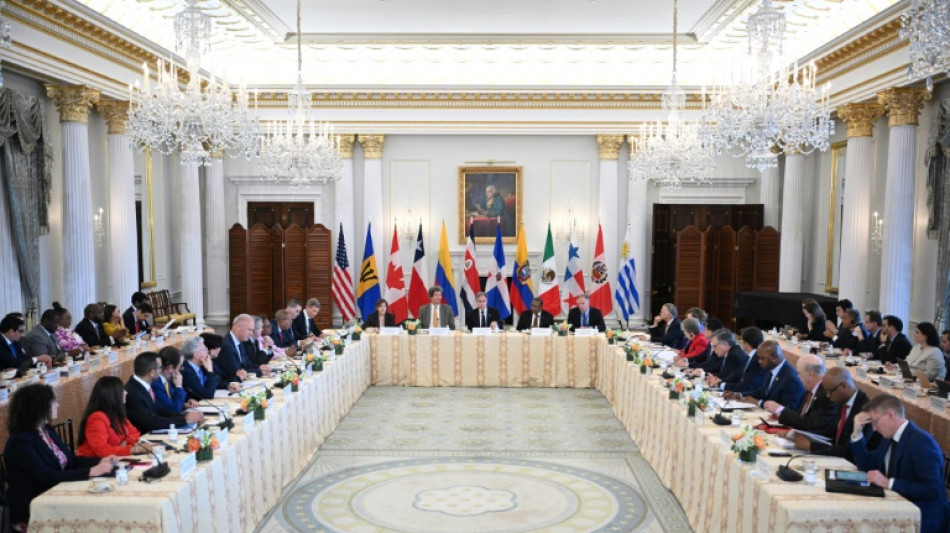
US unveils Americas-wide plan to boost semiconductor production / Photo: © AFP

 Argentina Abstains from UN Vote on Preventing Violence Against Women

 Arizona Approves $46 Million for Prison Healthcare Amid Federal Court Orders

 AVEVA and PETROJET Sign MoU for Digital Twin Projects in Egypt

 Daily Horoscope November 20, 2026: Astrological Predictions for All Signs

 Desire Under the Elms review - a horror show that bruises more than it moves

 Saudi PIF Retains Top Sovereign Wealth Fund Brand Title for Third Year
Secretary of State Antony Blinken unveiled Wednesday a new plan for countries in the Americas to boost production of semiconductors, which are critical just about everywhere in modern industry and a sector dominated by China.
"This initiative will turbocharge countries' capacity to assemble, to test and to package semiconductors, beginning with Mexico, Panama and Costa Rica," Blinken said as he opened a meeting with counterparts from 11 countries of Latin America.
Blinken said the Americas should play a bigger role in the global supply chain for semiconductors, which these days feature in everything from cell phones to refrigerators to weapons systems.
He also called for more investment in the Americas to promote the energy transition away from fossil fuels, and recalled that it is the previously stated goal of the 12 countries at this meeting to earmark $3 billion dollars for investment in infrastructure.
The ministerial meeting was being held as part of the Americas Partnership for Economic Prosperity, a program which President Joe Biden launched two years ago.
The next summit of this forum is scheduled for next year in Costa Rica.
The United States is working to compete, mainly through private investment, with massive amounts of money that China is pouring into infrastructure programs in Latin America. The US says this flow of money is leaving the host countries with excessive debt.
The United States wants to work with countries of the region to diversify semi- conductor supply chains so as to chip away at the world's dependence on China for this technology.
L.Maurer--VB

