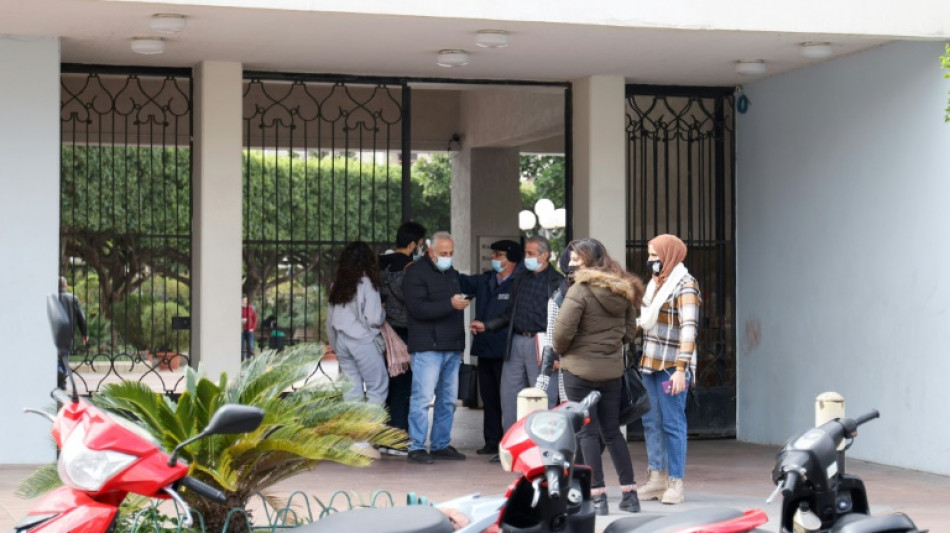
Lebanese students in limbo after fleeing Ukraine war / Photo: © AFP/File

 Packers beat Panthers 27-19 as Watson returns from hospital

 Affordable supermarket fashion offers designer-inspired autumn alternatives

 Judge throws out Australian mushroom killer's appeal, imposes harsher sentence

 Pelicans down Kings for first win of NBA season
 Tech firms take fresh hit as earnings misses fan AI fears

 Worcestershire leaders back renewed two-unitary council reorganisation

 India's animal megacentre vows reset after criticism

 Dodging fuel price hikes, Damascus drivers turn to electric cars

 Alvechurch manager praises resilience but seeks improvement after Anstey draw

 Crypto platform Binance confirms major hack, more than $2.5bn frozen

 Sports chiefs face losing battle to keep sport separate from politics

 Nvidia's web of AI bets: smart strategy or bubble risk?
 Carrick fights for Man Utd job, Arsenal face Liverpool test
 Apple TV crime drama Nocturne brings a Scandinavian thriller to Pennsylvania

 Charity crowdfunds millions to buy historic English estate

 'Diabolical' Halloween festivities banned in Honduran towns
 Everton boss Moyes backs 'club decision' to drop Grealish for Newcastle tie

 DoorDash shares rise as Instacart slips following $17 billion takeover plan

 Japanese star Forever Young goes for rare Breeders Cup Classic repeat

 Inter Miami stay third after 2-2 draw with FC Cincinnati
 Inkle buys Finally bookkeeping unit and expands India-based workforce

 PI Industries plans Indian launch of Pioxaniliprole insecticide this rabi season
 Small-market Brewers upend big-spenders as baseball lockout looms
 ISRO schedules NVS-03 navigation satellite launch for Friday

 Antonelli struck with illness ahead of Mexico GP

Lebanese university students who fled Ukraine are now struggling to complete their education back home, facing a precarious future as an unprecedented economic crisis crushes their country and their career prospects.
"Even war is better than being here," said 25-year-old Yasser Harb, who left Kyiv just two days before Russia invaded Ukraine on February 24.
The final-year medical student is now back in a country where electricity is scarce, public services are dysfunctional at best, the local currency has collapsed and living costs have skyrocketed.
He and fellow students are now battling to continue their studies remotely, while others face interruptions amid obstacles to transferring their enrolment.
Beirut said in late March that around 1,000 students had managed to leave Ukraine, long a destination for Lebanese seeking more affordable universities.
At least 340 of them have registered with Lebanon's education ministry to continue their studies.
But Education Minister Abbas Halabi said none of those registered had joined a private university in Lebanon, noting that most had arrived mid-semester.
He acknowledged that students "whose universities in Ukraine were bombed could not even recover their transcripts" to proceed with re-enrolment back home.
Bassam Badran, president of the country's only public university, the Lebanese University, said returning students would have to wait until the next academic year to enrol.
"They will have to pass the entrance examination at the start of the next school year," he said.
- 'No sense' -
Since returning, Harb has been struggling to complete his degree online from his family home in south Lebanon, as power cuts of up to 23 hours a day wreak havoc with his internet connection and his studies.
Even electricity from expensive private generators can be unstable and rarely covers the gaps.
"Slow internet makes it hard to understand what our teachers are saying and affects our grades," he told AFP, adding that he was thinking of returning to Ukraine once flights resume.
The capital Kyiv has managed to maintain electricity supply despite the ongoing conflict, and public transport has remained functional, with life steadily resuming a semblance of normalcy.
"In Kyiv, at least I had all the basic services," Harb said.
Samer Dakdouk, a fifth-year medical student at university in Kharkiv, is also struggling to adjust to studying from remote in Lebanon.
"Nothing is easy for us here," said the 23-year-old, who occasionally interns at a hospital in Beirut.
"Hospital positions are rare in Lebanon but practice is crucial," he said.
"Having an online medical degree makes no sense."
- 'Burden' -
Lebanon's economic crisis has spurred an exodus, with many of the country's educated youth, as well as medical professionals, among those flooding out.
Its higher education system, once a source of national pride, has also taken a battering.
According to the Arab Barometer survey published in April, nearly half of Lebanon's population is looking to leave.
Nathalie Deeb, 24, managed to flee Ukraine for Germany and continue her medical studies remotely from there.
"I didn't go back to Lebanon because Germany offers more opportunities and I don't want to burden my parents," she said.
Since 2019, the Lebanese pound has lost more than 90 percent of its value, and the monthly minimum wage -- once equivalent to $450 -- is now worth about $25.
Deeb said annual tuition fees at her university in Kyiv were around $4,400 per year -- five times less than re-enrolling at the average private Lebanese university.
The faculty of medicine at the public Lebanese University is saturated with applicants and only accepts a select few.
Deeb's father already had to sell their family home in Beirut and move back to his native village in south Lebanon so he could afford to pay for her studies in Ukraine.
She said she was "lucky" to have been able to stay in Europe instead of returning to Lebanon.
"Those who went back regret it," she said.
N.Fournier--BTB