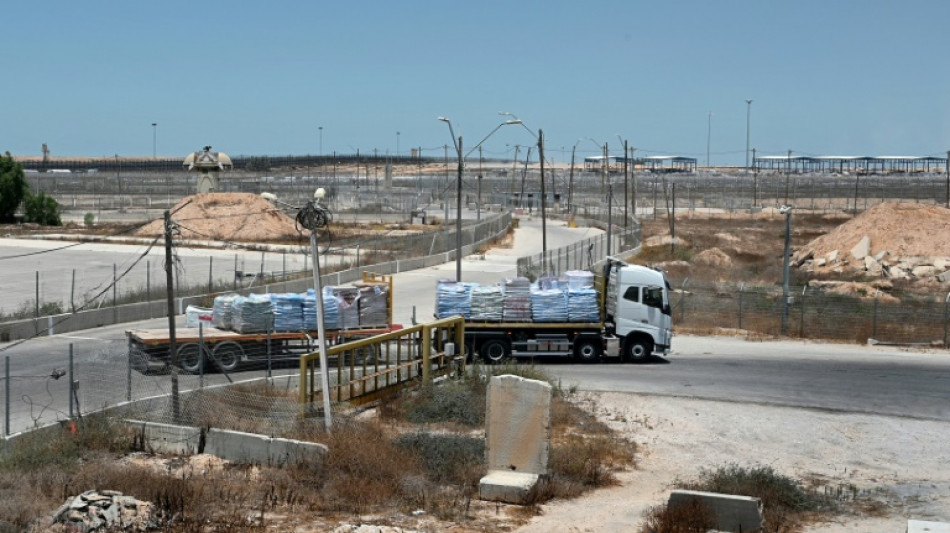
Commercial goods trucked into Gaza after aid logjams / Photo: © AFP

 Japan win marathon penalty shootout to set up South Korea gold-medal clash

 Djokovic grinds out opening-round win at China Open
 Northern Ireland police probe blockade of disputed parade

 UK PM Burnham reopens divisive debate on rejoining EU

 Man City future in doubt after guilty verdict

 'Do something,' begs Iranian woman after death sentence over protests
 China extends 52-year unbeaten record as Games organisers say sorry
 In Manchester, people say City scandal is 'shame for football'
 Stocks lacklustre as inflation data weighs on sentiment
 Israel-bound plane rerouted, pilots wounded in reported fight

 Truth commission on Sweden's Sami people seeks redress

 Energy costs spark inflation surges in France, Italy

 South Korea break China hearts to reach Asian Games football final

 Eala storms into Asian Games semi-finals to thrill adoring fans

 Turkey freezes ex-minister's assets as fund crisis grows
 What we know about the North Korean POW dispute

 Most equities rise after oil price plunge, US data in focus

 Polar oceans transformed as warming melts ice habitats: research

 Lost shark becomes viral star in South Korea

 Dangote to launch $16bn refinery in Kenya
 North Korean leader 'extremely obese': Seoul spy agency

 Yankees and pope-backed White Sox start MLB playoffs with wins
 Malaysia's ex-PM Mahathir in hospital for observation
 'No limits': Marathon world record holder Sawe chasing history
 Countdown begins to biggest-ever Rugby World Cup

As bombs thunder in Gaza, just across the border in southern Israel truck driver Itzik waits in a barbed-wire protected parking lot for his delivery to clear inspection into the hunger-stricken territory.
He lists a lorry loaded with Gaza-bound eggs, chicken, sesame, spices, tea and coffee, all destined for private markets that Palestinians and humanitarian workers describe as unaffordable.
Aid meanwhile languishes on the other side of the Kerem Shalom crossing, with Israel and the United Nations trading blame for the logjam, and Gazans suffering the resulting shortages.
Itzik, who declined to give his last name, said lately his cargo "mostly comes from the private sector".
He described a booming industry that keeps him running the route despite being branded a "traitor" to the Israeli war effort, efforts by right-wing activists to disrupt truck shipments to Gaza.
Israel maintains it lets in enough food to feed the entire Gazan population of 2.4 million. It accuses the United Nations of not effectively distributing aid stacked up on the other side of the checkpoint.
The UN, however, cites "insecurity, damaged roads, the breakdown of law and order, and access limitations" that hamper aid movement from Kerem Shalom to central Gaza.
Philippe Lazzarini, who heads the UN agency for Palestinian refugees, in May regretted that the private sector, though welcome, was "being prioritised" at Kerem Shalom.
The crossing has become the primary conduit for goods into Rafah since early May when Israeli troops seized the nearby Rafah crossing as they began ground operations against Hamas militants in the area.
Now Kerem Shalom is mostly being used to pump commercial supplies into the territory.
"Right now, the private sector is working better than the aid organisations," said Shimi Zuaretz, a spokesperson for COGAT, the Israeli defence ministry body overseeing Palestinian civilian affairs.
COGAT took journalists on a tour of the checkpoint on Wednesday, displaying crates stuffed with watermelons, cherries, tomatoes, oranges, potatoes and pulses.
Heaving open the gates of the remote desert compound, they allowed a parade of a dozen or so lorries to enter and load up the goods before departing for Gaza.
AFP was prevented from speaking to the Palestinian drivers by the Israeli soldiers leading the tour.
- Profiteering -
Funnelling supplies into Gaza was difficult even before the war, which began with Hamas's October 7 attacks on nearby Israeli communities and resulted in the deaths of more than 1,170 people, mostly civilians, according to an AFP tally of Israeli official figures.
Militants also took 251 hostages, 116 of whom remain in Gaza, including 42 the military says are dead.
Israel's retaliatory offensive has killed at least 38,295 people in Gaza, also mostly civilians, according to data from the health ministry in the Hamas-run territory.
After initially blocking all deliveries into Gaza, Israel reopened Kerem Shalom in December under international pressure.
An average of 250 trucks now cross the checkpoint daily according to COGAT, still well below UN figure of 500 aid and commercial trucks before the war.
Independent UN rights experts accused Israel on Tuesday of a "targeted starvation campaign" in the Gaza, where they said 34 Palestinians have died of malnutrition since October.
Israel denied the charge, and Elad Goren, of COGAT, countered that "the UN are not doing their job" distributing aid.
In the meantime, he said "the private sector continues to work."
Earlier in the war, the commercial pipelines dried up, leaving markets bare and a population dependent on aid, according to Juliette Touma, director of communications for UNRWA.
Now, she said the prioritisation of the private sector over the humanitarian has sown "chaos" between Palestinians with and without cash.
In Gaza, where everything is in short supply, profiteering is rife. Eggs now cost 120 shekels ($33), a box of baby formula 70 shekels and a packet of shampoo $26, the Norwegian Refugee Council said this week.
Those without money give what they have. In a territory where nearly the entire population has been displaced, that can mean the clothes or the jewellery they wear.
"To pump commercial supplies into Gaza this late in the war is a terrible idea," said Touma. "Gaza needs both commercial and humanitarian supplies, as it had before the war."
Desperation has fuelled a steady trade, with drivers to Kerem Shalom kept busy.
"I have worked as a driver here for more than 20 years," Itzik said. "I know my Gazan colleagues. I feel sorry for what is happening there."
D.Schlegel--VB