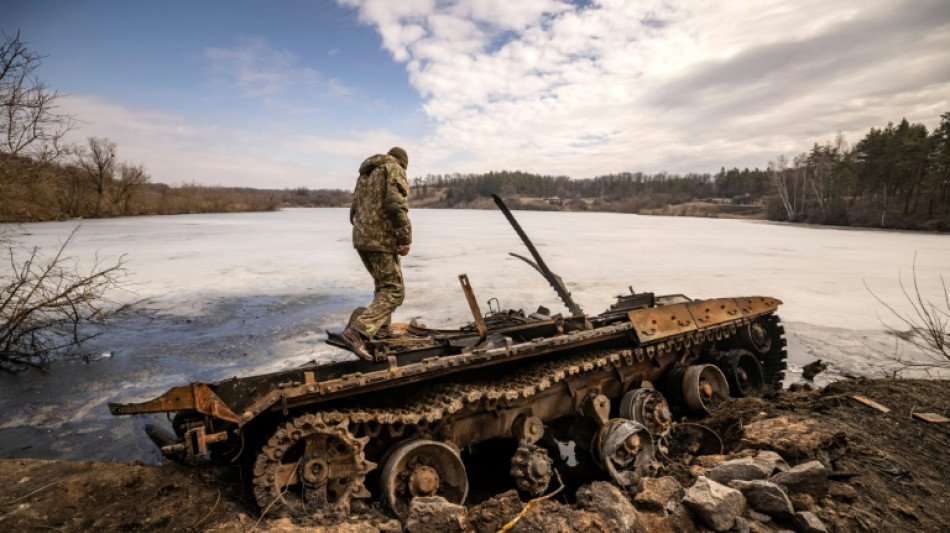
How far will Russia go in new phase of Ukraine assault? / Photo: © AFP/File

 Meta meets its own 'tobacco' moment in court

 Art or medicine? Japan's cosmetic tattoo artists in limbo
 Rybakina ousts Osaka to book Toronto semi-final against Gauff
 Colombia rescuers find woman alive as quake death toll passes 240
 Charges dropped against Bondi Beach attack hero

 Parched and desperate for rain, Kazakhstan turns to cloud-seeding
 The perfect storm that turbocharged Venezuela's twin quakes
 2.4 million girls banned from Afghan schools since Taliban return: UNESCO
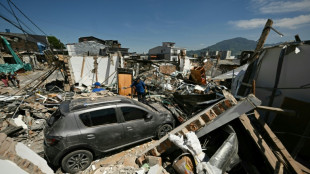 Colombians dig through rubble as quake death toll surpasses 240

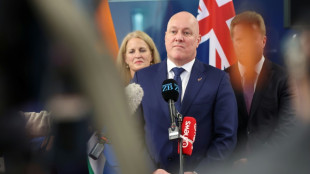 New Zealand's ruling party meets to decide PM Luxon's fate

 Total solar eclipse to spellbind Europe
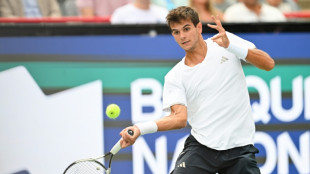 Jodar, Nakashima to make Masters semis debuts in Montreal

 Chilean veteran Sanchez signs with MLS club Montreal

 Cristiano Ronaldo marries long-term partner Georgina Rodriguez

 Oil prices higher, stocks mixed ahead of inflation report
 Jacobs into 100m final with eye on third title
 Eight-try New Zealand cruise to tour victory over Sharks

 Trump's secret plane swap triggers questions and confusion
 California calls Paramount's threat to leave state 'blackmail'

 PSG 'want to win everything', says Luis Enrique

 Barred from elections, Russia's anti-war party vows to fight on

 Jaissle states Newcastle ambition but urges patience

 NBA star Cooper Flagg trading card a slam dunk for lucky buyer
 ForumPay Expands Payment Infrastructure with New Card and Bank Transfer Acceptance Solution

 Oil prices higher, stocks flat ahead of inflation report

Two months after invading Ukraine, Russia says its aim is full control of the Donbas region in the east as well as the south of the country.
It is still unclear what military means Moscow will deploy in this "second phase" of the Ukraine campaign, and what medium and long-term objectives it is pursuing.
Russia appears to have learned some lessons in terms of targets and tactics from its difficulties during the first few weeks of the war, against an enemy it had clearly underestimated.
Russian troops are today present in a corridor of 200-250 kilometres (125-155 miles) inside Ukraine -- from the Sea of Azov to the outskirts of Kharkiv -- but don't have full control of the area.
- 'Full control' -
In March, the Russian army said it was focusing on the two Donbas regions, Donetsk and Lugansk where pro-Russian rebels have been active since 2014.
On Friday, Russian Major General Rustam Minnekaev was quoted as saying that "one of the tasks of the Russian army is to establish full control over the Donbas and southern Ukraine", adding this would provide "a land corridor to Crimea", the peninsula Russia annexed from Ukraine in 2014.
But this ambition brings challenges, according to Michel Goya, a former French army colonel.
"The deeper Russian forces go into Ukraine, the more vulnerable they are," he said on Twitter.
Pascal Ausseur, director of the FMES strategic studies institute, said the Russian army may well be hoping to establish an axis running from Kherson on the banks of the Dnipro River, to the city of the the same name to the north and then to Izyum in the east.
Experts no longer believe Russia has any designs on Ukraine's capital Kyiv, which appeared to be an early target of the campaign.
- 'Blitzkrieg didn't work' -
This is likely an outcome of its army's slow progress and massive losses of troops and equipment early in the war, which prompted a change in tactics.
"They realised that the Blitzkrieg option didn't work out," said Ausseur. "So they returned to the traditional Soviet bulldozer model: If you can't break the will of your enemies, you grind them down."
"They will Mariupol-ise the operation," Ausseur said, in reference to the southern port city that has been subjected to relentless Russian bombardment over the past two months, and whose inevitable fall is being delayed only by a small number of Ukrainian holdouts.
"It looks like the Russian military is simply pursuing a scorched earth approach, attempting to break the will of the Ukrainian military through the use of overwhelming force and indiscriminate shelling to force remaining civilians to flee," said Colin Clarke, senior research fellow at the Soufan Center, a think tank.
Some experts expect the Russian army to try to trap Ukrainian forces in pincer movements east of the Dnipro River.
To avoid encirclement, the defending Ukrainians may disperse into several fronts, Clarke said, in order to stretch Russian supply and communication lines. "That strategy has been successful so far," he said.
Western aid has been boosted in recent days, notably with the announcement of an $800-million military package by US President Joe Biden, specifically aimed at the struggle in the Donbas.
- 'Weeks or even months' -
But the clock is ticking. Armoured personnel vehicles "will take weeks or even months" to get to the Ukrainian army, according to Mark Cancian, a senior adviser at the Center for Strategic and International Studies (CSIS).
"Even if the vehicles come out of stocks already in Europe, they will require some servicing before they are ready for shipping," he said.
NATO countries have started supplying Ukraine with -- originally Soviet-developed -- S300 missile systems but, Ausseur noted, their deployment also takes time.
In the meantime, France said it was shipping Milan anti-tank weapons and Caesar canons to Ukraine.
But experts say Kyiv is still short of other advanced weapons, such as Howitzer canons.
Ukraine will need to establish a "dome of steel" to defend itself from air attack, said Ausseur.
- 'Need a shield' -
"They need a shield that makes the equation less favourable to the Russians," he said, adding that otherwise Russia could pursue air strikes for years.
Few observers now expect the conflict to be over soon.
"The emerging scenario is one of high-intensity bombings lasting several weeks, or maybe several months," Ausseur said.
Alexander Khramchikhin, of the Moscow-based Institute for Political and Military Analysis, said the fighting could even go on for years.
"Russia has so far achieved none of its objectives, and it's not easy to see how it will achieve them in the future," he told AFP.
P.Anderson--BTB