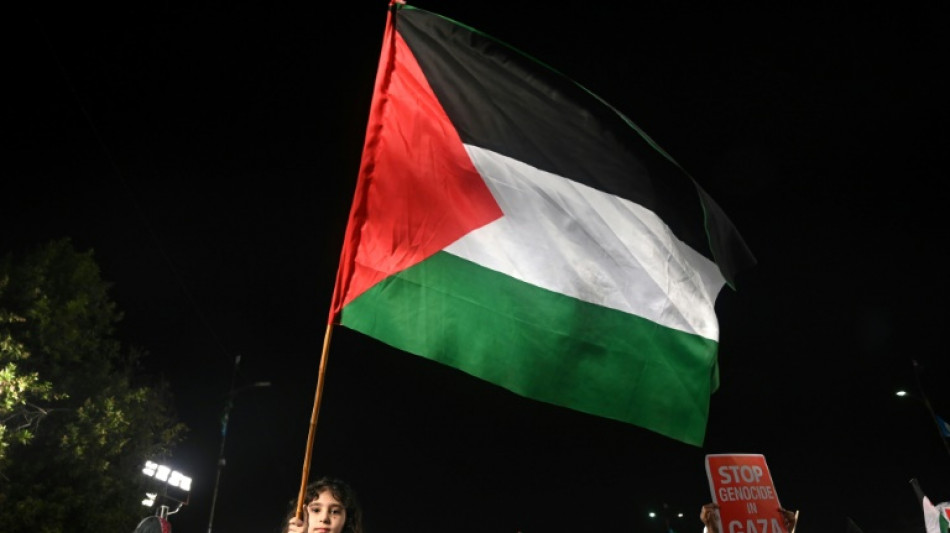
Which countries recognise Palestinian state? / Photo: © AFP/File

 Southampton boss Eckert given suspended ban over 'Spygate'

 Russia warns of 'false' information as second plague case reported
 IEA ready to release more oil reserves if necessary
 HSBC 'consults' over UK unit job cuts amid AI adoption
 UK court quashes five ex-traders' Libor rate rigging convictions
 XM Receives “Global Customer Experience Leader Award 2026” at the TrustFinance Performance Awards
 Stocks slide as oil climbs on Mideast flareup

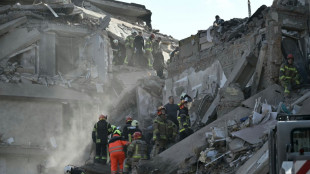 Heavy casualties in Ukraine after Russian strikes
 French wine harvest set to hit historic low
 Kyiv 'cannot agree' to EU membership limiting food exports: minister

 Arteta targets more Arsenal glory after signing new deal until 2030

 Russell hit with Singapore grid penalty for taking new power unit

 Spotify expands audiobooks to more than 180 markets

 French-Japanese duo wins chemistry Nobel for solving molecular 'mystery'

 England's Nations League surge helps heal World Cup wounds

 Mayor of opposition stronghold Izmir defects to Erdogan party
 Mertens beats Gauff to set up Swiatek clash at China Open

 Benin full of pride at role in Messi's last dance

 France suspends stun grenade use at student protests ahead of PM speech

 Indonesian court hears 'negligence' complaint against state over fires, haze

 Rubio in Greece to urge against Western civilisation 'decline'
 Micron workers at Taiwan plant vote in favour of strike
 In 'The Social Reckoning,' Jeremy Allen White takes on Facebook's 'frightening' ambition
 Chip industry activists call for South Korea to recognise cancer cases
 Famine-scarred southern Madagascar braces for El Nino
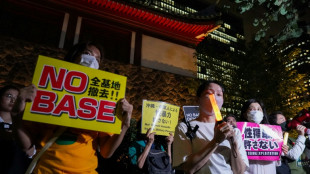
Israel's more than seven-month war in Gaza since the October 7 attack has revived a global push for Palestinians to be given a state of their own.
Norway, Spain and Ireland all announced plans on Wednesday to recognise a State of Palestine, breaking with the long-held position of Western powers that a Palestinian state can only come as part of a negotiated peace with Israel.
According to the Palestinian Authority, which has limited powers in parts of the occupied West Bank, 142 of the 193 member countries of the United Nations already recognise a State of Palestine.
They include many Middle Eastern, African and Asian countries, but not the United States, Canada, most of western Europe, Australia, Japan or South Korea.
In April, the United States used its veto at the UN Security Council to prevent a Palestinian bid to become a full UN member state.
Here is a quick recap of the Palestinians' quest for statehood:
- 1988: Arafat proclaims state -
On November 15, 1988, during the first Palestinian intifada, or uprising, Palestinian leader Yasser Arafat unilaterally proclaimed an independent Palestinian state with Jerusalem as its capital.
He made the announcement in Algiers, at a meeting of the exiled Palestinian National Council, which adopted the two-state solution as a goal, with independent Israeli and Palestinian states existing side by side.
Minutes later, Algeria became the first country to officially recognise an independent Palestinian state.
Within weeks, dozens of other countries, including much of the Arab world, India, Turkey, most of Africa and several central and eastern European countries had followed suit.
The next wave of recognitions came in late 2010 and early 2011, at a time of crisis in the Middle East peace process.
A host of South American countries including Argentina, Brazil and Chile answered calls by the Palestinians to endorse their statehood claims.
This came in response to Israel's decision to end a temporary ban on Jewish settlement building in the occupied West Bank.
- 2011-2012: UN recognition -
In 2011, with peace talks at a standstill, the Palestinians decided to push ahead with a campaign for full UN membership for a State of Palestine.
The quest failed but, in a groundbreaking move on October 31 of that year, the UN cultural agency UNESCO voted to accept the Palestinians as a full member.
The decision triggered a furious reaction from Israel and the United States, which suspended their funding of the Paris-based body.
They quit UNESCO outright in 2018, although the United States rejoined last year.
In November 2012, the Palestinian flag was raised for the first time at the United Nations in New York after the General Assembly overwhelmingly voted to upgrade the status of the Palestinians to "non-member observer state".
Three years later, the International Criminal Court also accepted Palestine as a state party.
- 2014: Sweden first in western Europe -
In 2014, Sweden, which has a large Palestinian community, became the first EU member in western Europe to recognise a Palestinian state.
The move followed months of almost daily clashes in Israeli-annexed east Jerusalem.
A state of Palestine had earlier been recognised by six other European countries -- Bulgaria, Cyprus, the Czech Republic, Hungary, Poland and Romania.
Israel reacted angrily to Stockholm's move, with then foreign minister Avigdor Lieberman telling the Swedes that "relations in the Middle East are a lot more complex than the self-assembly furniture of IKEA".
- 2024: New push in Europe -
Israel's relentless offensive in Gaza, which has left at least 35,647 people dead, according to the territory's health ministry, in retaliation for Hamas's killing of more than 1,170 people in Israel, has revived support in Europe for Palestinian statehood.
Norway, Spain and Ireland said they would recognise a Palestinian state by May 28, defying threats from Israel, which recalled its envoys from Ireland and Norway for discussions over the move.
Malta and Slovenia in March also expressed "readiness to recognise Palestine" when "the circumstances are right".
Australia recently too has floated the possibility of unilaterally endorsing Palestinian statehood.
President Emmanuel Macron has also said the question of recognising a Palestinian state without a negotiated peace is no longer "a taboo for France".
C.Koch--VB