Court rules UK government anti-protest powers unlawful / Photo: © AFP

 Rubio touts US power, calls on Europe to emerge from 'slumber'
 Trump says 'we don't think' Russian plague is bio-weapon
 Five children among 26 killed in Ukraine after Russian strikes

 Man City should 'accept' punishment for rule breaches, says Lineker
 US woman who survived botched execution is awake and speaking
 From 1800s to modern pharma: a Nobel-winning chemistry quest

 Southampton boss Eckert given suspended ban over 'Spygate'
 Russia warns of 'false' information as second plague case reported
 IEA ready to release more oil reserves if necessary
 HSBC 'consults' over UK unit job cuts amid AI adoption
 UK court quashes five ex-traders' Libor rate rigging convictions

 XM Receives “Global Customer Experience Leader Award 2026” at the TrustFinance Performance Awards

 Stocks slide as oil climbs on Mideast flareup
 Heavy casualties in Ukraine after Russian strikes
 French wine harvest set to hit historic low
 Kyiv 'cannot agree' to EU membership limiting food exports: minister

 Arteta targets more Arsenal glory after signing new deal until 2030

 Russell hit with Singapore grid penalty for taking new power unit

 Spotify expands audiobooks to more than 180 markets

 French-Japanese duo wins chemistry Nobel for solving molecular 'mystery'

 England's Nations League surge helps heal World Cup wounds

 Mayor of opposition stronghold Izmir defects to Erdogan party
 Mertens beats Gauff to set up Swiatek clash at China Open
 Benin full of pride at role in Messi's last dance

 France suspends stun grenade use at student protests ahead of PM speech

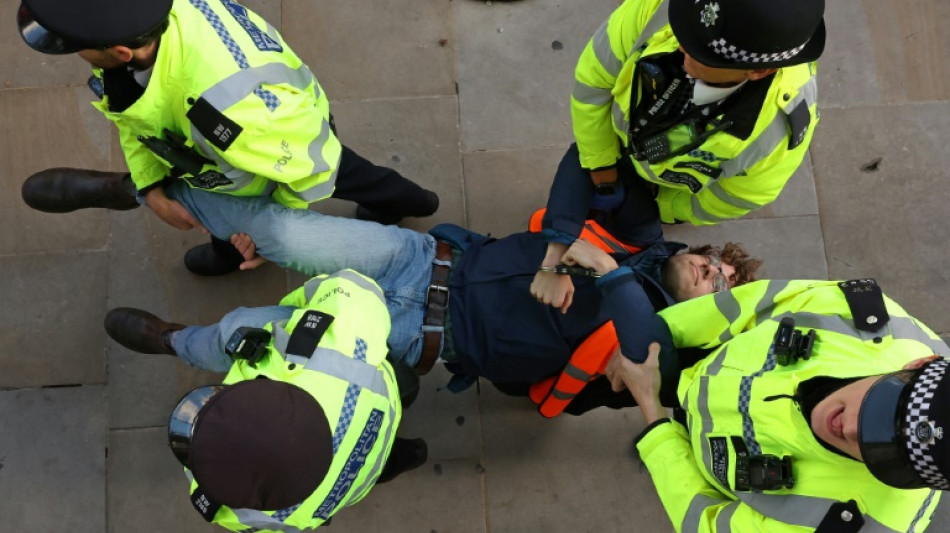
The UK government acted unlawfully by changing legislation to give police tougher powers to clamp down on street protests, judges ruled on Tuesday.
Civil liberties group Liberty brought a legal challenge to the amendments, which campaigners said gave police "almost unlimited" powers to restrict protests.
The changes were pushed through when outspoken right-winger Suella Braverman was home secretary. She had repeatedly promised to crack down on protesters using so-called "guerilla tactics".
That followed action, particularly by environmental groups such as Just Stop Oil and Extinction Rebellion, in which demonstrators glued or attached themselves to roads and buildings.
Liberty's challenge centred on powers conferred by parliament to the home secretary to amend existing laws about when police could intervene during protests to prevent "serious" wider disruption.
Two judges ruled that lawmakers had not intended to lower the threshold for police action against protesters. But the amendments allowed police to target anything considered a "more than minor" disturbance.
The government only consulted law enforcement agencies before enacting the changes, the High Court ruling added.
"For the procedure to be fair and balanced, government needed at least to obtain the views of those who might be adversely affected by the proposed measures," the judges added.
Liberty called the judgment "a victory for democracy" and said it "sets down an important marker that the government cannot just do what it wants".
Braverman, who was sacked for comments on immigration, initially tried to give police greater powers via a parliamentary vote on a new public order act.
Lawmakers rejected those proposals, and a few months later she used secondary legislation, which allows a minister to amend an existing law, to secure the powers "through the back door", Liberty said.
The government has indicated that it will appeal the ruling, which came as its adviser on political violence on Tuesday recommended sweeping measures to curb protests.
In a report, former Labour party MP John Woodcock proposed making organisers pay towards the policing of demonstrations and making it easier for members of the public to claim damages against activist groups that cause disruption.
He also recommended a blanket ban on face coverings at protests and buffer zones around MPs' constituency offices so demonstrations cannot be held there.
Current Home Secretary James Cleverly said in a written statement to parliament that he would carefully consider the proposals, including "amending the threshold to prevent protests from going ahead".
Protests have become a hot political issue in Britain with right-wing MPs regularly criticising massive pro-Palestinian demonstrations against the Israel-Hamas war.
Prime Minister Rishi Sunak intends to put security and combating perceived extremism at the heart of his Conservative party's general election campaign later this year.
L.Wyss--VB