UK report finds cover-up of decades-long infected blood scandal / Photo: © AFP

 After botched execution, US woman was nearly taken off life support before revival
 Searing AIDS drama 'Elsinore' opens London film festival

 Evicted pensioner who sparked Spain housing protests dies: tenant union

 Golf star Rahm quitting LIV tour over 'unacceptable' terms
 Thousands march fearing return of a Bolsonaro presidency in Brazil
 French PM denies police ordered to confront student protesters
 Rubio touts US power, calls on Europe to emerge from 'slumber'

 Trump says 'we don't think' Russian plague is bio-weapon

 Five children among 26 killed in Ukraine after Russian strikes

 Man City should 'accept' punishment for rule breaches, says Lineker

 US woman who survived botched execution is awake and speaking
 From 1800s to modern pharma: a Nobel-winning chemistry quest

 Southampton boss Eckert given suspended ban over 'Spygate'
 Russia warns of 'false' information as second plague case reported

 IEA ready to release more oil reserves if necessary
 HSBC 'consults' over UK unit job cuts amid AI adoption
 UK court quashes five ex-traders' Libor rate rigging convictions
 XM Receives “Global Customer Experience Leader Award 2026” at the TrustFinance Performance Awards
 Stocks slide as oil climbs on Mideast flareup
 Heavy casualties in Ukraine after Russian strikes
 French wine harvest set to hit historic low

 Kyiv 'cannot agree' to EU membership limiting food exports: minister

 Arteta targets more Arsenal glory after signing new deal until 2030

 Russell hit with Singapore grid penalty for taking new power unit

 Spotify expands audiobooks to more than 180 markets

A decades-long UK scandal in which thousands of people died after being treated with infected blood was covered up and largely could have been avoided, according to a bombshell report published Monday.
More than 30,000 people were infected with viruses such as HIV and hepatitis after being given contaminated blood in Britain between the 1970s and early 1990s, the Infected Blood Inquiry concluded.
Victims included those needing blood transfusions for accidents and in surgery, and those suffering from blood disorders such as haemophilia who were treated with donated blood plasma products.
Some 3,000 of them died, and more will follow, in what has been described as the biggest treatment disaster in the eight-decade history of the state-run National Health Service (NHS).
In some instances, children with bleeding disorders were treated as "objects for research". Many went on to develop and die from HIV and hepatitis.
The long-awaited report, running to more than 2,500 pages, laid bare a "catalogue of failures" with "catastrophic" consequences for victims and their loved ones.
"I have to report that it could largely, though not entirely, have been avoided," concluded its author, judge Brian Langstaff.
His team found that successive governments and health professionals failed to mitigate risks despite it being apparent by the early 1980s that the cause of AIDS could be transmitted by blood.
Blood donors were not screened properly and blood products were imported from abroad, including from the United States where drug users and prisoners were used for donations.
Too many transfusions were also given when they were not necessarily needed, the report added.
There were even attempts to conceal the scandal, including evidence that officials in the health department destroyed documents in 1993.
"Viewing the response of the NHS and of government overall, the answer to the question, 'Was there a cover-up?' is that there has been," the report stated.
"Not in the sense of a handful of people plotting in an orchestrated conspiracy to mislead, but in a way that was more subtle, more pervasive and more chilling in its implications.
- 'Vindicated' -
"In this way there has been a hiding of much of the truth," it added.
On top of the 3,000 who died, many more were left with lifelong health problems.
Langstaff said that "the scale of what happened is horrifying" and said people's suffering had been compounded by repeated denials and false assurances that they had received good treatment.
When victims were told the truth, sometimes years later, this was sometimes done in "insensitive" and "inappropriate" ways.
"What I have found is that disaster was no accident. People put their trust in doctors and the government to keep them safe and that trust was betrayed," Langstaff told reporters.
He recommended that victims now received compensation. The government is expected to announced a package worth about 10 billion pounds (12 billion dollars) on Tuesday.
Prime Minister Rishi Sunak is expected to express regret when he speaks in parliament later on Monday.
Speaking ahead of the inquiry, a government spokesman said: "This was an appalling tragedy that never should have happened. We are clear that justice needs to be done and swiftly."
Former prime minister Theresa May launched the inquiry -- one of the country's largest -- in 2017.
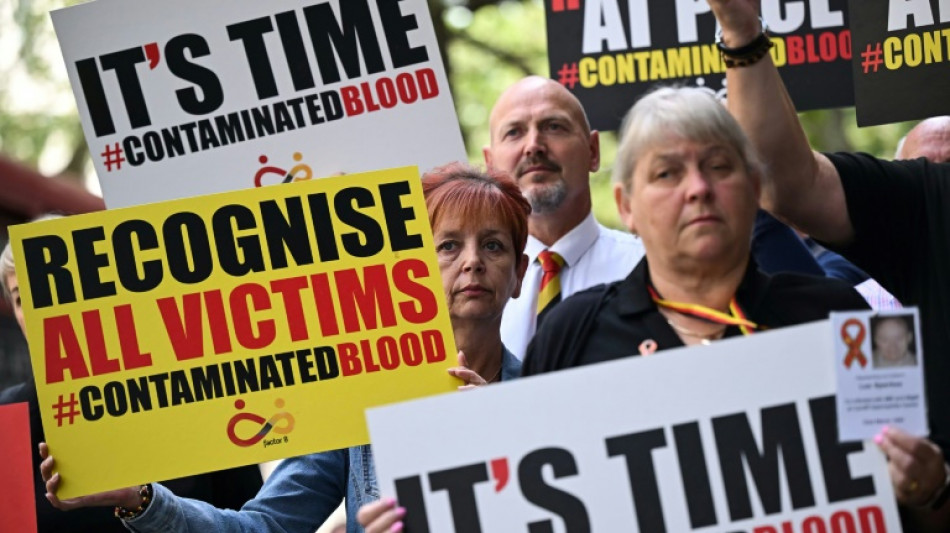
Campaigners hailed the report as the culmination of a decades-long struggle but noted that it came too late for many of the victims who will never see justice.
Andy Evans, chairman of the Tainted Blood campaign group, described the report as "momentous" and that he felt "validated and vindicated".
"We have been gaslit for generations... Sometimes we felt like we were shouting into the wind during the last 40 years," he told reporters.
R.Fischer--VB