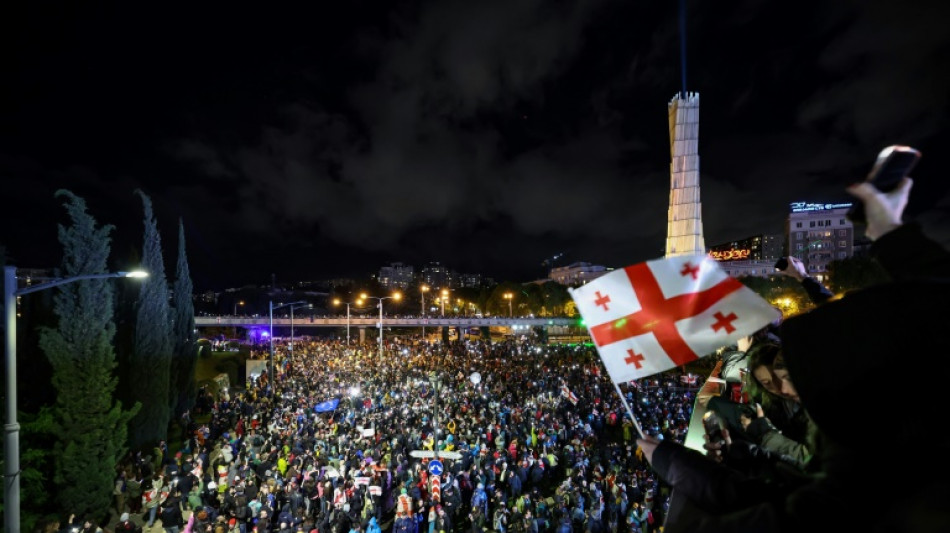
Russian exiles in Georgia inspired by protests but scared / Photo: © AFP

 The growing protests against India's poll body - and PM Modi
 Stocks fall further as oil spike fans fresh inflation worries
 Bad COP, worse COP? EU tempers hopes for UN climate summit
 Rookie Henry named in Wallabies midfield to face All Blacks
 Housing crisis set to dominate Spain's snap election
 Gas, health care, utilities: high costs squeeze US midterm voters
 New Zealand Rugby seeks injunction over PNG Chiefs name
 Samsung expects 780% quarterly operating profit jump on AI boom
 Guardians survive with 9-3 win over White Sox
 Saudi Arabia says 3 dead at airports after Houthis claim attacks
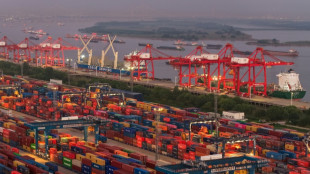
 Stocks slide as oil sees volatile trading day over Iran war fears
 Microsoft pushes AI vision with new, expensive Surface laptop
 Five children among 28 killed in Russian strikes on Ukraine

 Odell Beckham Jr signs with Minnesota Vikings
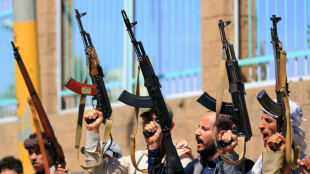
 Saudi Arabia says three dead at airports after Houthis claim attacks
 Trump plans to turn Florida golf course into presidential retreat
 WHO says cannot conduct full risk assessment on Russia plague reports
 After botched execution, US woman is awake and shackled to bed
 New Zealand fly-half Mo'unga ruled out of Australia Tests
 Protests in major Turkish city after mayor defects to Erdogan party
 Climate change strips island's title of largest penguin colony: study
 Rubio says West must choose between national power or decline
 Russia's plague scare: What we know
 French luxury giant to fund redevelopment of two Paris streets: city hall
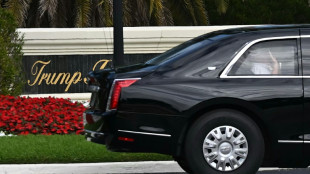 Trump wants to turn Florida golf course into presidential retreat
Stood in the middle of a Tblisi demonstration, Russian emigre Ivan looked on with a tinge of nostalgia as thousands of Georgians protested against a highly-controversial law targeting NGOs and the media.
The 37-year-old has seen such legislation before.
Ivan fled neighbouring Russia where a stricter version of Georgia's law has made it dangerous to publically criticise President Vladimir Putin and his leadership.
Like thousands of Russians, Ivan left in the aftermath of the Kremlin's 2022 invasion of Ukraine, which ushered in a new era of repression.
Now living in exile in Tbilisi, anti-Kremlin Russians have watched weeks of mass protests against the "foreign influence" law with a mix of admiration, worry -- and some jealousy.
"I know exactly what the consequences of this law are," said Ivan, who refused to give his surname, fearing for his relatives back home.
Ivan and his friend Sergei, an ethnic-Ukrainian raised in Russia, took part in the protest, where Georgians chanted "No to Russian law!".
"I sometimes get overcome by jealousy because people did not come out like this in Russia," said Sergei, also in his 30s.
"And then these laws were unfortunately adopted. We can see what is happening, how they are being used," he said.
In Russia, new "foreign agents" are declared on a weekly basis. Most who dare speak out against Putin get the label and go into exile.
"I don't want Georgia to become another Russia or Belarus," Sergei said.
- 'Our Russian scenario' -
President Salome Zurabishvili on Saturday vetoed Georgia's "foreign influence" law that was voted through parliament this week by the ruling Georgia Dream party.
The bill requires NGOs and media outlets that receive more than 20 percent of their funding from abroad to register as bodies "pursuing the interests of a foreign power."
The European Union has said the law threatens Georgia's ambitions to join the block and Zurabishvili called the legislation "Russian in its essence". But Georgia Dream has a majority in parliament to overcome her veto.
Some Russians have joined Georgians in the street, while others support them but prefer not to attend.
Ivan said the atmosphere made him "nostalgic" for Moscow protests in 2017 and 2019, mostly organised by late opposition leader Alexei Navalny, who died in a Russian Arctic prison in February.
Demonstrations are now almost impossible in Russia.
While Ivan said he felt "inspired", he worried that "it can all change with the snap of a finger".
He feared the protests could die down as people tire of fighting for their rights -- as slowly happened in Russia.
Russia adopted its "foreign agent" law in 2012 and has since hardened it several times.
"I understood that our Russian scenario was repeating itself," said Maria Makarova.
She worked for Navalny's office in the Urals city of Chelyabinsk, but fled Russia in January 2022 after his organisation was labelled extremist.
She arrived in the Georgian capital several weeks before a flood of Russians triggered by the Ukraine invasion.
"It was very scary when I first saw the foreign agent bill here," she said, from an apartment she shares with two other female Russian opposition activists.
"The worst thing is that the motives are the same," she added.
Georgian authorities have accused government critics of taking orders from abroad and NGOs of plotting a revolution.
For Russians in Tbilisi, this brings back memories of how it all started at home.
"I saw how my country slowly slipped into dictatorship, how the screws were gradually tightened," Makarova said.
- 'Permanent fear' -
Other Russians still could not fathom the relaxed atmosphere of the demonstrations -- compared to protests in their homeland.
"In other countries, where protests work and you are around other people, you get overcome by adrenaline," said 25-year-old Maria.
She refused to give her last name, saying her mother had problems at work for attending opposition rallies.
"In Russia, it is permanent fear," she said, adding nervously: "That fear is periodically broken by euphoria that you did not get arrested or beaten."
The arrival of Russian emigres has changed Tbilisi.
There is some tension, with graffiti seen around the city reading: "Russians go home".
"We're at the same time brothers and enemies for them," said a 26-year-old Russian artist who changed his name to Grey.
He felt relieved not to be in Russia, where "you always look over your shoulder".
But he worried there was a change in the air in the Caucasus country: "With self-expression, recently you have been able to feel our Russian vibe."
He said it was critically important for Georgia to still have a political discussion and the right to protest -- unlike in Russia.
"So that you don't end up in a swamp where there is nothing you can do."
L.Meier--VB