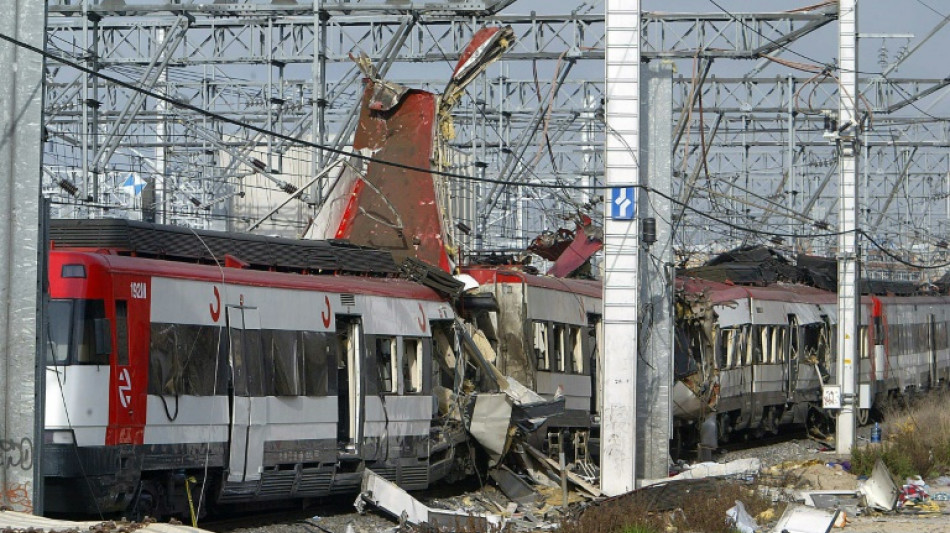
Two decades after Madrid attacks, jihadist threat to Spain changed / Photo: © AFP/File

 Musk backs SpaceX-Tesla merger as rocket firm turns profit

 Zelensky, US hail 'productive' talks to end Trump feud

 'Unbelievable' Foden back in the groove with treble in Man City rout

 Pistons rally to beat Celtics in NBA 2026-27 season opener

 PSG late show downs Barca in Champions League, Liverpool fight back

 Liverpool strike back to beat Villarreal in seven-goal thriller

 Dow boosted as markets rotate from tech shares

 Zelensky hails resumption of US advance warning of strikes on Ukraine

 Carrick says only wins can ease doubts over Man Utd future

 Top NBA Draft pick Dybantsa to miss opener with ankle sprain

 Italy sends troops, toughens security laws after Milan clashes

 Alberta separatists vow to fight on, risking turmoil for Canada

 Two men re-arrested for suspected spying for Iran in airbase scare: UK police

 Guatemalan man gets 30 years for truck smuggling deaths of 53 migrants

 'Clayface' gets under the skin of the superhero genre

 Zelensky, US envoys hold Oslo talks as Ukraine claims US missile holdup

 All-rounder Minhas stars as Pakistan crush England in tri-series

 Bavuma hits 179, Rabada strikes as South Africa dominate

 Allrounder Minhas stars as Pakistan crush England in tri-series

 Albania PM blames 'hybrid war' for week of unrest

 Bavuma hits 179 to lead South African fightback

 Solid GM results overshadowed by latest jump in commodity costs

 Houthi attacks undermine Saudi Arabia's economic ambitions

 French PM vows 'massive' police deployment for new demonstrations

 Power outage hits Google Cloud services, disrupting UK banks

Twenty years ago, a large, well-organised terror cell planned and staged the deadly Madrid train bombings, but today the jihadist threat facing Spain comes from lone wolves and small self-radicalised groups.
On March 11, 2004, 10 bombs were placed on four suburban trains heading for the capital's Atocha station.
They exploded within minutes of each other, killing 192 people and injuring nearly 2,000 in Europe's worst jihadist attack.
The attacks were carried out by a large cell made up mainly of first-generation Moroccan immigrants.
Three weeks later, seven suspected members of the cell blew themselves up when police surrounded the place where they were hiding on the outskirts of Madrid.
Another 18, mostly Moroccans but also several Spaniards, a Syrian and an Egyptian, were jailed over the attacks.
Two decades on, Spain's latest annual national security report found that "the greatest (jihadist) threat" facing Spain and the West is posed by "lone wolf attackers and self-radicalised cells".
It was now "more difficult to carry out a complex act of terror in Spain" given that the capacity of the Islamic State (IS) group and Al Qaeda to stage such attacks in Europe "has decreased considerably".
Even so, Spain remains at the second highest of its five levels of alert.
- 'Individual, emotional' jihad -
Spain's last major attack, in 2017, left 16 dead in Barcelona and the nearby seaside town of Cambrils.
But the most recent jihad-inspired violence were three individual operations in 2018, 2019 and 2023, which claimed two lives.
Each attack appeared to be motivated by an outburst of madness, mental health issues or revenge, with barely any advance preparation. None of them involved the use of guns.
"We're seeing a more individual, emotional approach to jihad," said Carola Garcia-Calvo, senior researcher for radicalisation and global terrorism at Madrid's Real Instituto Elcano think tank.
"But at the end of the day, it is still used... to justify acts carried out in line with the directives of jihadist groups," she told AFP.
"We must not drop our guard, because one of the characteristics of the global jihadist movement and its inherent terrorist threat is its huge capacity to mutate and adapt to new contexts," she said.
And a new mobilising element had emerged in the last few months with the Israel-Hamas war, she added. It was playing out in "a very sensitive area".
Fernando Reinares, a jihadism expert who wrote three books about the Madrid train bombings said that for Spain, the threat remained "considerable", speaking during a roundtable hosted by the Real Instituto Elcano last week.
Spain, he pointed out, was "among the three European countries that systematically carried out the most anti-jihad terror operations and arrested most jihadist suspects".
- More than 1,000 arrests -
At the time of the 2004 attacks, Spain was also dealing with the threat posed by ETA, the armed separatist group that laid down its weapons in 2011 and disbanded seven years later.
That allowed the security forces to focus their attention on Islamic radicalism. In the two decades since the train bombings, Spain has arrested 1,047 suspects in 408 operations, official figures show.
And during that period, the profile of the would-be jihadist has changed. They tend to be younger, often born in Spain and are in contact with fellow extremists online rather than in person.
"Firstly, those who are radicalised are younger," wrote Alvaro Vicente, an analyst with the Real Instituto Elcano think tank.
"And the under-18s are the only demographic that has grown among jihad militants over the last decade," he added.
"Secondly, virtual spaces have been established as the main place where (radicalisation) happens."
K.Hofmann--VB