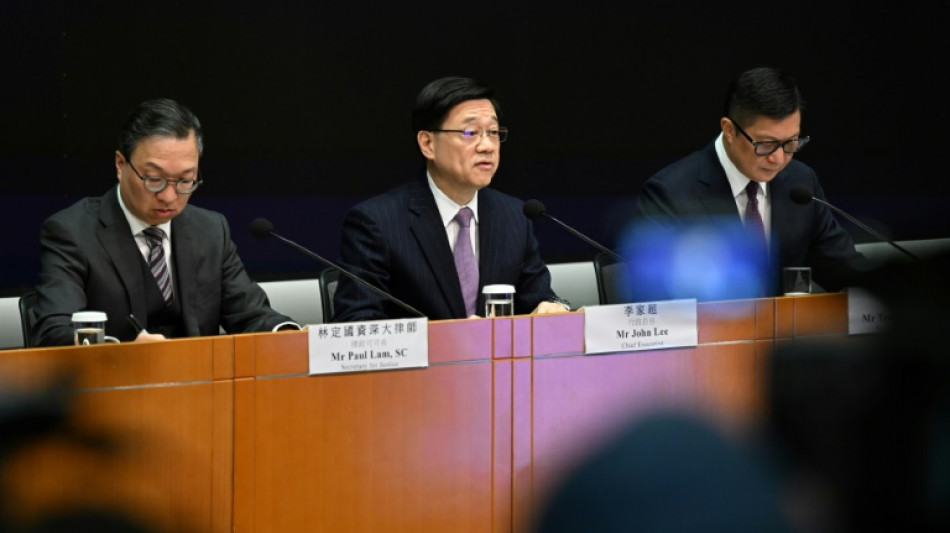
New Hong Kong national security law to add five crimes / Photo: © AFP

 QNB expands cross-border funding for AI and digital infrastructure

 France's Le Pen launches presidential bid vowing to restore 'rule of law'

 Qatar Charity delivers Braille Qurans to blind readers in Kosovo and Albania
 Houthis say attacked Riyadh airport hours after flights resume

 Monaco hold Lille as Rennes go top of Ligue 1

 Thousands gather in Prague to protest licence fee plans

 Pease spins to floor gold as US tops gymnastics medal table

 Marchant back in England training squad ahead of Nations Championship fixtures

 French skater Siao Him Fa soars to victory in season-opener at home

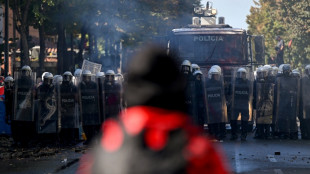 Embattled Albanian PM vows fines for violent protesters

 Steelers top Saints in NFL's first regular-season game in Paris

 Carrick unsure over Man Utd future after Bournemouth loss

 2027 Dakar Rally to be moved from Saudi Arabia

 Man Utd battered by Bournemouth to leave Carrick on the brink

 Storms batter Europe hitting power supplies, flights and phones

 Inter rally late to down Fiorentina and regain Serie A lead

 UDST opens Fall 2027 admissions to students in Qatar and abroad

 Le Pen begins presidential campaign after violent protests across France

 Adan Hospital launches catheter-based tricuspid valve replacement programme

 KIB Group nine-month profit rises 30% to KD 26.6 million

 Ladakh declared India’s first fully organic union territory

 J&K Bank raises accident cover for government employees to ₹1 crore

 Technical outlook diverges for Bharti Airtel, PFC, REC and Alkyl Amines

 Insurance deductibles and no-claim bonuses require a careful claims decision

 Poland’s WB Group plans $100 million India investment for drone production

Hong Kong will create its own national security law "as soon as possible", city leader John Lee said Tuesday, adding insurrection and other crimes not covered by existing legislation imposed by Beijing four years ago.
Massive pro-democracy protests rocked the finance hub in 2019, bringing hundreds of thousands of people to the streets to call for greater freedoms.
In response, Beijing imposed a national security law to punish four major crimes -- secession, subversion, terrorism and collusion with foreign forces -- with sentences ranging up to life in prison.
Officials on Tuesday said Hong Kong's security law -- mandated by Article 23 of the city's mini-constitution -- will cover five offenses: treason, insurrection, espionage, destructive activities endangering national security, and external interference.
"While we society as a whole looks calm and very safe, we still have to watch out for potential sabotage and undercurrents that try to create troubles, particularly some of the independent Hong Kong ideas that are still embedded in some people's minds," Lee told a press conference.
"The threats to national security are real, we have experienced them and suffered from them badly... we don't want to go through that painful experience again," he said, adding that "some foreign agents may still be active in Hong Kong".
"I must stress that the Basic Law Article 23 legislation must be done... as soon as possible," Lee said, noting the city had waited 26 years to make it a reality.
Lee said the consultation process for the law -- which runs until the end of February -- would be "open", with the document published online and the government planning to discuss it with local and foreign groups.
He also said he anticipated "badmouthing" of the new law, while insisting it would soon dissipate.
"When people see that this law will bring security and stability, they will love it," he said.
- 'Put a full stop' -
Since the British handed Hong Kong back to China in 1997, the city has been under a "one country, two systems" regime, in which the legal and court structures are separate from the mainland.
Under its mini-constitution, known as the Basic Law, Hong Kong is required to enact a law combating seven security-related crimes, including treason and espionage.
The first legislative attempt in 2003 was shelved after half a million Hong Kongers took to the streets to protest the move.
Critics of the existing national security law have said it has affected Hong Kong's status as an international hub since its enactment in 2020, pointing to an ongoing talent drain as foreign companies reconsider the city as its Asia base.
The law's expansive reach has also had chilling effects, observers say -- quietening Hong Kong's once-vibrant civil society space and shuttering news outlets and radio programmes.
But Lee downplayed the law's impact, pointing to an increase in the number of foreign and mainland companies choosing to open in Hong Kong.
"I am very confident the earlier we finish enacting Article 23, what has been troubling us for over 26 years, we can put a full stop to it and we can focus comprehensively on economic development," he said.
He added that law would not send arrested people to mainland China -- a hot topic for Hong Kongers as it was an extradition bill proposed in 2019 that sparked the massive pro-democracy protests.
"The law we are legislating will have no element at all about sending any arrested persons in Hong Kong to the mainland. So that is very clear," he said.
Since Beijing's law was enacted in 2020, 290 people have been arrested on national security grounds -- including dozens of the city's prominent elected politicians, democracy activists, rights lawyers, unionists and journalists.
More than 30 have been convicted under the existing law, while dozens have been held in pre-trial detention for over two years.
T.Egger--VB