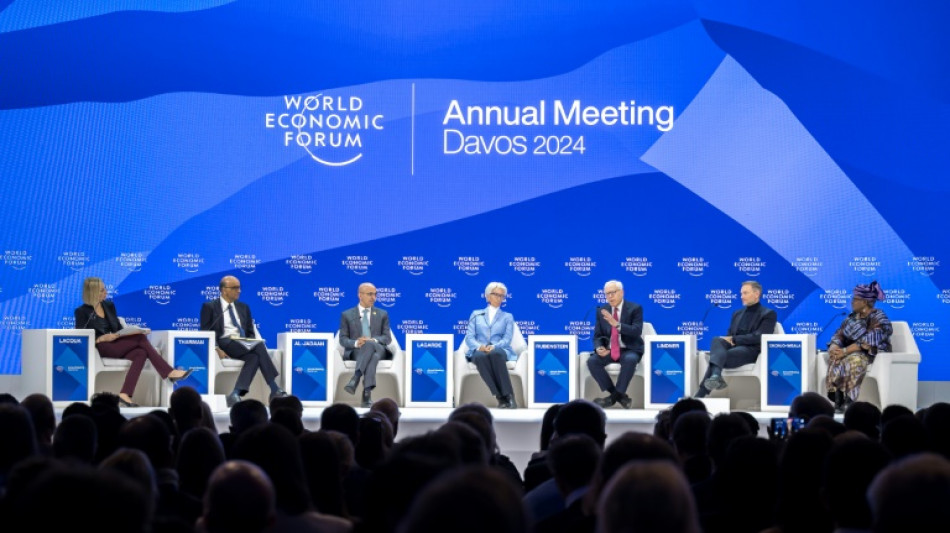
Davos free-trade champions fret over war, climate / Photo: © AFP

 Germany, EU, stable investment stops despite upheaval: Merz

 China brands drop Mbappe for 'offending national sentiments'
 India orders evacuations as Cyclone Arnab looms

 Dutch broadcaster pulls out of Eurovision over Israel 'sensitivities'

 Critical coal inventories affect nearly half of India’s domestic power plants
 FCNR(B) deposit drive puts sharper margin pressure on private banks

 Noel Tata requests records of September 17 Tata Sons board meeting

 Reparations calls to dog King Charles's tough Caribbean trip

 Global rates and foreign outflows remain key risks for Indian markets
 Neha Nagar says ₹3 crore can fund retirement with disciplined planning

 Vikas Satija says steady SIP flows shielded Indian equities from deeper losses

 Brewers rout Rays to reach brink of World Series sweep

 Mbappe dropped by Chinese brands for 'offending national sentiments'

 Kuwait exhibition presents Ukraine’s Islamic heritage and cultural ties

 Tech firms track Wall St rally on mixed day for Asian markets
 Jay-Z to perform at Super Bowl LXI halftime show: NFL

 Climate-threatened Fijian utopia rejects calls to relocate

 Israel to give verdict on Netanyahu in pivotal election

 $1m bounties, dawn arrests: Trump presses voter fraud campaign

 Gasping for air: Borneo residents struggle as island burns
 Doha exhibition charts a millennium of Chinese maritime ceramics trade
 New Zealand ex-PM Ardern to teach leadership in Sydney

 Ballon d'Or 'beyond wildest dreams' but Kane has plenty more to prove

 No envy, no secrets: How Spain's Gipuzkoa became football coaching hotbed
 South Korea economy grows three times faster than expected in Q3

After Covid and the war in Ukraine, free-trade boosters in Davos fretted over a new bout of turmoil in global supply chains due to rising geopolitical frictions.
The Israel-Hamas conflict, Yemeni rebel attacking ships in the Red Sea and tensions over Taiwan weighed on political and business elites at the five-day meeting of the World Economic Forum, which wrapped up Friday.
"There are geopolitical dynamics that are on our minds with respect to obviously the potential disruption of supply chains," Francesco Ceccato, CEO of Barclays Europe, told AFP on the sidelines of the WEF.
"We thought we had normalised those after Covid. Clearly, that's a little bit more precarious after ... what is happening every day in the Red Sea," he said.
Before Hamas's attack on Israel in October, the World Trade Organization had forecast global trade growth of 3.3 percent, an improvement from 0.8 percent in 2023.
But WTO chief Ngozi Okonjo-Iweala told the forum this week that she was now "less optimistic" about world trade in 2024 due to "worsening geopolitical tensions".
She added, however, that it would be "much better than what we saw in 2023. Unless a major war breaks out, then all bets are off."
- Disruptions for 'few months' -
The Red Sea route carries about 12 percent of global maritime trade, but the attacks have prompted many companies to take a massive and costly detour around the southern tip of Africa.
Iran-backed Huthi rebels in Yemen say they are targetting Israel-linked ships in protest over the war in Gaza.
US and UK military forces have launched a series of strikes against rebel sites in Yemen.
The Huthis have "changed global trade and global shipping costs," said Karen Harris, an economist at the consulting firm Bain & Co.
Vincent Clerc, the CEO of Danish shipping giant Maersk, said the the conflict will probably disrupt supply chains "for a few months at least. Hopefully less, but it could be also longer because it's so unpredictable".
Automakers Tesla and Volvo were forced to temporarily suspend some production in Europe due to a shortage of parts.
Qatar's prime minister, Sheikh Mohammed bin Abdulrahman Al Thani, told the Davos conference that shipments of liquefied natural gas "will be affected" by the Red Sea tensions.
- Taiwan tensions -
There are concerns along other major trade routes.
Taiwan's presidential election last weekend renewed US-China tensions over the democratic island, which China considers a part of its territory that must be brought back under its control, by force if necessary.
Speaking in Davos, US Secretary of State Antony Blinken recalled that a huge amount of commerce flows through the Taiwan Strait.
"If that were to be disrupted, it would affect the entire planet. And it's about the last thing we need, especially coming back from Covid," Blinken said.
Taiwan itself is a major producer of semiconductors, the microchips that are vital for a range of products from smartphones to cars.
"Any disruption in the flow of that product is going to be, again, a watch item or a concern," Ceccato said.
- Green an tech trade spats -
Microchips are already at the heart of a trade spat between Washington and Beijing as the United States has tightened export curbs on the technology over national security concerns.
China is also squabbling with the European Union over the bloc's probe into Chinese electric car subsidies.
Chinese Premier Li Qiang took the podium on Wednesday to slam what he called "discriminatory" trade measures on green and tech trade.
Europe is also concerned about the huge subsidies for clean technologies in the United States under the Inflation Reduction Act.
But German Finance Minister Christian Lindner warned the EU against following in the Americans' footsteps.
"We have to avoid a subsidy race," Lindner told Friday's panel.
- Panama drought -
On top of geopolitical tensions, climate change has also played tricks on global trade.
A drought and water shortages linked to the El Nino weather phenomenon reduced ship traffic through the Panama Canal.
"We have more sources of disruptions," said Tobias Meyer, CEO of German logistics group DHL.
"It's more likely that two, three, four of these events somehow accumulate. And that leads then in the system of transport to certain bottlenecks," he said.
M.Vogt--VB