-
 'Not very smart' - Verstappen slams Red Bull stable-mate after clash
-
Leclerc quickest in Mexico GP practice

-
 Trump admin approves potential Patriot missiles sale to Ukraine
-
Polish riot police deployed as deposed court chief sets off crisis
-
 Sun Goddess wins at Breeders' Cup, O'Brien leads Baffert
-
Young Canadians focus on mental health at key climate trial

-
 Nations agree push to get nature goals on track
-
'Breath of fresh air' truce brings hope to Ukraine's ravaged Kherson
-
 Leclerc shows practice pace as Antonelli prowls in Mexico
-
British king reflects on colonial atrocities in Guyana

-
 Trump, Milei under pressure to explain Bolsonaro flight from Brazil
-
Nations agree crucial texts in overtime at UN nature summit

-
 Hakimi bags hat-trick as Paris Saint-Germain rip Le Havre to pieces
-
NBA Trail Blazers lose guard Morant for four weeks

-
 Polish riot police deployed after court chief suspended
-
UN nature summit in extra time as nations grapple for deal

-
 Emery's focus fully on Fulham despite Barcelona tie
-
Complaints upheld against Swiss TV commentary on Israeli bobsleigher

-
 Reigning champs chase history in New York Marathon
-
Tielemans glad Man Utd sticking with Carrick

-
 Monaco taken off global money-laundering 'grey list'
-
Scottish police probe Andrew, Epstein stay at royal castle: UK media

-
 Canada, EU launch new alliance with deals on Ukraine, minerals, AI
-
Medvedev into Vienna semis and books ATP Finals place

-
 Tears, fear, anger: relatives of Spain train crash dead await fate
-
UN nature talks in extra time as nations struggle to reach deal

-
 Spurs get Maddison boost ahead of Palace clash
-
Meta settles, leaving Snap sole defendant in new social media trial

-
 French authorities fear new street violence at Halloween protests
-
Chelsea manager Alonso dismisses talk of Estevao loan deal

-
 Rickelton, Mulder centuries lift South Africa's chances in Test decider
-
Thousands of students, workers hold peaceful protests in Italy

-
 Maresca adamant Donnarumma can be dropped but first name selected
-
Iraola glad to raise Liverpool fans' hopes but says hard work ahead

-
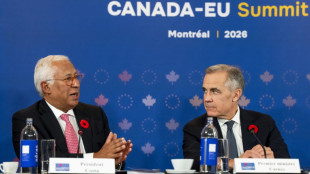 EU and Canada to 'withstand shocks together' with new alliance
-
Pope Leo makes history with US midterm vote

-
 Flick praises Yamal 'mentality' after missing out on Ballon d'Or
-
Arsenal boss Arteta fires 'Disneyland' warning at Dowman after Fleetwood red card

-
 Binance heist: How were cryptocurrency billions stolen?
-
Russia's ice hockey stars come in from the cold after CAS ruling

-
 France boards up ahead of Halloween protests
-
Wall Street tech rout deepens on doubts over AI spending

-
 Is Bukele's troop deployment in Haiti just a rescue mission?
-
'Life in the old dog': German economy grows more than expected

-
 Relatives' anguish grows as Spain identifies train crash dead
-
England great Anderson asks what's 'wrong with me?' after Lancashire exit

-
 Italy inflation surges to 5.4% as economy stalls
-
Markets lashed by tech rout as earnings fan AI fears

-
 US jury hands win to Bayer in weedkiller cancer case
-
Germans to join Europe's youth protest wave

N Korea test-fires most advanced ICBM with US in range
North Korea on Monday test-fired its most advanced intercontinental ballistic missile that has the potential to reach the United States, extending a record-breaking number of weapons tests this year and triggering further international condemnation.
South Korea said the North fired an ICBM that used solid fuel, which makes missiles easier to transport and faster to fire than liquid-fuelled versions.
Monday's launch was the third time the North had tested a solid-fuel ICBM, after launches in April and July, which analysts said signalled consistent efforts to improve the technology.
North Korea had said the previous two were "Hwasong-18" missiles but did not immediately comment on Monday's launch.
The United States, South Korea and Japan all quickly condemned the missile test, stating it was in breach of United Nations Security Council resolutions and would make the Korean peninsula less secure.
South Korean President Yoon Suk Yeol ordered an "immediate and overwhelming" countermeasure, and called for a joint response with the United States and Japan.
Japan's defence ministry said the ICBM had a potential range of more than 15,000 kilometres, which would cover all of the United States. It followed a short-range missile launch on Sunday night.
"(The launches are) not only a clear violation of UN Security Council resolutions but also a threat to peace and stability of the region and we strongly condemn," Japanese Prime Minister Fumio Kishida said.
The United Nations Security Council has adopted many resolutions calling on North Korea to halt its nuclear and ballistic missile programmes since it first conducted a nuclear test in 2006.
However China, a close ally of North Korea, offered no direct response to the latest launches and instead released a statement highlighting the deep trust between the two nations.
"In the face of the turbulent international situation, China and the DPRK have always firmly supported and trusted each other," Foreign Minister Wang Yi said after meeting an official from Pyongyang, using the official acronym for North Korea.
South Korea's military initially said it had detected the launch of a long-range ballistic missile from the Pyongyang area on Monday morning that flew 1,000 kilometres (620 miles) before splashing down in the East Sea, also known as the Sea of Japan.
The South reported the missile flew up rather than across, a method Pyongyang has previously said it employs in some weapons tests to avoid flying over neighbouring countries.
- 'Irreversible' nuclear power -
North Korea last year declared itself an "irreversible" nuclear power and has repeatedly said it will never give up its nuclear programme, which the regime views as essential for its survival.
Park Won-gon, a professor of North Korean Studies at Ewha University, said the latest ICBM was likely the Hwasong-18, adding that it would be a huge asset for North Korea, if and when it becomes operational.
"The Hwasong-18 uses solid fuel, so there will be no preparation time, and it can be fired immediately from a mobile launcher, and it can be seen as a weapon system with a practical ability to strike the US mainland," Park told AFP.
However the North has yet to perfect those capabilities, according to Go Myong-hyun, a researcher at the Asian Institute for Policy Studies.
"Regarding ICBMs, there are still many technical aspects that need to be supplemented, including securing the re-entry technology and multiple warhead technology," Go told AFP.
- Nuclear threats -
The back-to-back launches followed yet another bout of angry rhetoric between the US-South Korea alliance and the North.
The United States and South Korea on Friday held their second session of the Nuclear Consultative Group in Washington, where they discussed nuclear deterrence in the event of conflict with the North.
On Saturday they warned that any nuclear attack from Pyongyang on the United States and South Korea would result in the end of the North Korean regime.
A spokesperson for North Korea's defence ministry on Sunday slammed the allies' plans to expand annual joint military exercise next year to include a nuclear operation drill.
"This is an open declaration on nuclear confrontation to make the use of nuclear weapons against the DPRK a fait accompli," said a statement carried by the KCNA news agency, using the official acronym for North Korea.
"Any attempt to use armed forces against the DPRK will face a preemptive and deadly counteraction."
The North's launch of a military spy satellite launch last month further damaged ties.
The North portrayed it as a major breakthrough, claiming it was providing images of US and South Korean military sites.
That event fractured a military agreement between the Koreas established to de-escalate tensions on the peninsula, with both sides then ramping up security along the Demilitarized Zone (DMZ) separating them.
D.Schlegel--VB