
Gaza's post-war governance uncertain as war rages / Photo: © AFP/File

 India seeks threefold increase in coal stocks to prevent summer power shortages

 Indus Towers expands solar-powered network to 50,000 telecom sites

 Equitas Small Finance Bank rebounds after naming interim chief executive

 Titan quarterly profit seen rising as jewellery business drives growth

 Kuwait finance minister holds economic cooperation talks at COMCEC

 82-Year-Old American Transforms 2003 Mercedes Sprinter into Permanent Home

 Abdul El-Sayed declares victory in Michigan Senate contest

 Democrats capture US Congress in sweeping midterm victory

 Manchester United rallies past Roma as PSG dominates in Champions League

 Qatar prime minister advances mediation through diplomatic calls

 Greenland parliament approves security agreement with United States

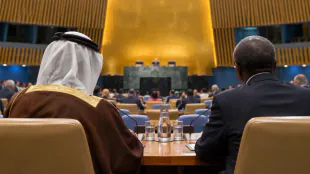 Qatar envoy meets incoming UN General Assembly president

 Trump Signals Willingness to Work With Democrats After Midterm Defeat

 Pitches and Keynote Speakers Are Confirmed for Blue Magic Netherlands on November 17
Who will govern Gaza when Israel's military offensive against Hamas ends? After five weeks of fighting, the answer remains shrouded in confusion.
Hamas, a Palestinian Islamist group with an armed wing, has governed the coastal territory of about 2.4 million people since 2007 after which Israel placed Gaza under a strict blockade governing the movement of people and goods in and out.
Hamas had seized power that year following street battles with the Palestinian Authority (PA).
US Secretary of State Antony Blinken said late last month that the PA should retake control of the Gaza Strip from Hamas, with international players potentially filling a role in the interim.
The Palestinian Authority currently has partial administrative control in the Israeli-occupied West Bank.
But in a meeting with Blinken earlier this month, Palestinian president Mahmud Abbas said the PA could only assume power in Gaza if a "comprehensive political solution" is found for the decades-old Israel-Palestinian conflict encompassing the West Bank, east Jerusalem and the Gaza Strip.
Last Wednesday Blinken again spoke of "Palestinian-led governance", and a Gaza "unified with the West Bank" under the Palestinian Authority.
Abbas, 88, who has led the PA for 18 years, is widely unpopular and has been powerless against the rapid expansion of Israeli settlements and military control in the West Bank and annexed east Jerusalem.
- 'Little hope' -
Israeli Prime Minister Benjamin Netanyahu, who has long sought to sideline the PA, on Wednesday told Fox News his country does not plan to reoccupy Gaza.
Israel had occupied Gaza in 1967 and remained there until completing a withdrawal in 2005, leaving local authority with the PA.
"We don't seek to govern Gaza. We don't seek to occupy it, but we seek to give it and us a better future," Netanyahu said.
Pushed on his plan for Gaza's future, Netanyahu said the impoverished and blockaded territory must be "demilitarised, deradicalised and rebuilt."
"We'll have to find a government, a civilian government that will be there," he added, without detailing who might form it.
Israel launched its offensive in Gaza after Hamas fighters poured across the heavily militarised border on October 7, killing about 1,200 people, mostly civilians, and taking around 240 hostages.
Vowing to destroy the militant group, Israel retaliated with bombardment and a ground campaign that the Hamas health ministry in Gaza says has killed more than 11,000 people, mostly civilians including thousands of children.
"I do not believe that any actor will agree to govern Gaza in these circumstances," said Hasan Khreisheh, deputy speaker of the Palestinian Legislative Council, which has not met since 2007.
"No Palestinian, no sane person will agree to return to Gaza on an American or Israeli tank."
In a note, the International Crisis Group (ICG) of analysts said there was "little hope" that the already deeply unpopular Palestinian Authority could return to Gaza on the back of an Israeli invasion and not be "treated as an enemy".
- 'No one knows' -
Earlier this week, Lebanon-based senior Hamas official Osama Hamdan said the group will not accept a puppet government in the Gaza Strip and will remain in the territory.
"Our people will not allow the United States to impose its plans to create an administration that suits it and that suits the occupation (Israel)," he said.
The US, Britain, Israel and others have designated Hamas as a terrorist organisation.
Saleh al-Aruri, the group's exiled deputy chief of political affairs, has suggested that the future of Hamas cannot be divorced from that of the Palestinian people as a whole. To "talk about post-Hamas is to talk about post-Palestine", he said.
On Friday, the Palestinian militant group Islamic Jihad, which is fighting alongside Hamas, vowed to reject any imposed power on the territory.
"If an international force were to be deployed to govern Gaza... the Palestinian people would consider it an occupying force and oppose it," said Mohammad al-Hindi, the group's deputy secretary-general.
Jamal al-Fadi, a political and international relations professor in the Gaza Strip, believes that even if the PA agreed to regain control of Gaza, it would not do so without a potential agreement with Hamas.
Without this, he told AFP, the Palestinian Authority would "run the risk of a new civil war".
Majed al-Aruri, a human rights advocate based in Ramallah, in the Israel-occupied West Bank, said everyone knows how the latest war started, "but no one knows how or on which terms it will end."
he-az-sbh-ezz/ac/jd/it
R.Kloeti--VB