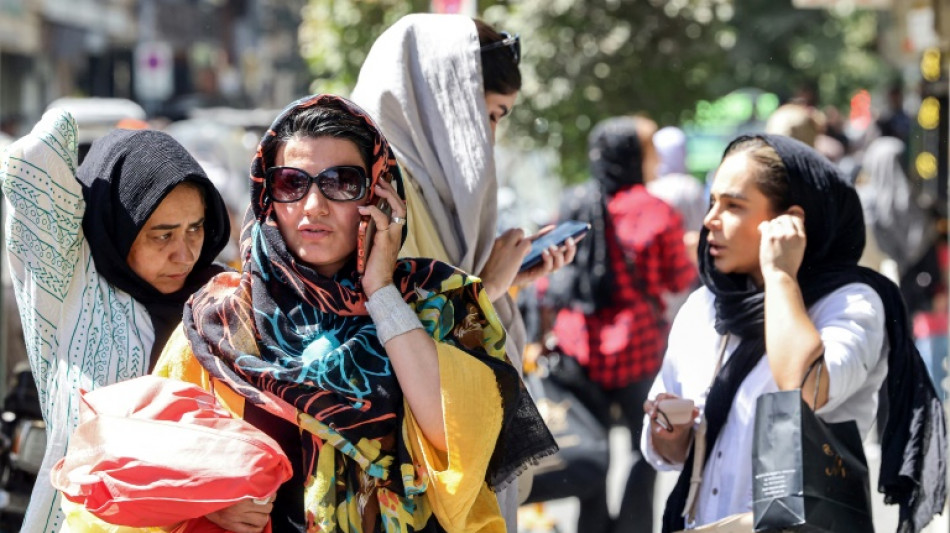
Iran on alert ahead of Mahsa Amini's death anniversary / Photo: © AFP

 Rene Eyre Revisits Autobiographical Performance 'Say A Little Prayer' in London

 UAE's HCT Holds Record Graduation and Announces Major Training Expansion

 NASA Awards $10B Lunar Contract Framework to SpaceX, Blue Origin

 Katy Perry Tells Fans Ex-Husband Russell Brand 'Should Be in Jail' During UK Concert

 South African election results renew debate over identity-based voting

 South African voters report smoother local election but declining IEC trust

 Dolly Parton museum and Nashville hotel open after singer’s death

 George and Amal Clooney attend New York political-comedy reading

 British buyers pay substantial premiums for period-home appearance

 Thomas Markle released to house arrest after child-abuse-image charge

 Dawn of War 4 developers chose Adeptus Mechanicus for tactical variety

 Italy face unbeaten South Africa in Turin Nations Championship match

 ChatGPT interactive interface feature tested across six custom tools
Iran's government has warned it will not tolerate any signs of "instability" as the first anniversary nears of the death of Mahsa Amini and the months-long protests it sparked.
Amini, a 22-year-old Iranian Kurd, died on September 16 last year after her arrest in Tehran for an alleged breach of the Islamic republic's strict dress code for women.
Her death triggered months of nationwide demonstrations under the slogan "Woman, Life, Freedom".
Hundreds of people were killed in street clashes, including dozens of security personnel, before authorities moved to quell what they branded foreign-instigated "riots".
One year on, no plans for demonstrations have been overtly announced to mark the anniversary of Amini's death on Saturday, which is also a religious public holiday.
President Ebrahim Raisi issued a warning in a television interview on Tuesday.
"Those who intend to abuse Mahsa Amini's name under this pretext, to be an agent of foreigners, to create this instability in the country, we know what will happen to them," he said.
Security services will be vigilant, the deputy head of the judiciary, Sadeq Rahimi, said late last month.
"The intelligence and security agencies are monitoring all the movements and will identify and deliver to judicial authorities those who want to... take to streets in the coming days and create problems," he warned.
Last week, Iranian authorities shut down at least five social media pages and arrested the six individuals behind them, on accusations they were "organising riots" for the anniversary.
- 'Traumatised' -
Last year's wave of protests posed a major challenge for the Iranian government, which is also at odds with Western powers over its nuclear programme and under punishing sanctions.
"No incident in the history of the Islamic republic has driven such a wedge between the system and the people as the death of Mahsa Amini," said Fayyaz Zahed, a professor of contemporary history.
He said he believes the government "cannot solely rely on security and repressive responses" to contain the issue.
Mohammad Sadegh Javadi-Hessar, a reformist activist based in the northeastern city of Mashhad, said many people "are still traumatised by last year's events".
The months-long demonstrations, aside from the bloodshed, also saw thousands of people arrested.
In February, Iran's supreme leader Ayatollah Ali Khamenei declared the end of the unrest and the defeat of the "plot" fomented by the "enemy", a reference to the Western governments and Iranian exiled opposition groups that backed the demonstrations.
On Monday, Khamenei accused Iran's arch foe the United States of intending to exploit "issues they think can cause crisis in Iran" including that of women.
Women in Iran have been required to cover their heads and necks since shortly after the 1979 Islamic Revolution and encouraged to wear modest garments.
- Economic pain -
While last year's protests have cooled, many Iranian women, especially in the capital Tehran, have been increasingly flouting the strict dress code.
"The most remarkable effect the Mahsa movement had on Iranian society was the change in the society... which has become more colourful and livelier," said Zahed.
"Women's clothing has changed significantly," he said, also noting a shift to brighter colours.
Authorities have pushed back, installing surveillance cameras in public places to monitor violations and shutting businesses where rules have been breached.
Iran's parliament has discussed a bill that would toughen penalties on those flouting the dress code.
But not everyone backs the strict punishments.
Prominent Shiite cleric Grand Ayatollah Makarem Shirazi has expressed his rejection against using "violence and pressure" to impose the hijab headscarf.
Reformist leaders have also denounced the recent dismissal of dozens of university professors.
Local media has quoted several professors as saying they were dismissed against the backdrop of their political views in support of the protest movement.
While the issue of hijab remains critical, for many in Iran, where inflation hovers at nearly 50 percent, economic pain is a priority, said Javadi-Hessar, the activist.
"The main demand of the people is the improvement of the economy, ahead of civil and political freedoms," he said.
H.Gerber--VB