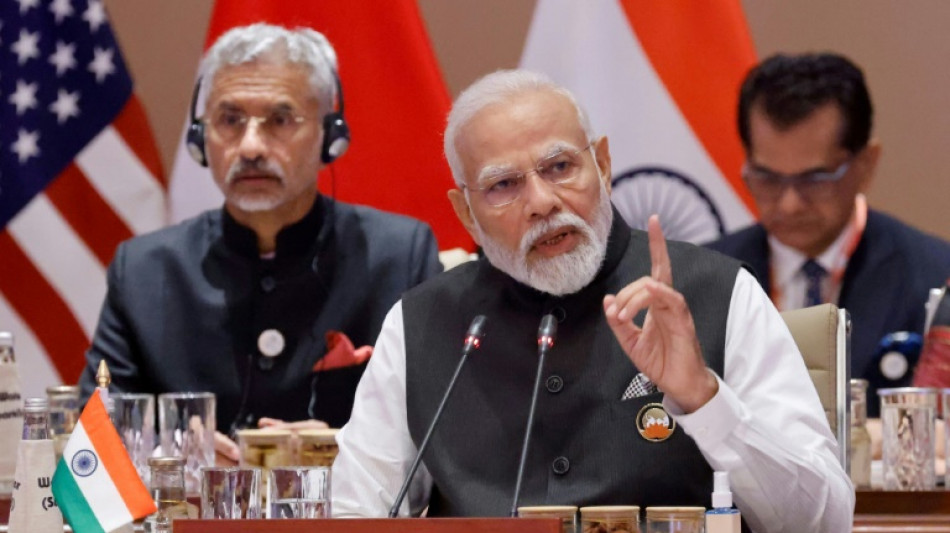
Modi seeks to cement India's global standing with G20 summit / Photo: © POOL/AFP/File

 Rene Eyre Revisits Autobiographical Performance 'Say A Little Prayer' in London

 UAE's HCT Holds Record Graduation and Announces Major Training Expansion

 NASA Awards $10B Lunar Contract Framework to SpaceX, Blue Origin

 Katy Perry Tells Fans Ex-Husband Russell Brand 'Should Be in Jail' During UK Concert

 South African election results renew debate over identity-based voting

 South African voters report smoother local election but declining IEC trust

 Dolly Parton museum and Nashville hotel open after singer’s death

 George and Amal Clooney attend New York political-comedy reading

 British buyers pay substantial premiums for period-home appearance

 Thomas Markle released to house arrest after child-abuse-image charge

Indian Prime Minister Narendra Modi used his G20 presidency to burnish his image at home and abroad as a steward of national power and prosperity, asserting India's place in the world ahead of general elections next year.
For months, the 72-year-old leader has been a ubiquitous presence across Delhi, looking down from countless roadside posters and billboards put up across India's capital.
Among other slogans, they proclaimed the country the "Voice of the Global South".
India overtook China as the world's most populous country earlier this year, after displacing former coloniser Britain as its fifth-biggest economy in 2022.
Now Modi is seeking a place on the global stage to match, using the G20 summit as a catalyst to position India as a representative of many others outside traditional power blocs.
Among the most tangible outcomes of the summit was a permanent seat at the table for the African Union, and on the first day, Modi banged a ceremonial gavel to announce that the leaders had reached consensus to adopt a declaration.
It was somewhat unexpected. The grouping had agreed on most things last year in Bali but not all.
But by herding deeply divided leaders into a common -- if largely symbolic -- statement on vexed issues such as Russia's invasion of Ukraine, Modi scored a diplomatic win.
The statement avoided any direct criticism of Russia -- a long-time arms and energy supplier to India -- or summit absentee President Vladimir Putin, who is accused of war crimes by the International Criminal Court.
And on climate, there was no commitment to phase out fossil fuels, but there was backing for the goal of tripling renewable energy capacity by 2030.
"It is a success for India's diplomacy," said Ashok Kantha, former Indian ambassador to China.
"We could persuade our friends in the West, and say they need not insist on an explicit condemnation of Russia's invasion of Ukraine," he added.
"It's a good compromise."
And Michael Kugelman, director of the South Asia Institute at the Wilson Center, said the outcome had "vindicated" India's policy of "strategic autonomy".
"It's definitely not a reflection of a 100 percent consensus, or maybe not even an 80 or 90 percent consensus," but it did "suggest a level of convergence on more issues than I had expected.
"That's a bit of a pleasant surprise."
- Symbolic scene -
Delhi went on an intense beautification drive before the two-day meeting.
Men were hired to chase away monkeys, some 70,000 flower pots were placed across the city and on summit days, swathes of the metropolis were locked down -- with some preparations criticised as thousands of homeless people were moved to shelters.
The summit itself was replete with Hindu symbols, a not-so-subtle message from populist Modi to his base.
His political career and success have been based on support from India's one-billion-plus Hindus and, critics say, stoking enmity toward the country's large Muslim minority.
The summit's logo -- a globe with a lotus -- echoed the symbol of his Hindu nationalist Bharatiya Janata Party.
At the summit table, Modi sat behind a nameplate that said "Bharat" -- an ancient Sanskrit word steeped in Hindu religious symbolism -- rather than India.
He will go to the world's biggest election next year as the clear favourite, with the opposition Congress Party plagued by its reputation for corruption.
A recent poll by Pew showed eight in 10 Indians have a positive view of Modi, and almost as many believe he is leading the country to greater influence on the world stage.
His international reputation is a little less lustrous.
Under Modi's tenure, India has slumped in Freedom House's rankings for political rights and civil liberties, with police cracking down on protests, the ruling party scoring lavish funding from business allies and press freedoms curtailed.
Sweden's V-Dem Institute now describes the country as an "electoral autocracy" rather than a democracy.
But Kugelman said the G20 presidency "will really deliver a shot in the arm, so to speak, to his already very strong political prospects".
"He'll come out of this, I think, politically energised and certainly advantaged politically as well."
C.Stoecklin--VB