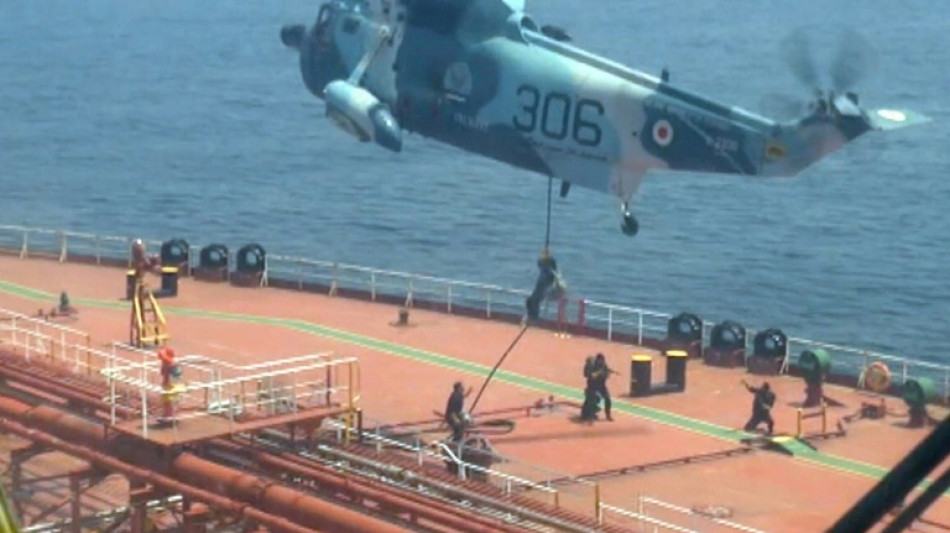
US confirms April seizure of Iran oil shipment / Photo: © Iranian Army office/AFP

 Rene Eyre Revisits Autobiographical Performance 'Say A Little Prayer' in London

 UAE's HCT Holds Record Graduation and Announces Major Training Expansion

 NASA Awards $10B Lunar Contract Framework to SpaceX, Blue Origin

 Katy Perry Tells Fans Ex-Husband Russell Brand 'Should Be in Jail' During UK Concert

 South African election results renew debate over identity-based voting

 South African voters report smoother local election but declining IEC trust

 Dolly Parton museum and Nashville hotel open after singer’s death

 George and Amal Clooney attend New York political-comedy reading
The United States confirmed Friday that it seized a tanker load of Iranian oil in April, just before Iran seized two vessels in the Gulf region, in the Justice Department's first official statement on the incident.
The department said that it had seized the Suez Rajan, a Greek-managed tanker, and its cargo of 980,000 barrels of crude oil, allegedly being sold by Iran's powerful Islamic Revolutionary Guard Corps to China.
That sale allegedly violated US and international sanctions, and the United States government obtained a warrant early this year for its seizure.
On April 19, around the time of the seizure, the vessel's owner, Suez Rajan Ltd, pleaded guilty to sanctions violations and was fined $2.5 million.
Subsequently the Greek vessel operator, Empire Navigation, agreed to cooperate with US authorities and ordered the ship, located in Southeast Asia at the time, to take its load of oil to the United States.
At the time US authorities would not confirm it was taking control of the cargo and that the ship was sailing to the United States.
But Iran's seizure of two tankers -- the Marshall Islands-flagged Advantage Sweet as it sailed toward the United States in the Gulf of Oman, and then the Greek-owned Niovi, as it travelled from Dubai to Fujairah -- came just days later.
At the time the United States accused Iran of "harassment" and "interference with navigational rights in regional and international waters."
The seizures elevated tensions in the Gulf region.
In early July the US military said it had blocked two more attempts by the Iranian navy to seize commercial tankers in international waters off Oman.
The Justice Department said Friday that the Suez Rajan case was the first successful disruption of a major crude shipment by the Islamic Revolutionary Guard Corps using US criminal law.
They said the participants in the Suez Rajan scheme had "attempted to disguise the origin of the oil using ship-to-ship transfers" and masking the locations and identities of the vessels involved.
They also said that the charterer of the vessel used the US financial system to facilitate the transportation of Iranian oil, violating Iran sanctions.
The US has moved to formerly take ownership of the cargo, worth tens of millions of dollars, which will then be sold.
S.Gantenbein--VB