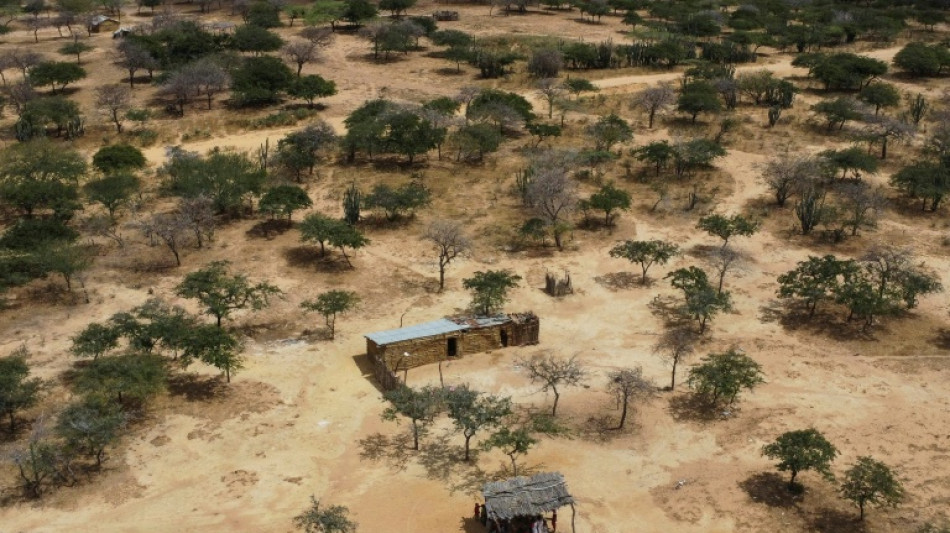
Colombia mulls future of massive coal mine as water dries up / Photo: © AFP

 Rene Eyre Revisits Autobiographical Performance 'Say A Little Prayer' in London

 UAE's HCT Holds Record Graduation and Announces Major Training Expansion

 NASA Awards $10B Lunar Contract Framework to SpaceX, Blue Origin

 Katy Perry Tells Fans Ex-Husband Russell Brand 'Should Be in Jail' During UK Concert

 South African election results renew debate over identity-based voting

 South African voters report smoother local election but declining IEC trust

 Dolly Parton museum and Nashville hotel open after singer’s death

 George and Amal Clooney attend New York political-comedy reading
Colombia's massive El Cerrejon coal mine has landed in the crosshairs of President Gustavo Petro, who has blamed the open-pit operation for plunging the local Indigenous community into a severe water crisis.
Gigantic black craters scar the earth in La Guajira, northern Colombia, after four decades of coal extraction that has sucked up large quantities of water in an already-arid region hit by a wave of extreme droughts.
The leftist leader Petro, who has championed environmental concerns, in July declared an "economic, social and ecological emergency" in La Guajira, where poverty levels are at 67 percent, and dozens of children die every year from malnutrition.
In August, during a visit by Switzerland's president, Petro said he was looking for a "coordinated exit" by Glencore, the Swiss commodities giant which owns the mine.
El Cerrejon is the largest open-pit coal mine in Latin America, stretching over 69,000 hectares (170,000 acres) across a harsh landscape that is also home to the semi-nomadic Wayuu tribe, who live in huts and survive off ranching, small-scale agriculture, and fishing.
Traditionally, they capture and store water in reservoirs known as "jagueyes."
Petro has said that much of the region's scarce water supplies are now being monopolized by the "agriculture, energy, and coal" industries.
His state of emergency in the region forbids the extension of mining contracts or the expansion of any existing projects.
In 2022 a United Nations report listed El Cerrejon as among the 50 most polluted places in the world, saying the mine has had "devastating" consequences for the Wayuu, and that residents living near it have "high levels of toxic substances in their blood."
Last month, the mine published on its website a rejection of the accusations in the report, underlining its investment in social and environmental projects.
The company has also highlighted its efforts to improve water supply, including distributing water and building infrastructure for communities.
- Economic blow -
Experts say that shutting the mine, which produces 80,000 tons of coal per day and employs more than 12,000 workers -- many of them from La Guajira -- could deal a great economic blow to the community and the country.
The coal mine brings in 43 percent of La Guajira's gross domestic product, and 0.7 percent to Colombia as a whole, according to the Fedesarrollo investigations center.
The company shelled out some nine billion dollars to the state in 2022 in taxes and royalties.
These funds are "essential to support vital sectors such as health, water, education and roads," the region's governor Diala Wilches, told a local radio station.
"If the extraction of coal from the El Cerrejon mine is limited or suddenly stopped, there will be a fiscal crisis ... which will have to be compensated by government transfers," said Sergio Cabrales, a professor at the Universidad de los Andes in Bogota.
A solution to the dilemma could lie in the energy transition.
La Guajira boasts high wind speeds and solar radiation, however projects to harness them as energy have limped along, hampered by territorial conflicts with the local community.
Cabrales says an alternative to the coal industry lies in "boosting tourism ... and power generation from renewable sources." But this requires "time, national and international investment, as well as better leadership."
Officials from El Cerrejon told AFP the company was "committed to continue operating in a responsible manner" until the end of its contract in 2034.
T.Suter--VB