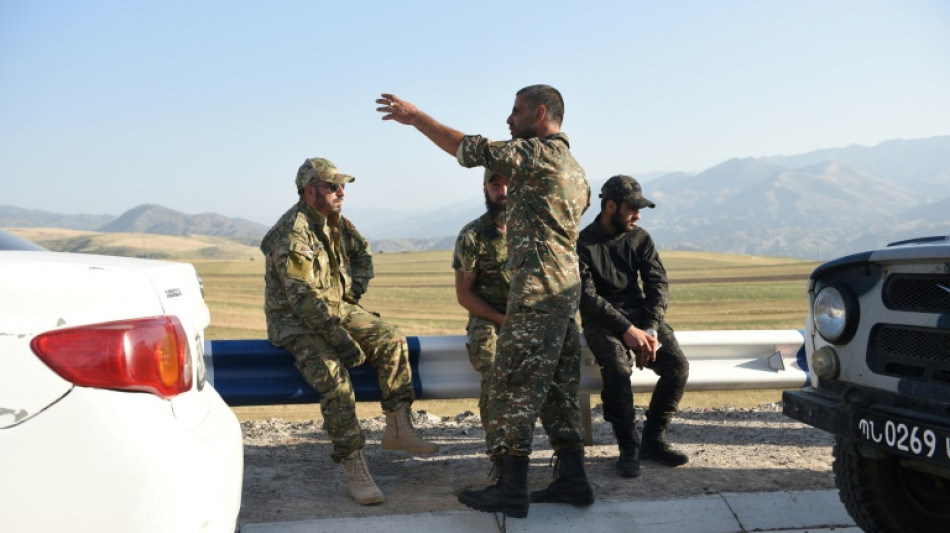
Armenia says Azerbaijan preparing fresh 'military provocation' / Photo: © AFP/File

 Rene Eyre Revisits Autobiographical Performance 'Say A Little Prayer' in London

 UAE's HCT Holds Record Graduation and Announces Major Training Expansion

 NASA Awards $10B Lunar Contract Framework to SpaceX, Blue Origin

 Katy Perry Tells Fans Ex-Husband Russell Brand 'Should Be in Jail' During UK Concert

 South African election results renew debate over identity-based voting

 South African voters report smoother local election but declining IEC trust

 Dolly Parton museum and Nashville hotel open after singer’s death

 George and Amal Clooney attend New York political-comedy reading
Armenia on Thursday accused arch-foe Azerbaijan of preparing a "fresh military provocation" by massing troops on their border and near the breakaway Nagorno-Karabakh region.
The ex-Soviet republics have been locked in a decades-long conflict over the mostly Armenian-populated region of Nagorno-Karabakh inside Azerbaijan which is controlled by separatists.
Tensions have escalated sharply in recent months as each accuses the other of cross-border attacks.
"The military-political situation in our region has seriously worsened," Prime Minister Nikol Pashinyan told his cabinet meeting in Yerevan.
He said Azerbaijan was "concentrating" troops on the border and also near the mountainous Karabakh region.
"Azerbaijan is demonstrating its intention to undertake a fresh military provocation against Nagorno-Karabakh and Armenia," Pashinyan said.
Azerbaijan denounced the claims as "yet another false political manipulation."
"Armenia must abandon territorial claims to Azerbaijan, to end military-political provocations, and to stop creating obstacles to the peace process," its foreign ministry said in a statement.
- 'Strategic mistake' -
Armenian Defence Minister Suren Papikyan cancelled a planned visit to Cyprus "due to the escalation of the situation in Armenia," his Cypriot counterpart Michalis Giorgallas wrote on social media.
The European Union monitoring mission deployed on the Armenian side of the border said it has "increased patrolling activity... to observe any military developments."
Pashinyan's claims came ahead of snap presidential elections in the separatist enclave on Saturday and days before joint drills between Armenian and US peacekeeping forces hosted by Yerevan.
The Kremlin on Thursday criticised the drills, saying they would harm stability in the volatile Caucasus region that Moscow sees as its backyard.
"Without a doubt, the conduct of these kinds of exercises do not help to stabilise the situation or strengthen the atmosphere of mutual trust in the region," Kremlin spokesman Dmitry Peskov said.
"Russia continues to fulfil its function as a guarantor of security," he added.
Yerevan has accused Baku of blockading Nagorno-Karabakh since December, spurring a humanitarian crisis in Armenian-populated towns.
Pashinyan has criticised Moscow for failing to unblock the sole road linking Nagorno-Karabakh to Armenia, which is being patrolled by Russian peacekeepers.
They deployed in 2020 when Russia brokered a ceasefire ending a war between Armenia and Azerbaijan for control of the region.
Pashinyan recently said it was a "strategic mistake" for Yerevan -- a traditional Moscow ally -- to rely on Russia as its security guarantor.
Yerevan and Baku have fought two wars for control over the region, which is internationally recognised as part of Azerbaijan but largely populated by ethnic Armenians.
The two sides have been unable to reach a lasting peace settlement despite mediation efforts by the European Union, the United States and Russia.
L.Stucki--VB