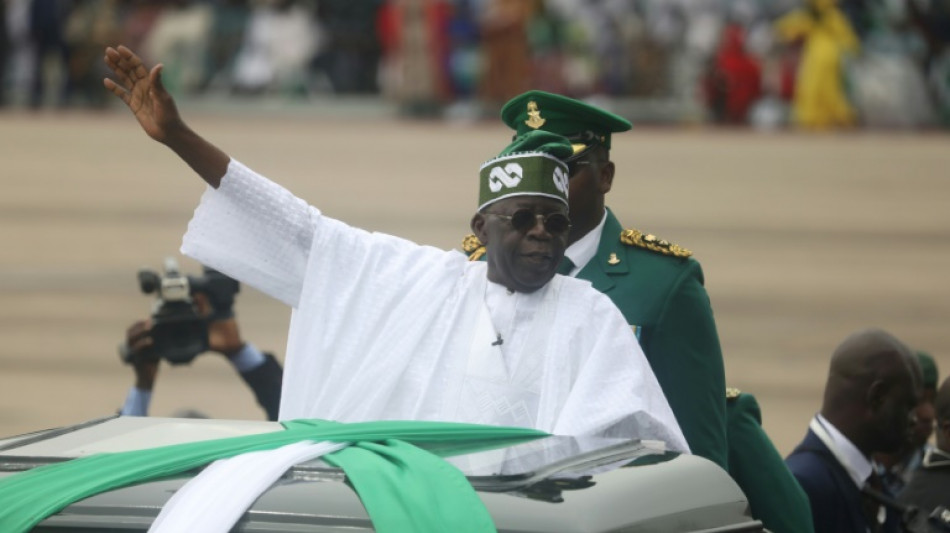
Nigeria court to rule on opposition election challenge / Photo: © AFP/File

 Rene Eyre Revisits Autobiographical Performance 'Say A Little Prayer' in London

 UAE's HCT Holds Record Graduation and Announces Major Training Expansion

 NASA Awards $10B Lunar Contract Framework to SpaceX, Blue Origin

 Katy Perry Tells Fans Ex-Husband Russell Brand 'Should Be in Jail' During UK Concert

 South African election results renew debate over identity-based voting

 South African voters report smoother local election but declining IEC trust

 Dolly Parton museum and Nashville hotel open after singer’s death

 George and Amal Clooney attend New York political-comedy reading

 British buyers pay substantial premiums for period-home appearance

 Thomas Markle released to house arrest after child-abuse-image charge

A Nigerian appeals court on Wednesday will rule on an opposition challenge to overturn President Bola Tinubu's election victory in an eagerly awaited decision.
The five-judge Abuja court has been deliberating for months on wide-ranging lawsuits from the opposition Peoples Democratic Party (PDP) and Labour Party claiming fraud and irregularities.
In a tight race, former Lagos governor Tinubu won 37 percent of votes in the February 25 vote, beating the PDP's Atiku Abubakar and Labour's Peter Obi to secure the presidency of Africa's most populous country.
Any decision on Wednesday appears unlikely to be the final stage of legal wrangling over the election, as lawyers say parties can appeal to the Supreme Court for a final verdict.
Despite repeated challenges to past elections, no court has overturned a presidential vote in Nigeria since its return to democracy from military rule in 1999.
Tinubu's government has appeared confident, highlighting the judiciary's integrity.
"As a result of his faith and confidence in the judiciary, he believes that the mandate which Nigerians freely gave to him during the elections will stand," presidential spokesman Ajuri Ngelale told Channels TV this week.
"He is not worried, simply because he knows he won the election."
Tinubu took office at the end of May and has quickly introduced a set of reforms the government says will help put Africa's largest economy back on track.
He is currently in India to participate in the G20 summit where he is seeking foreign investment.
- Nullify or verify -
The 2023 election was one of the most contested in the country's modern history, thanks in part to the emergence of a major third-party candidate to challenge the dominance of Tinubu's All Progressives Congress (APC) and the PDP.
Labour's Obi looked to appeal to younger voters who said they were looking for an alternative to the old-guard candidates.
To improve transparency, the Independent National Electoral Commission (INEC) introduced biometric technology and IReV, a central database for uploading results in real time.
INEC acknowledged "glitches" but dismissed claims the vote was not free and fair.
In two lawsuits, the PDP and Labour are calling for the results to be nullified and for their candidates to be declared the winner or for the court to order a rerun.
The PDP's Abubakar called the vote a "rape of democracy" and the party says it presented proof that INEC broke electoral law in its transmission of results, and of Tinubu's failure to meet constitutional requirements.
Labour's lawsuit followed similar allegations, referencing INEC breaking electoral law, vote rigging and also claims Tinubu was not qualified to run.
A smaller party will also receive a decision on its petition.
The court ruling comes as Nigerians struggle with a rising cost of living after the government ended a fuel subsidy programme that kept petrol prices low and also freed up the naira currency.
Government officials say the policies are needed to revive the economy, calling for patience and supplying state governments with funds to help offset the impact.
Tinubu's government is also tackling huge security challenges, from jihadists still fighting a long war in the northeast to intercommunal clashes and kidnap gangs operating in other regions.
C.Kovalenko--BTB