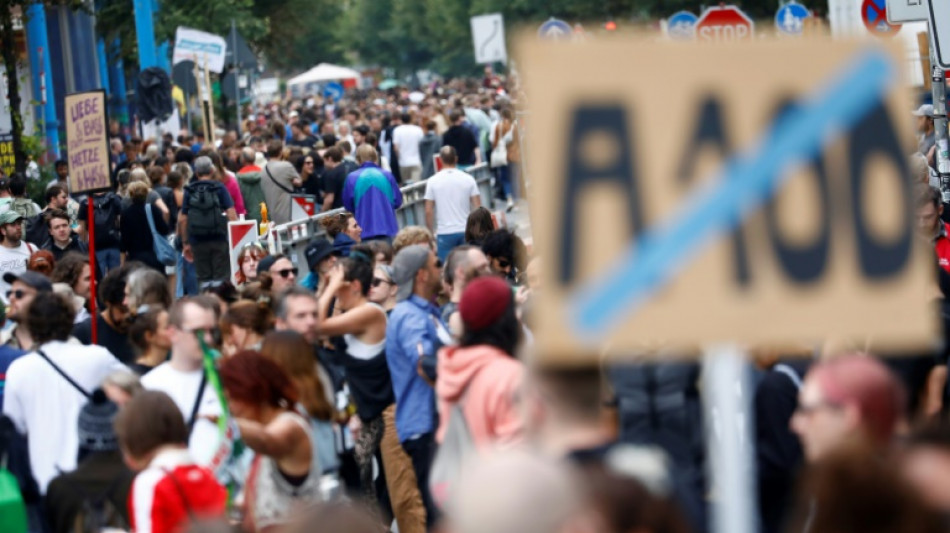
Berlin techno clubs under threat from motorway expansion / Photo: © AFP

 Rene Eyre Revisits Autobiographical Performance 'Say A Little Prayer' in London

 UAE's HCT Holds Record Graduation and Announces Major Training Expansion

 NASA Awards $10B Lunar Contract Framework to SpaceX, Blue Origin

 Katy Perry Tells Fans Ex-Husband Russell Brand 'Should Be in Jail' During UK Concert

 South African election results renew debate over identity-based voting

 South African voters report smoother local election but declining IEC trust

 Dolly Parton museum and Nashville hotel open after singer’s death

 George and Amal Clooney attend New York political-comedy reading

 British buyers pay substantial premiums for period-home appearance

 Thomas Markle released to house arrest after child-abuse-image charge

The Autobahn may have been beloved by the band Kraftwerk, but it has become the bugbear of the Berlin techno scene as a motorway expansion threatens to shut down several clubs in the German capital.
The planned extension of the A100 has also united clubbers with environmental campaigners, who argue it will contribute to the climate crisis.
The motorway, which runs a partial ring around central Berlin, is due to be extended north from Treptower Park across the Spree river towards nightlife hub Friedrichshain some time in the next few years.
The extension would threaten five popular nightspots in the area, according to the Berlin Club Commission, a network for the city's clubs and cultural promoters.
They include About Blank, an industrial-style techno club next to Ostkreuz station, and Renate, a hub for the LGBTQ community in an unrenovated apartment block.
"These are clubs that have been here for the last 20-30 years... They're what makes Berlin famous and why people love it," Lutz Leichsenring, a spokesman for the Club Commission, told AFP.
The Club Commission helped organise a protest rave in early September in a bid to whip up opposition to the plans.
Temporary stages along the planned A100 route blasted out techno as several thousand people held up placards and danced along in hotpants and leopard prints.
- Club culture -
"The clubs in this area... are really important to the culture of Berlin," said student Adrian Schmidt, 25, wearing a black crop top and a pearl necklace.
"Those clubs create spaces in which everyone can freely express themselves," he said.
Carole Canale, 25, a marketing manager from Paris, had her first German clubbing experience in About Blank and is a regular in all five of the clubs under threat.
"This is a place where people have lots of memories... and it would be really sad if everything was closing," she said.
Berlin's club scene flourished after the Wall fell, giving a new purpose to the city's many disused buildings and industrial wasteland.
But nightclubs in the city have struggled in recent years due to the Covid-19 pandemic as well as noise complaints, rent increases, bureaucracy and rising expenses.
Eli Steffen, 37, a member of the collective that owns About Blank, refers to the planned A100 extension as "this grey motorway nonsense".
Does she really believe the protesters have a chance against Germany's powerful automotive industry and a transport ministry led by the business-friendly FDP?
"Nobody can say at the moment," she said.
But "we are very determined to resist and believe that it is always worth fighting for a transport-friendly, climate-friendly, colourful, diverse city".
The German wing of the Fridays for Future movement also joined the protest rave, bringing their concerns for the environment.
"The construction of the A100 must absolutely be stopped, not only for the obvious social reasons but also because motorways are a major driver of the climate crisis," said Clara Duvigneau, 21, a spokeswoman for the group.
- 'Increasing traffic flows' -
But outside the cultural bubble of central Berlin, not everyone is so determined to stop the traffic.
According to a recent survey by the newspaper Die Welt, 62 percent of Germans are in favour of the renewal and further expansion of the country's road network.
Only 33 percent said the expansion of motorways should be halted in favour of climate protection.
Decisions about motorway infrastructure are made by the central government, with this particular extension of the A100 first agreed in 2016 under former chancellor Angela Merkel.
The current coalition under Olaf Scholz has pledged to go ahead with the plans, despite promising to reassess some large infrastructure projects for their environmental impact.
At a recent government press conference, Transport Ministry spokesman Bastian Pauly said the expansion of motorways was "necessary in order to be able to manage and satisfy the increasing traffic flows in the future".
The project is also unlikely to be met with political opposition in Berlin, which earlier this year elected a conservative mayor for the first time in 20 years.
Kai Wegner, a 50-year-old former insurance salesman, has declared himself firmly in favour of the extension.
W.Lapointe--BTB