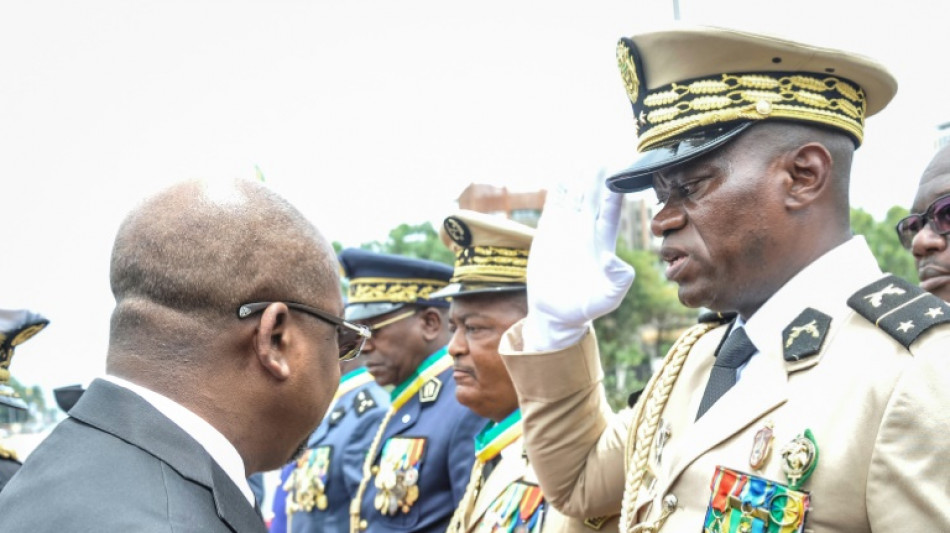
Key moments in Gabon's coup / Photo: © AFP/File

 Rene Eyre Revisits Autobiographical Performance 'Say A Little Prayer' in London

 UAE's HCT Holds Record Graduation and Announces Major Training Expansion

 NASA Awards $10B Lunar Contract Framework to SpaceX, Blue Origin

 Katy Perry Tells Fans Ex-Husband Russell Brand 'Should Be in Jail' During UK Concert

 South African election results renew debate over identity-based voting

 South African voters report smoother local election but declining IEC trust

 Dolly Parton museum and Nashville hotel open after singer’s death

 George and Amal Clooney attend New York political-comedy reading

 British buyers pay substantial premiums for period-home appearance

 Thomas Markle released to house arrest after child-abuse-image charge

The swearing-in of Gabonese coup leader Brice Oligui Nguema as interim president on Monday seals the downfall of the Bongo dynasty that ruled the oil-rich central African country for over half a century.
Here are five key moments in the latest military takeover in Africa:
- Bongo out -
Moments after Ali Bongo Ondimba, in power for 14 years, is proclaimed the winner of a presidential elections held on August 26, the army goes on TV on August 30 to say it is "putting an end to the current regime".
The country's borders are closed (but later reopened), its institutions are dissolved and the election results are cancelled.
Bongo, son of the country's long-time leader Omar Bongo, is placed under house arrest.
One of Ali Bongo's sons, Noureddin Bongo Valentin, is arrested on charges of treason and embezzlement, among other charges.
Former colonial power France, long accused of meddling in Gabon's affairs, condemns the coup, as do other Western countries, the African Union and the United Nations. Russia says it it is "deeply concerned".
- Video appeal -
Bongo issues a video appeal in English for his friends "all over the world" to "make noise" about his overthrow.
China calls for his safety to be guaranteed.
- Euphoria -
On the streets of the capital Libreville and the economic hub of Port-Gentil crowds celebrate the "liberation of Gabon" from the Bongos.
Coup leader Oligui, the head of the Republican Guard, is named interim president on August 31 and carried through the streets of Libreville by his troops.
EU foreign policy chief Josep Borrell says that while coups are "not the solution" the world "must not forget that in Gabon there had been elections full of irregularities."
- AU red card -
The African Union on August 31 suspends Gabon as a member with immediate effect.
- General becomes president -
On September 4, Oligui is sworn in as interim president.
He promises "free" and "transparent" elections after an unspecified transitional period and to "preserve the achievements of democracy".
He also promises to free political prisoners.
L.Dubois--BTB