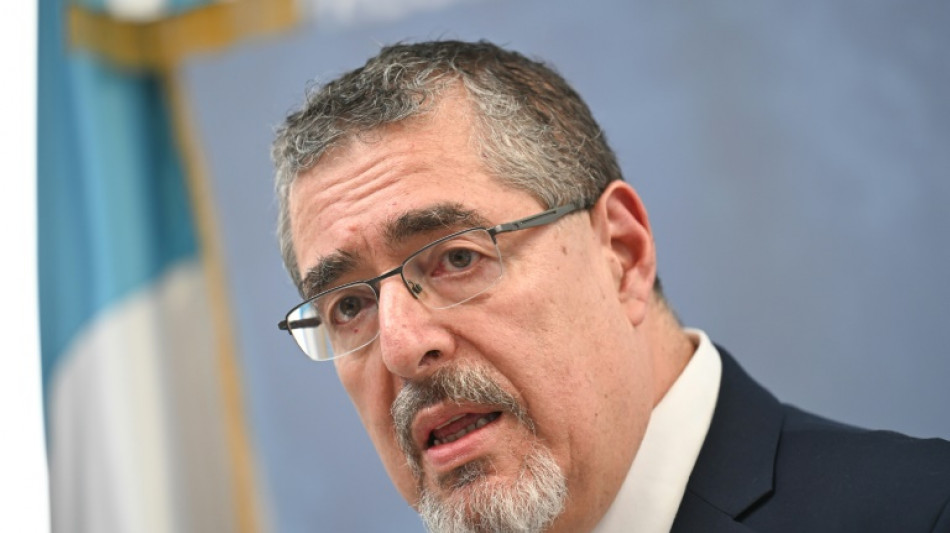
New Guatemala leader slams 'coup' plan to block him from office / Photo: © AFP

 Rene Eyre Revisits Autobiographical Performance 'Say A Little Prayer' in London

 UAE's HCT Holds Record Graduation and Announces Major Training Expansion

 NASA Awards $10B Lunar Contract Framework to SpaceX, Blue Origin

 Katy Perry Tells Fans Ex-Husband Russell Brand 'Should Be in Jail' During UK Concert

 South African election results renew debate over identity-based voting

 South African voters report smoother local election but declining IEC trust

 Dolly Parton museum and Nashville hotel open after singer’s death

 George and Amal Clooney attend New York political-comedy reading

 British buyers pay substantial premiums for period-home appearance

 Thomas Markle released to house arrest after child-abuse-image charge

Guatemala's president-elect Bernardo Arevalo on Friday denounced an "ongoing coup" by the country's institutions to block him from taking power, after his political party was suspended.
Arevalo, a 64-year-old sociologist, swept from obscurity to win an August 20 election with his vow to crack down on graft, which observers say has alarmed a corrupt elite.
After a campaign marked by concerns of meddling, Arevalo was on Monday declared the winner of the poll with 58 percent of votes, but the electoral tribunal suspended his Semilla (Seed) Movement.
"There is a group of corrupt politicians and officials who refuse to accept this result and have launched a plan to break the constitutional order and violate democracy," Arevalo told a press conference.
"These actions constitute a coup d'etat that is promoted by the institutions that should guarantee justice in our country."
Arevalo pulled off a massive upset by advancing to the runoff after a first round marked by apathy among voters tired of the poverty, violence, and corruption that pushes thousands abroad every year in search of a better life, many to the United States.
After the first round of voting on June 25, Guatemalan judge Fredy Orellana, at the request of prosecutor Rafael Curruchiche, ordered the electoral tribunal to suspend Semilla pending an investigation into alleged anomalies in its registration as a party.
Orellana and Curruchiche are both on a US list of "corrupt actors" and foreign allies slammed meddling in the election process.
At the time, the court said a party could not be suspended in the middle of an election campaign.
But with voting over, the suspension was confirmed.
"We are seeing an ongoing coup, in which the justice apparatus is used to violate justice itself, mocking the popular will freely expressed at the polls," said Arevalo.
- Death threats -
Analysts told AFP the suspension would not prevent Arevalo taking up the presidential reins in January, but would impede his Semilla party's work in Congress.
The party also cannot issue statements or collect money.
"They are weakening and denying the resources, authority and legitimacy that the people of Guatemala have legally conferred upon us," Arevalo said.
The head of the electoral mission to Guatemala for the Organization of American States (OAS), Eladio Loizaga, also warned about a possible "break in the constitutional order in Guatemala."
Speaking at an extraordinary meeting in Washington on Guatemala, Loaiza said the mission "considers that the abuse of legal instruments ... continues to cause a high degree of uncertainty in the process and puts the country's democratic stability at risk."
Last week, the Washington-based Inter-American Commission on Human Rights (IACHR) said Arevalo and his deputy Karin Herrera "are being subjected to stigmatization, harassment, hounding, public disclosure of personal details on social media, and threats including two specific plans to hurt them and even kill them."
The government said in a statement that "necessary measures" had been taken in coordination with police to boost their protection.
O.Krause--BTB