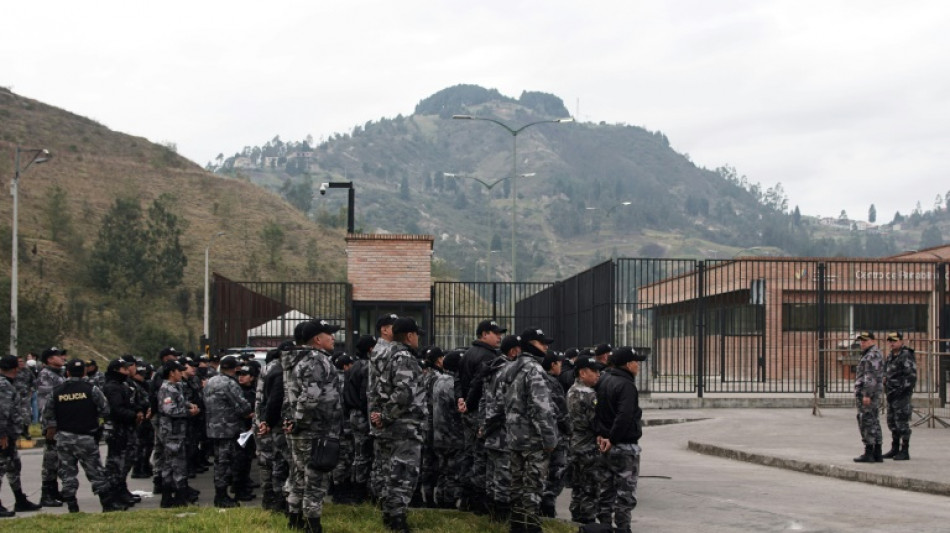
Inmates hold scores of guards hostage in Ecuador's latest prison crisis / Photo: © AFP

 Rene Eyre Revisits Autobiographical Performance 'Say A Little Prayer' in London

 UAE's HCT Holds Record Graduation and Announces Major Training Expansion

 NASA Awards $10B Lunar Contract Framework to SpaceX, Blue Origin

 Katy Perry Tells Fans Ex-Husband Russell Brand 'Should Be in Jail' During UK Concert

 South African election results renew debate over identity-based voting

 South African voters report smoother local election but declining IEC trust

 Dolly Parton museum and Nashville hotel open after singer’s death

 George and Amal Clooney attend New York political-comedy reading

 British buyers pay substantial premiums for period-home appearance

 Thomas Markle released to house arrest after child-abuse-image charge

Almost 60 prison guards and police officers were being held hostage Friday by inmates across Ecuador.
Here is what you need to know about the latest unrest to rock the country, where a brutal gang war has played out in prisons in recent years as the state battles to gain control.
- Car bombs and grenades -
Ecuador's SNAI prisons authority announced Thursday night that 50 prison guards and seven police officers were being held in six different prisons, without giving further details.
At one prison in the Andean city of Cuenca on Friday morning, three inmates on the roof -- one in colorful pajamas holding a walkie-talkie -- shouted at a crowd of uniformed offices to retreat, according to an AFP journalist.
The news came after two car bombs were detonated near buildings belonging to the prisons authority in Quito the previous evening, with no-one injured. Three grenade explosions also shook the capital.
"We are concerned about the safety of our officials," said Interior Minister Juan Zapata.
Such attacks are rare in Quito.
- Drug war invades prisons -
Ecuador was once a peaceful haven nestled between the world's largest cocaine producers -- Colombia and Peru.
However, the war on drugs in other South American nations has put pressure on foreign cartels, who were lured by Ecuador's large Pacific ports with laxer controls, corruption, and a dollarized economy.
Aside from using the country to export massive amounts of cocaine to Europe and the United States -- often in containers of its main export, bananas -- the presence of powerful drug cartels has stirred up bloody conflict between rival gangs.
Much of this has played out in the country's overcrowded prisons, where corruption has allowed gangs to control parts of the jails.
Conflict between powerful gangs linked to Colombian and Mexican cartels has led to more than 430 inmate deaths since 2021, in massacres that leave a trail of burned and dismembered bodies.
In late July, a riot in the Guayas 1 prison in the port city of Guayaquil left over 30 people dead.
According to former head of army intelligence Mario Pazmino, "prisons are the headquarters and sanctuary" of the gangs, and "it is not the public adminstration which controls them."
- Election assassination -
The latest violence comes in the middle of an election marked by the assassination of a serious presidential contender less than two weeks before a first-round vote took place on August 20.
Journalist and anti-corruption crusader Fernando Villavicencio was gunned down in public following a campaign event, after he warned he had been threatened by one of the country's powerful gang.
On Wednesday, six Colombians accused of his murder were transferred between prisons to avoid gang violence, according to Security Minister Wagner Bravo.
The same day, hundreds of soldiers and police raided a prison in the southern city of Latacunga, searching for weapons, ammunition and explosives.
Authorities suspect the hostage-taking was carried out in reaction to the transfers and prison raid.
President Guillermo Lasso in July decreed a 60-day state of emergency for the country's prisons, allowing the deployment of soldiers to control the penitentiary system, further igniting tensions.
"The measures we have taken, especially in the prison system, have generated violent reactions from criminal organizations that seek to intimidate the State," Lasso said on X, formerly Twitter.
The prisons crisis has become a key point of debate ahead of the second round election on October 15, between leftist lawyer Luisa Gonzalez and 35-year-old upstart Daniel Noboa.
Noboa has proposed leasing ships to hold the country's most violent prisoners offshore.
B.Shevchenko--BTB