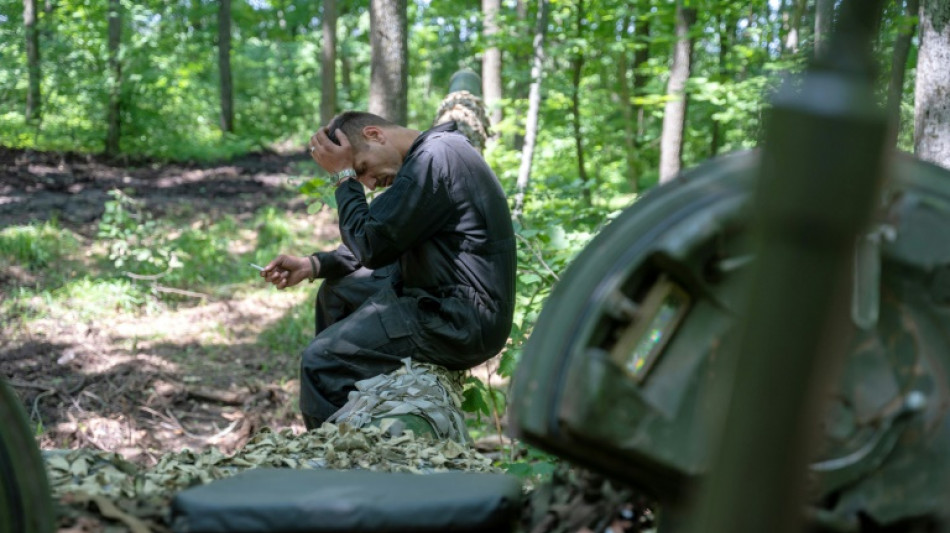
You winning yet? Allies' scepticism irritates Ukraine / Photo: © AFP/File

 Rene Eyre Revisits Autobiographical Performance 'Say A Little Prayer' in London

 UAE's HCT Holds Record Graduation and Announces Major Training Expansion

 NASA Awards $10B Lunar Contract Framework to SpaceX, Blue Origin

 Katy Perry Tells Fans Ex-Husband Russell Brand 'Should Be in Jail' During UK Concert

 South African election results renew debate over identity-based voting

 South African voters report smoother local election but declining IEC trust

 Dolly Parton museum and Nashville hotel open after singer’s death

 George and Amal Clooney attend New York political-comedy reading

 British buyers pay substantial premiums for period-home appearance

 Thomas Markle released to house arrest after child-abuse-image charge

Some of Ukraine's allies have started wondering whether the counteroffensive against Russia is getting bogged down, to the irritation of Kyiv which says it needs more weapons, not criticism.
Over the past two weeks US media have been quoting anonymous military sources questioning Ukraine's strategy, and saying its armed forces are too dispersed to pierce Russian defensive lines.
"Recently a new narrative has started to take hold in some commentaries on the state of the war, notably from Pentagon officials, to the effect that the offensive is turning out to be a deep disappointment," Lawrence Freedman, professor emeritus at King's College London, wrote last month. "Questions are now being raised about whether this is a war that Ukraine can ever win."
On the record, any criticism remains muted.
"This offensive, as you know, is going slow. It's bloody, it's high casualties on both sides," said Mark Milley, US chairman of the Joints Chief of Staff.
"But the Ukrainians still have a significant amount of combat power in reserve," he told AFP, crediting Ukraine with "at least partial success".
Retired Polish army general Boguslaw Pacek, less circumspect, wrote on the Biznesalert website that the current rhythm of the counter-offensive "does not permit the hope that it will meet its targets before the start of the rainy season this year".
Robert Brieger, chairman of the EU Military Committee, went further, telling German daily Die Welt that "the Russians will be able to continue this war for a long time".
He said, "It remains questionable whether Ukraine's full sovereignty can be restored with the means available".
- 'Everyone is an expert' -
The Ukrainian leadership has made it clear it has little patience for the musings of people far from the battlefield.
"Everyone is now an expert on how we should fight. A gentle reminder that no one understands this war better than we do," the defence ministry in Kyiv posted on X, the former Twitter. "We need ammunitions, not advice."
Foreign Minister Dmytro Kuleba said on Thursday that "to criticise the counteroffensive as slow is to spit in the face of the Ukrainian soldiers who give their lives".
Speaking on the margins of an EU ministerial meeting he said: "I suggest that all those who criticise shut up, come to Ukraine and try to liberate a square centimetre of territory themselves".
Experts told AFP they believe the implicit criticism of Ukraine in the US is not gratuitous, but intended to influence public opinion ahead of next year's presidential election there.
"There is a wish for quick results," said military historian Michel Goya. "And to show that American help is making a difference."
Military expert Michael Kofman said that in the US "folks are already positioning themselves for a potential blame game to play out".
In a podcast for the War on the Rocks website, he said that while military strategy was defined by Ukraine, "it is also very much shaped by Western support or lack thereof".
Nobody, experts observed, knows this better the President Volodymyr Zelensky, who has consistently asked for more weapons since the start of the war 18 months ago.
Phrasing is important or risks playing into the hands of Russian President Vladimir Putin, cautioned Phillips O'Brien, a professor of strategic studies at the University of St Andrews in Scotland.
"There is a fundamental difference between saying the counteroffensive is going slowly to saying it's failing," he said. "The failing idea is repeating a definite line of Vladimir Putin, which is aimed at undermining support for Ukraine."
- 'Relationship remains good' -
For now, no high-ranking government or military official among Ukraine's allies has suggested that western support may be faltering.
Even Kuleba's testy comments do not "hint at a fracture", said Ivan Klyszcz, research fellow at the International Centre for Defence and Security in Estonia.
But, he said, "there have been some questions in Ukraine to the extent to which Kyiv's partners truly share its military objectives" which are the full restoration of its territorial integrity, he told AFP.
But despite those nagging suspicions "so far these questions have not amounted to mistrust, and are generally a background concern," said Klyszcz.
"The relationship remains good," he added.
J.Horn--BTB