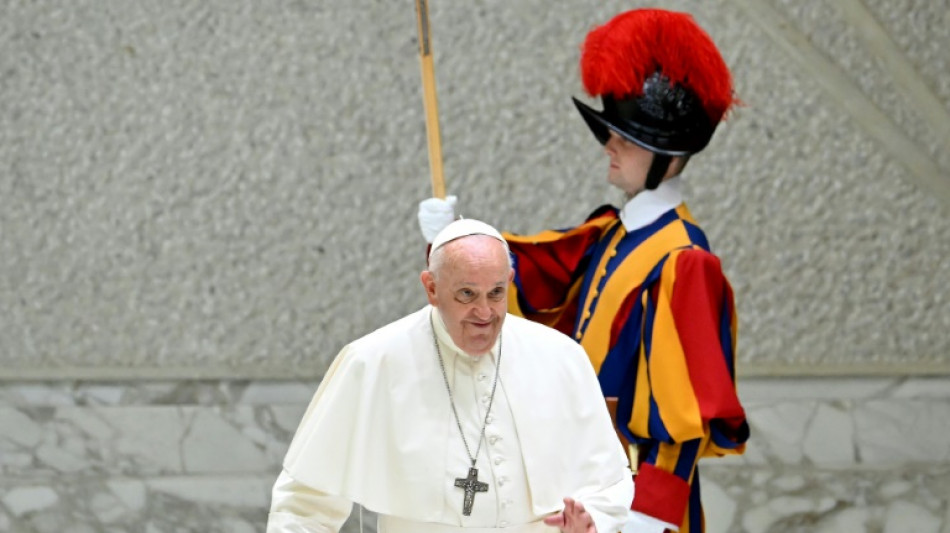
Pope arrives in Mongolia to back tiny Catholic presence on China's doorstep / Photo: © AFP

 Rene Eyre Revisits Autobiographical Performance 'Say A Little Prayer' in London

 UAE's HCT Holds Record Graduation and Announces Major Training Expansion

 NASA Awards $10B Lunar Contract Framework to SpaceX, Blue Origin

 Katy Perry Tells Fans Ex-Husband Russell Brand 'Should Be in Jail' During UK Concert

 South African election results renew debate over identity-based voting

 South African voters report smoother local election but declining IEC trust

 Dolly Parton museum and Nashville hotel open after singer’s death

 George and Amal Clooney attend New York political-comedy reading

 British buyers pay substantial premiums for period-home appearance

 Thomas Markle released to house arrest after child-abuse-image charge

Pope Francis arrived Friday in Mongolia, beginning the first papal visit to the vast Asian nation landlocked between China and Russia.
The 86-year-old pontiff's trip through Monday to the Buddhist-majority nation is a gesture of support for the tiny community of Catholics numbering about 1,400.
But the voyage -- Francis' second to the region in a year after a September trip to Kazakhstan -- is also geopolitically strategic.
It is seen as encouraging Mongolia's fragile democracy and potentially helping the Church make inroads with the country's more powerful neighbours.
"This is a clear effort of the Holy See to take care of Central Asia and not abandon it to Russia or China," Michel Chambon, a scholar of Catholicism in Asia, told AFP.
The visit -- Francis' 43rd voyage in his decade as global head of the Catholic Church -- is also crucial in keeping the door open for improved Vatican ties with Beijing and Moscow, which have yet to offer the Pope an invite.
"It's a way to not give up, to remind them 'I'm here!'" Chambon said. "It's a way not to just stay in Rome and wait for things to happen but to jump in."
- Stamina test -
The Argentine pontiff left Rome at 1640 GMT Thursday bound for the Mongolian capital Ulaanbaatar, arriving Friday morning local time following a nine-hour journey.
The trip will be a stamina test for the pope, who continues to travel widely despite undergoing a hernia operation in June and pain in his knee which has forced him to use a wheelchair.
After a day of rest, the pontiff's itinerary Saturday includes a welcome ceremony, meetings with President Ukhnaa Khurelsukh and Prime Minister Luvsannamsrai Oyun-Erdene, and a first address to authorities, diplomats and members of civil society.
He will meet the Catholic community -- which includes just 25 priests and 33 nuns, only two of them Mongolian -- later Saturday in Saints Peter and Paul Cathedral. Its circular nave resembles a "ger", the Mongolian nomads' traditional tent dwelling.
The Jesuit pope addresses an interreligious meeting Sunday, where the rector of Ulaanbaatar's Russian Orthodox Church is expected to be present with a delegation, and later presides over a mass inside a newly built ice hockey arena.
Pilgrims from nearby countries are expected at the mass, the Vatican said, including from Russia, China, South Korea, Thailand, Vietnam, Kazakhstan, Kyrgyzstan and Azerbaijan.
- 'Not taking sides' -
Once part of the empire of Genghis Khan, Mongolia is dependent on Russia for energy imports and on China for the export of its raw materials, primarily coal.
But while toeing a neutral line with its powerful neighbours, it has engaged in a "third neighbour" policy, strengthening relations with other nations, including the United States, Japan and South Korea, for balance.
That makes Mongolia potentially helpful for Vatican relations with both Beijing and Moscow. The Holy See last year renewed a deal on the thorny issue of bishop appointments with China, and Francis has sought to broker an end to the war in Ukraine with Russia.
Francis may use his trip to the former Soviet satellite state, a democracy since just 1992, to hammer home democratic principles.
A major coal industry corruption scandal provoked street protests in December, eroding public trust amid a weak economy, high inflation and major gaps between rich and poor.
Chambon, a fellow at Singapore's Asia Research Institute, said Francis may take a page from last year's Kazakhstan visit, during which he warned authorities they have a responsibility to govern well.
"The pope is not taking sides but is really putting politicians in front of their responsibilities," Chambon said.
"'Who are we serving, are we honest, are we caring for the poor and marginalised, are we taking care of the entire nation in its religious and ethnic diversity?'
"He plays the games but he asks the hard questions."
Francis, who plans in October to publish an update to his seminal 2015 "Laudato Si'" a global call to action for the environment, will also likely bring attention to the impact of climate change on Mongolia's ecosystems.
Together with mining and overgrazing, rising temperatures and their effects are fuelling desertification across swathes of the country.
Severe cold, flooding and drought have killed off herds on the vast grasslands, forcing nomads who make up one-third of the population to migrate to Ulaanbaatar, now surrounded by shantytowns inhabited by displaced herders.
N.Fournier--BTB