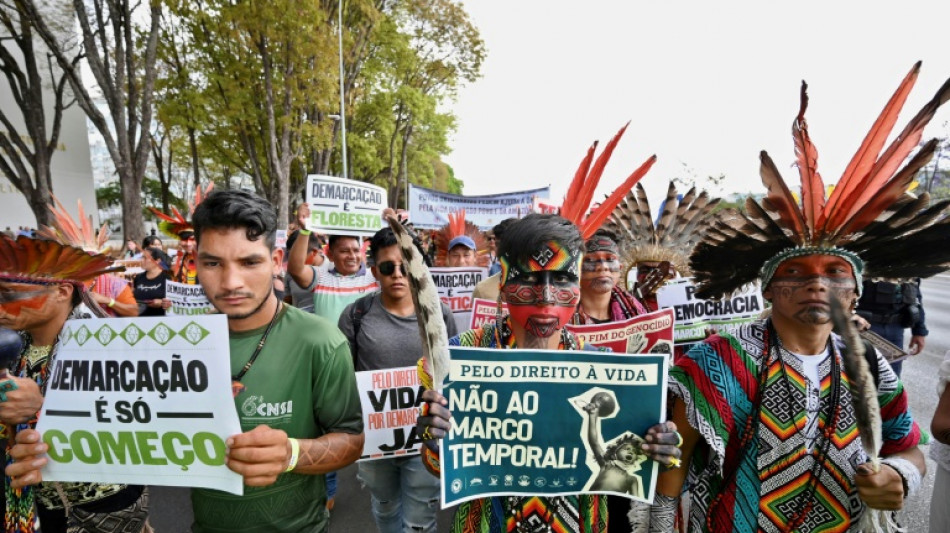
More Brazil Supreme Court judges vote on Indigenous land rights case / Photo: © AFP

 Rene Eyre Revisits Autobiographical Performance 'Say A Little Prayer' in London

 UAE's HCT Holds Record Graduation and Announces Major Training Expansion

 NASA Awards $10B Lunar Contract Framework to SpaceX, Blue Origin

 Katy Perry Tells Fans Ex-Husband Russell Brand 'Should Be in Jail' During UK Concert

 South African election results renew debate over identity-based voting

 South African voters report smoother local election but declining IEC trust

 Dolly Parton museum and Nashville hotel open after singer’s death

 George and Amal Clooney attend New York political-comedy reading

 British buyers pay substantial premiums for period-home appearance

 Thomas Markle released to house arrest after child-abuse-image charge

Brazil's Supreme Court on Thursday ended its latest deliberations on whether to restrict native peoples' rights to claim their ancestral lands -- seen as key buffers against climate change -- with four votes against and two in favor.
There are 11 judges in total, which left five still to vote in the case that the Supreme Court began hearing in 2021, but which has been adjourned several times.
The court, meeting in the capital Brasilia, is weighing the legality of the so-called "time-frame argument," which holds that native peoples should not have the right to lands where they were not present in 1988, when the current constitution was ratified.
Indigenous groups say that violates their rights, given that many were forced from their ancestral lands, including during the military dictatorship that ruled Brazil from the 1960s to 1980s.
One of the judges who voted against the measure, Cristiano Zann, said that "no type of 'time-frame' can be imposed to the detriment of the Indigenous people."
He said Indigenous peoples benefit "from their exclusive possession since the empire, from 1734."
Climate campaigners have joined native activists in pressing for the court to reject the time-frame argument, given that numerous studies have found that protected Indigenous reservations are one of the best ways to fight deforestation and, with it, global warming.
"The argument ignores our constitutional rights to our ancestral lands, puts existing Indigenous reservations at risk and makes creating new ones unviable," Dinamam Tuxa, coordinator of the Association of Brazil's Indigenous Peoples (APIB), told AFP ahead of the proceeding.
Indigenous rights groups have dubbed the case the "trial of the century."
The trial adjourned after the latest round of vote casting and is set to continue next week, when the remaining judges will vote.
K.Brown--BTB