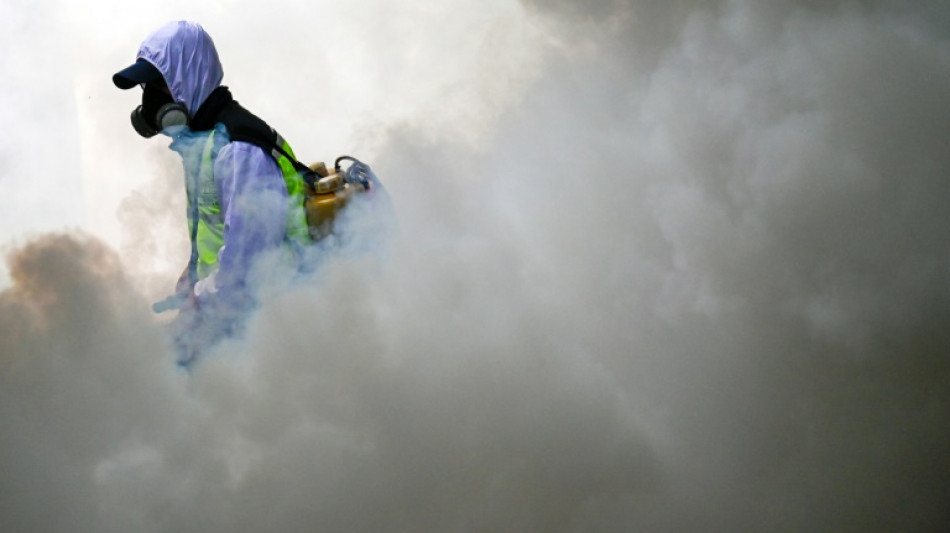
Guatemala declares dengue health emergency / Photo: © AFP

 Rene Eyre Revisits Autobiographical Performance 'Say A Little Prayer' in London

 UAE's HCT Holds Record Graduation and Announces Major Training Expansion

 NASA Awards $10B Lunar Contract Framework to SpaceX, Blue Origin

 Katy Perry Tells Fans Ex-Husband Russell Brand 'Should Be in Jail' During UK Concert

 South African election results renew debate over identity-based voting

 South African voters report smoother local election but declining IEC trust

 Dolly Parton museum and Nashville hotel open after singer’s death

 George and Amal Clooney attend New York political-comedy reading

 British buyers pay substantial premiums for period-home appearance

 Thomas Markle released to house arrest after child-abuse-image charge

Guatemala on Thursday declared a national health emergency in the face of a dengue outbreak that has killed 22 and infected thousands so far this year.
Health Minister Francisco Coma announced the measure that would remain in effect for three months and would entail widespread fumigation to eradicate mosquitos that carry the disease.
According to health ministry data, more than 12,200 cases of dengue have been reported so far this year, more than double the number in the corresponding period of 2022. There have been 22 deaths.
Civil protection official Walter Monroy said that with the approach of the rainy season, there will be more standing water for mosquitos to breed in.
"The importance of this intervention and this interagency coordination is to prevent current cases from increasing," he said of the state of emergency.
Guatemala recorded its highest-ever number of yearly cases in 2019, with more than 50,000.
Dengue is a disease endemic to tropical areas that causes high fevers, headaches, nausea, vomiting, muscle pain and, in the most serious cases, bleeding that can lead to death.
The World Health Organization said in April that dengue and other diseases caused by mosquito-borne viruses are spreading faster and further due to climate change.
I.Meyer--BTB