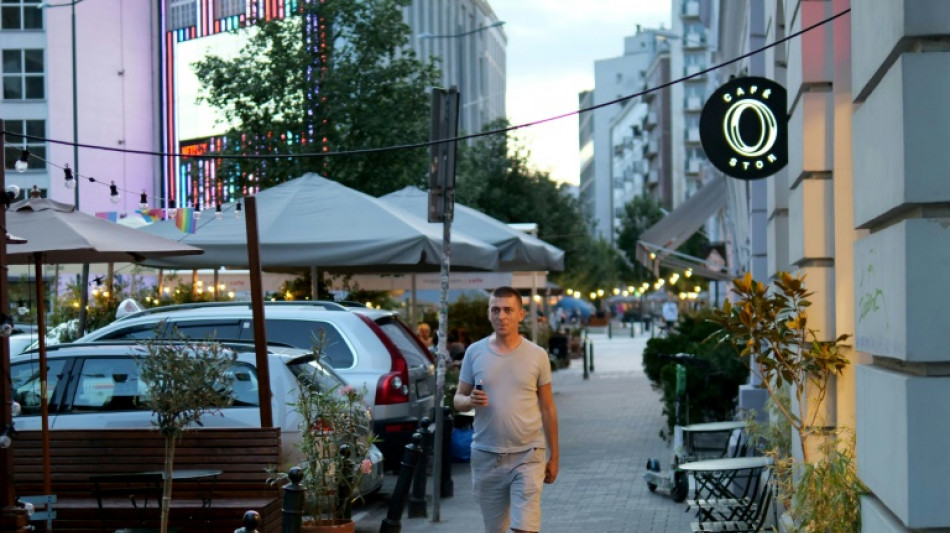
'Don't belong there': the Ukrainians dodging the front / Photo: © AFP

 Rene Eyre Revisits Autobiographical Performance 'Say A Little Prayer' in London

 UAE's HCT Holds Record Graduation and Announces Major Training Expansion

 NASA Awards $10B Lunar Contract Framework to SpaceX, Blue Origin

 Katy Perry Tells Fans Ex-Husband Russell Brand 'Should Be in Jail' During UK Concert

 South African election results renew debate over identity-based voting

 South African voters report smoother local election but declining IEC trust

 Dolly Parton museum and Nashville hotel open after singer’s death

 George and Amal Clooney attend New York political-comedy reading

 British buyers pay substantial premiums for period-home appearance

 Thomas Markle released to house arrest after child-abuse-image charge

Ivan Ishchenko volunteered to fight against invading Russian troops, but after a month of combat he was willing to pay thousands of dollars and risk prison to flee the front.
"Before I went to war, I thought I was a superhero. But all heroism ends when people see (war) with their own eyes and realise that they don't belong there," Ishchenko, 30, said.
"I saw someone being shot near his spleen; the pain was crazy. Then I saw a severed head. It all built up... I didn't want to see anything else."
So, one day he deserted without warning anyone but his mother and fled Ukraine.
Ishchenko is far from being the only one.
The war triggered a patriotic impulse, but some Ukrainians are refusing to fight despite societal pressures, and warnings from authorities cracking down on draft evaders amid a difficult counteroffensive.
Ishchenko managed to leave the country despite a ban on the departure of all men aged between 18 and 60.
He paid $5,000 for a government-plated car to escort him to a forest on the border with Hungary.
He then escaped through a hole in the fence and ran.
"The scariest moment was back then, when I left Ukraine and fled on foot," he said.
Since the beginning of the war, authorities have detained 13,600 people trying to cross the border outside of checkpoints, State Border Guard spokesman Andriy Demchenko told AFP.
Another 6,100 -- most of them fighting-age men -- have been caught when attempting to leave with forged documents, Demchenko said.
- 'Everyone knows' –
But officials contacted by AFP did not provide a precise number for suspected draft evaders and deserters.
They now face up to five and 12 years in prison respectively, according to a law passed in January toughening the punishments.
Amid a struggling counteroffensive, Kyiv is cracking down on corruption schemes that allow men to avoid the army.
All top officials in charge of conscription have been fired in recent weeks, and investigators said they had "uncovered large-scale corruption schemes in almost all regions of the country."
Ivan, a 24-year-old who declined to give his last name due to legal concerns, said that "everyone knows there are opportunities" for avoiding service.
"Everybody has friends or acquaintances who can offer options," he said.
In May, Ivan spent $5,000 on a medical certificate that exempted him from service -- and allowed him out of Ukraine.
He is not proud of his actions, saying "it all felt wrong and disturbing".
To avoid breaking the law, some men have left before turning 18 or never came back after the war began.
Bogdan Marynenko's family pushed him to leave for Poland in August 2022, two days before his 18th birthday.
His father is fighting and Marynenko has been working on construction sites to provide for his family.
"If something were to happen to my father, I remain the only support system for my mother and sisters," said the now 19-year-old, who wore oversize street wear and sunglasses.
- 'Not in vain' -
Yevgen Kuruch was on a bus from Belgium to Ukraine without phone credit when the driver announced the war had started.
The 38-year-old reserve officer knew he would be among the first mobilised if he went back.
So he got off the bus in Warsaw –- the last scheduled stop before Ukraine –- went to the nearest McDonalds, connected to the wifi and called his wife and parents.
They insisted he stay in Poland, as sirens sounded in his hometown of Odesa.
"I understand that I have a duty to defend my country," Kuruch told AFP.
"At the same time, I understand that my family also needs me," he said.
"Above all, I must take care of them."
He began working as a taxi driver in Warsaw, where his wife, his 8-year-old daughter Anastasia and 5-year-old son Kirill joined him.
Kuruch recalled tense encounters with several Ukrainian women that he drove through the Polish capital.
"I have been told 'our husbands are at the front, they are fighting, and you cowards are staying here? You're hiding behind our husbands' backs'."
Many families have been separated since the war began as women and children fled to safety abroad.
Polish statistics show that out of nearly a million Ukrainians registered in Poland, one out of two is a child -- and women make up 77 percent of the adult population under protection.
"I understand it's a painful subject for them... If I see this brings conflict, I just stop talking and try to simply bring the passenger wherever they need," Kuruch told AFP.
He usually turns to his family for reassurance.
"Looking at them, I draw strength and realise that what I am doing now is not in vain."
N.Fournier--BTB