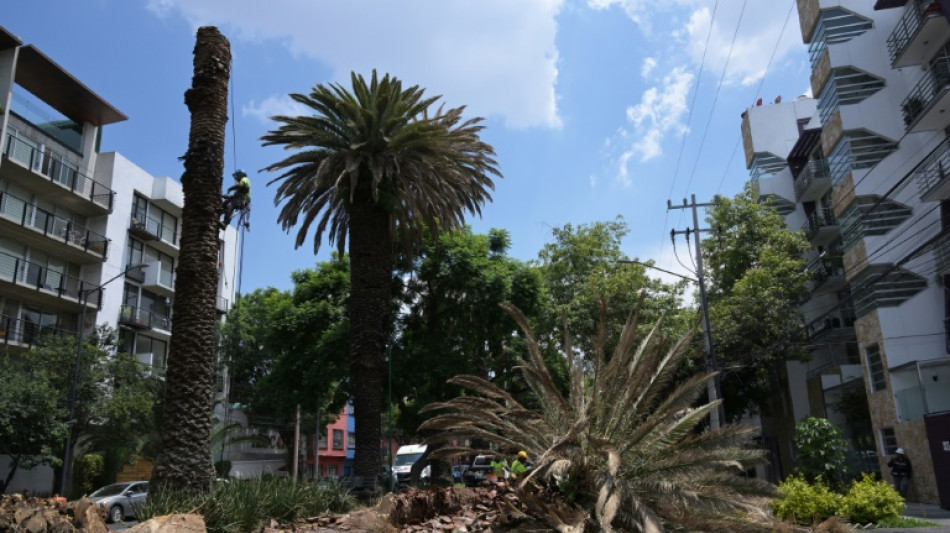
Climate change, pests threaten Mexico City's iconic palms / Photo: © AFP

 Rene Eyre Revisits Autobiographical Performance 'Say A Little Prayer' in London

 UAE's HCT Holds Record Graduation and Announces Major Training Expansion

 NASA Awards $10B Lunar Contract Framework to SpaceX, Blue Origin

 Katy Perry Tells Fans Ex-Husband Russell Brand 'Should Be in Jail' During UK Concert

 South African election results renew debate over identity-based voting

 South African voters report smoother local election but declining IEC trust

 Dolly Parton museum and Nashville hotel open after singer’s death

 George and Amal Clooney attend New York political-comedy reading

 British buyers pay substantial premiums for period-home appearance

 Thomas Markle released to house arrest after child-abuse-image charge

Climate change and a deadly disease spread by insects have forced authorities in Mexico City to chop down palm trees beloved by residents as an emblem of the capital.
The Canary Island date palms, which are endemic to the Spanish archipelago off the coast of northwestern Africa, can sometimes live for more than 200 years.
But the ones providing shade and a splash of green in Mexico City are suffering from lethal yellowing, which experts say is caused by the red palm weevil, a type of beetle.
The pest is native to tropical Asia but has spread around the world, causing irreversible damage to palm trees in various countries.
Climate change is making the trees more vulnerable to such insects, according to Reyna Rojas, an expert in plant disease.
"The increase in temperatures causes much more stress for a plant," she told AFP.
"As a result, they attract insects," she added.
Tree surgeons have been cutting down wilting palms in the central Narvarte neighborhood, ripping out part of Mexico City's history.
"It's taking away the essence of the neighborhood," said 55-year-old resident Ivan Felipe.
"Narvarte will no longer be Narvarte without the palm trees," he added.
Irma Gutierrez, 68, mourned the loss of the trees she has known since childhood.
"As long as I have been here, the palm trees have been there," she said.
Announcing the removal of 155 palm trees in July, the Mexico City government said that the species "has proven to be susceptible to climate change currently occurring worldwide."
At the time, temperatures in the city were above 30 degrees Celsius (86 degrees Fahrenheit) -- higher than normal in the Mexican capital.
Although it is located in the tropics, the city has relatively mild summers due to its altitude of 2,240 meters (7,350 feet) above sea level.
One of the capital's most iconic palm trees, located on a roundabout on its main avenue Paseo de la Reforma, was removed in April 2022 after it was attacked by fungus.
A native cypress tree was planted in its place, but wilted and withered just weeks later and had to be removed.
L.Janezki--BTB