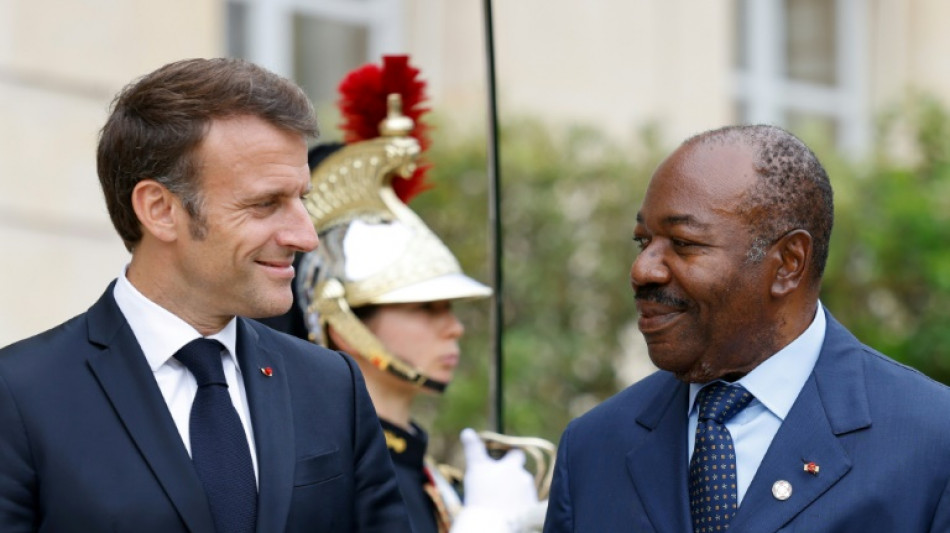
France condemns Gabon coup as another African ally falls / Photo: © AFP/File

 Rene Eyre Revisits Autobiographical Performance 'Say A Little Prayer' in London

 UAE's HCT Holds Record Graduation and Announces Major Training Expansion

 NASA Awards $10B Lunar Contract Framework to SpaceX, Blue Origin

 Katy Perry Tells Fans Ex-Husband Russell Brand 'Should Be in Jail' During UK Concert

 South African election results renew debate over identity-based voting

 South African voters report smoother local election but declining IEC trust

 Dolly Parton museum and Nashville hotel open after singer’s death

 George and Amal Clooney attend New York political-comedy reading

 British buyers pay substantial premiums for period-home appearance

 Thomas Markle released to house arrest after child-abuse-image charge

France condemned the toppling of Gabonese President Ali Bongo Ondimba on Wednesday which could represent another setback for Paris in Africa where friendly governments have been falling in an "epidemic" of coups.
France "condemns the military coup that is under way in Gabon", government spokesman Olivier Veran told reporters in Paris after military officers announced on television that they had overturned the government.
Veran said that France was following events "with a lot of attention" and that it "reiterates its desire to see the results of the election respected," referring to Saturday's disputed presidential polls in the West African country.
Gabon's electoral authority had announced earlier Wednesday that Bongo, a French ally whose family has ruled oil-rich Gabon for 55 years, had won a third term with 64.27 of the vote.
France has around 400 soldiers permanently deployed in the country for training and military support, including at a base in the capital, and has extensive economic ties to the country in the mining and oil sectors.
The political demise of Bongo -- who has been placed under house arrest along with other top officials, according to the new military regime -- fits a pattern of coups in French-speaking Africa in recent years.
In Mali, Burkino Faso and latterly Niger in the northwest Sahel region, new military governments have taken openly hostile positions towards France, tapping into resentment felt by many locals about the former colonial power and its ongoing influence.
"Official France -- its army, its diplomatic representatives -- are being literally chased out of countries in the Sahel," Jean-Herve Jezequel, an expert on the region at think tank the International Crisis Group told AFP.
In Gabon, the views and politics of the new military regime remain unknown, with the head of the Republican Guard, General Brice Oligui Nguema, thought to be at its head.
- Colonial past -
Paris has maintained a strong military presence in many of its former colonies in West Africa, as well as close business links which were promoted as part of a discredited post-colonial policy known as "Francafrique".
Its past support for corrupt and authoritarian leaders has tarnished its image, while China and most recently Russia have worked to undercut its influence in an area where it was once the undisputed foreign power.
French President Emmanuel Macron lamented an "epidemic of putsches" during a speech to ambassadors on Monday.
The 45-year-old French leader visited Gabon in March for a forestry summit in a move that was interpreted by some opposition figures as signalling support for Bongo ahead of Saturday's disputed presidential elections.
During a speech in the capital Libreville, Macron denied any French ambitions to interfere in Africa, saying that the age of "Francafrique" was "well over."
But a coup in Niger last month which overthrew President Mohamed Bazoum, a close French ally, has led Macron to take a hard line with the new military regime which he has refused to recognise.
France has 1,500 troops stationed there and was banking on the country to serve as a cornerstone of its new military strategy for the Sahel region, where it is fighting against a growing jihadist insurgency by groups aligned with Al-Qaeda and Islamic State.
France intervened militarily to beat back advancing extremists in Mali in 2013 at the request of the country's then government.
"France will not benefit from continuing to deny the turning-point that we are seeing in the Sahel and perhaps more widely in West Africa," Jezequel told AFP.
- Anti-French feeling -
Bongo's father Omar was one of France's closest African allies in the immediate post-colonial era and Ali has long been a regular in Paris, where his family owns an extensive real estate portfolio that is being investigated by anti-corruption magistrates.
He was last welcomed at the presidential palace in June.
Former French president Francois Hollande, a regular critic of the government, said Macron had initially failed to take a sufficiently hard line with coup leaders in Mali in 2020 and had endorsed the results of a military-enforced power change in Chad in 2021.
"There was a form of acceptance of military coups by force," he told Franceinfo radio on Wednesday.
He also highlighted the ongoing struggle for influence in Africa.
"Is it possible that there are foreign influences, notably autocratic regimes -- Russia and China -- that are trying to destabilise these (coup-hit) countries and reduce Western influence? It's obvious," he added.
bur-adp-Dt-cf/jh/kjm
G.Schulte--BTB